Uttarakhand Observes Partition Horrors Remembrance Day
Source:indiatimes ↗
Why It Matters
The article bridges modern historical events (Partition of India, Radcliffe Line) with contemporary cultural restoration efforts and significant political legislations. It is highly relevant for UKPSC Prelims regarding state-specific cultural geography (Char Dham shrines, Kumbh Mela) and national polity milestones (Article 370, CAA).
Summary
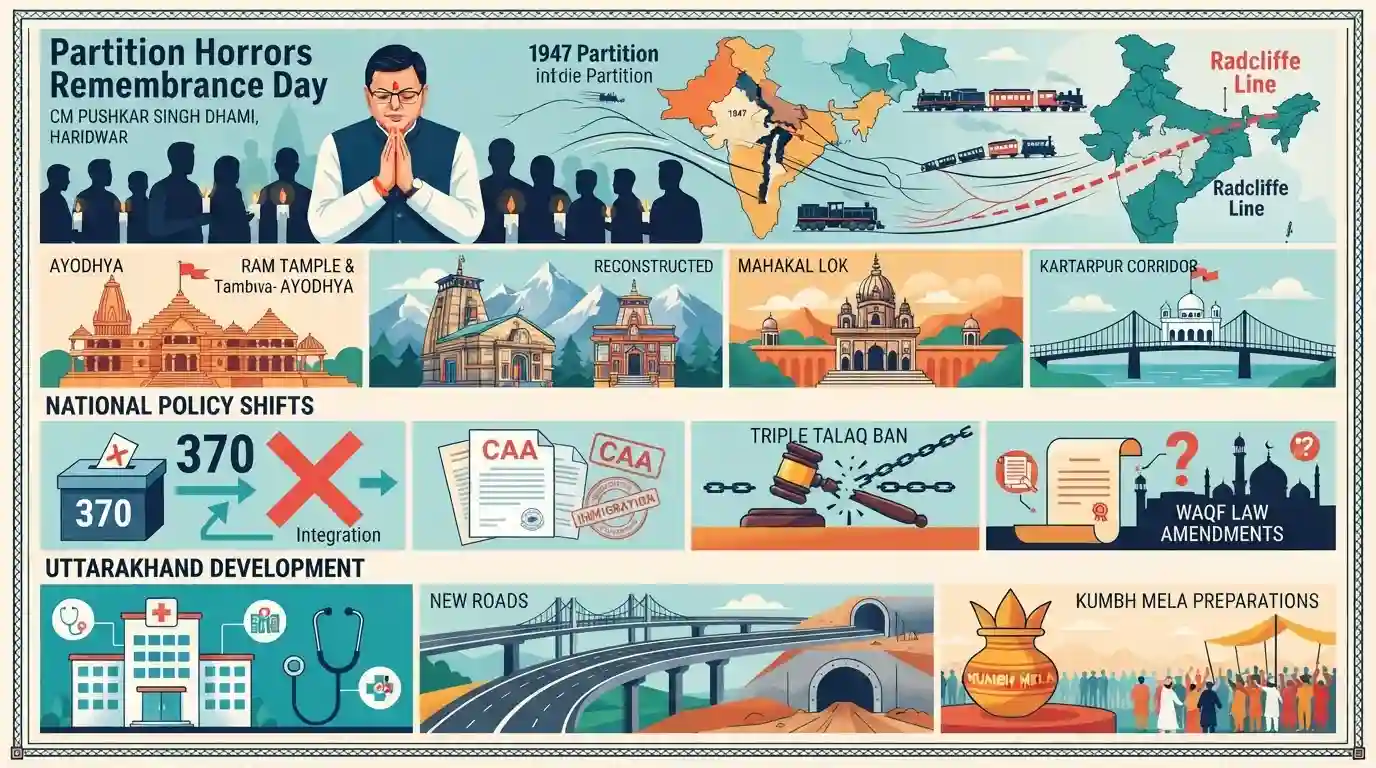
Uttarakhand Chief Minister Pushkar Singh Dhami attended a 'Partition Horrors Remembrance Day' event in Haridwar, paying tribute to the victims of the 1947 partition. He criticized the hastily drawn Radcliffe Line which led to widespread suffering and displacement. Dhami highlighted the government's commitment to restoring India's shared cultural and religious heritage, citing projects like the Ram Temple in Ayodhya, the reconstruction of the Kedarnath and Badrinath shrines, Mahakal Lok, and the Kartarpur Corridor. He also noted significant national policy shifts, including the abrogation of Article 370, the implementation of the CAA, the banning of Triple Talaq, and proposed Waqf law amendments. Regionally, he emphasized Uttarakhand's development in healthcare, infrastructure, and preparations for the upcoming Kumbh Mela.
Key Points
- Partition Horrors Remembrance Day is observed to recall the tragedy and massive displacement caused by the partition of India in 1947, drawn by Sir Cyril Radcliffe.
- Uttarakhand is focusing on the preservation of its religious and cultural heritage, including the ongoing reconstruction of the Kedarnath and Badrinath shrines and preparations for the Kumbh Mela in Haridwar.
- Major national legislative milestones emphasized include the abrogation of Article 370, the enactment of the Citizenship Amendment Act (CAA), and the ban on Triple Talaq.
- Broader Indian cultural restoration projects were highlighted, such as the Ram Temple in Ayodhya, Mahakal Lok corridor, and the Kartarpur Sahib Corridor.
Important Terms
Partition Horrors Remembrance Day

A national memorial day observed annually on August 14 in India to commemorate the victims, mass displacement, and suffering caused by the 1947 partition of the subcontinent.
UPSC context
Relevant for GS Paper 1 (Modern History). It highlights post-independence consolidation, the legacy of partition, and efforts to maintain communal harmony.
Radcliffe Line
The boundary line drawn by Sir Cyril Radcliffe in 1947 to partition the provinces of Punjab and Bengal between the newly independent nations of India and Pakistan.
UPSC context
Important for GS Paper 1 (Modern History and Geography). Tests knowledge on border demarcations, geopolitical consequences of partition, and territorial disputes.
Citizenship Amendment Act (CAA)
A 2019 amendment to the Citizenship Act of 1955 that provides a fast-track pathway to Indian citizenship for persecuted non-Muslim religious minorities from Afghanistan, Bangladesh, and Pakistan.
UPSC context
Highly relevant for GS Paper 2 (Polity). Tested on constitutional values, citizenship rules, secularism, and debates around Article 14 (Right to Equality).
Waqf Amendment Bill
Proposed legislation seeking to amend the Waqf Act of 1995 to enhance state regulation over Waqf properties, streamline board management, and address disputes regarding unauthorized land occupation.
UPSC context
Important for GS Paper 2 (Polity and Governance). Touches upon religious endowments, minority rights, and the balance between state control and community governance.
Article 370
A former provision of the Indian Constitution that granted special autonomous status to Jammu and Kashmir. It was effectively abrogated in August 2019 to fully integrate the region.
UPSC context
Key for GS Paper 2 (Polity) and GS Paper 3 (Internal Security). Tests federalism, constitutional amendments, and regional integration strategies.
Triple Talaq Law
Officially the Muslim Women (Protection of Rights on Marriage) Act, 2019, this legislation criminalizes the practice of instant divorce (talaq-e-biddat) to protect the rights of Muslim women.
UPSC context
Essential for GS Paper 1 (Society) and GS Paper 2 (Social Justice). Covers women's empowerment, gender justice, and Uniform Civil Code debates.
Prelims Trap
"The Rawal (head priest) of the Badrinath temple is traditionally appointed from the local Garhwali Brahmin community."
The Rawal of Badrinath is traditionally a Namboothiri Brahmin from Kerala, tracing back to Adi Shankaracharya's time. It is not a local Garhwali tradition.
Static Concepts Connected
What are the key geographical markers of the Badrinath and Kedarnath shrines?
- Badrinath Location: Situated on the banks of the Alaknanda river in the Chamoli district of Uttarakhand.
- Kedarnath Location: Located near the Mandakini river in the Rudraprayag district of Uttarakhand.
- Historical Origin: The 8th-century philosopher Adi Shankaracharya is credited with reviving Badrinath and establishing its traditional practices.
What are the core provisions of the Citizenship (Amendment) Act 2019?
- Target Groups: Fast-tracks citizenship for Hindu, Sikh, Buddhist, Jain, Parsi, and Christian minorities.
- Eligible Countries: Applies only to persecuted minorities fleeing from Pakistan, Bangladesh, and Afghanistan.
- Cut-off Date: Applicants must have entered India on or before December 31, 2014, to be eligible.
Cross-Topic Patterns
Temple corridors & PRASHAD Scheme
Kedarnath and Badrinath redevelopments align with the PRASHAD scheme, transforming religious pilgrimage circuits into highly structured economic drivers for state tourism and local MSMEs.
Radcliffe Line & constitutional amendments
The hastily drawn 1947 boundary created lasting anomalies that required modern legislative fixes, such as the 100th Constitutional Amendment Act to exchange territorial enclaves with Bangladesh.

Expect a matching question in UKPSC Prelims pairing Uttarakhand shrines (Badrinath/Kedarnath) with their respective rivers (Alaknanda).
Linked PYQs · 4
Linked PYQs · 4
- 2024UKPSC_PRELIMSGS1
The McMahon line demarcates the boundary between which of the following options ?
- 2024UKPSC_PRELIMSGS1
Bengal was partitioned by Lord Curzon in 1905. In which year partition was annulled ?
- 2016UKPSC_PRELIMSGS1
Which one of the following shrines of Uttarakhand was visited by maximum number of tourists in the year 2015?
- 2024UKPSC_PRELIMSGS1
Hindu religious pilgrimage place named 'Purnagiri' is situated in which of the following districts of Uttarakhand ?
