Punjab seeks war-resilient infrastructure for border districts
Source:Indian Express ↗
Why It Matters
The article provides an excellent case study of the multi-dimensional challenges faced by a border state. It touches upon GS3 topics like border area management, the threat of drone-based smuggling, groundwater depletion, and crop diversification, while also shedding light on GS2 topics such as inter-state water disputes (SYL canal) and the principles of cooperative federalism via interactions with NITI Aayog.
Summary
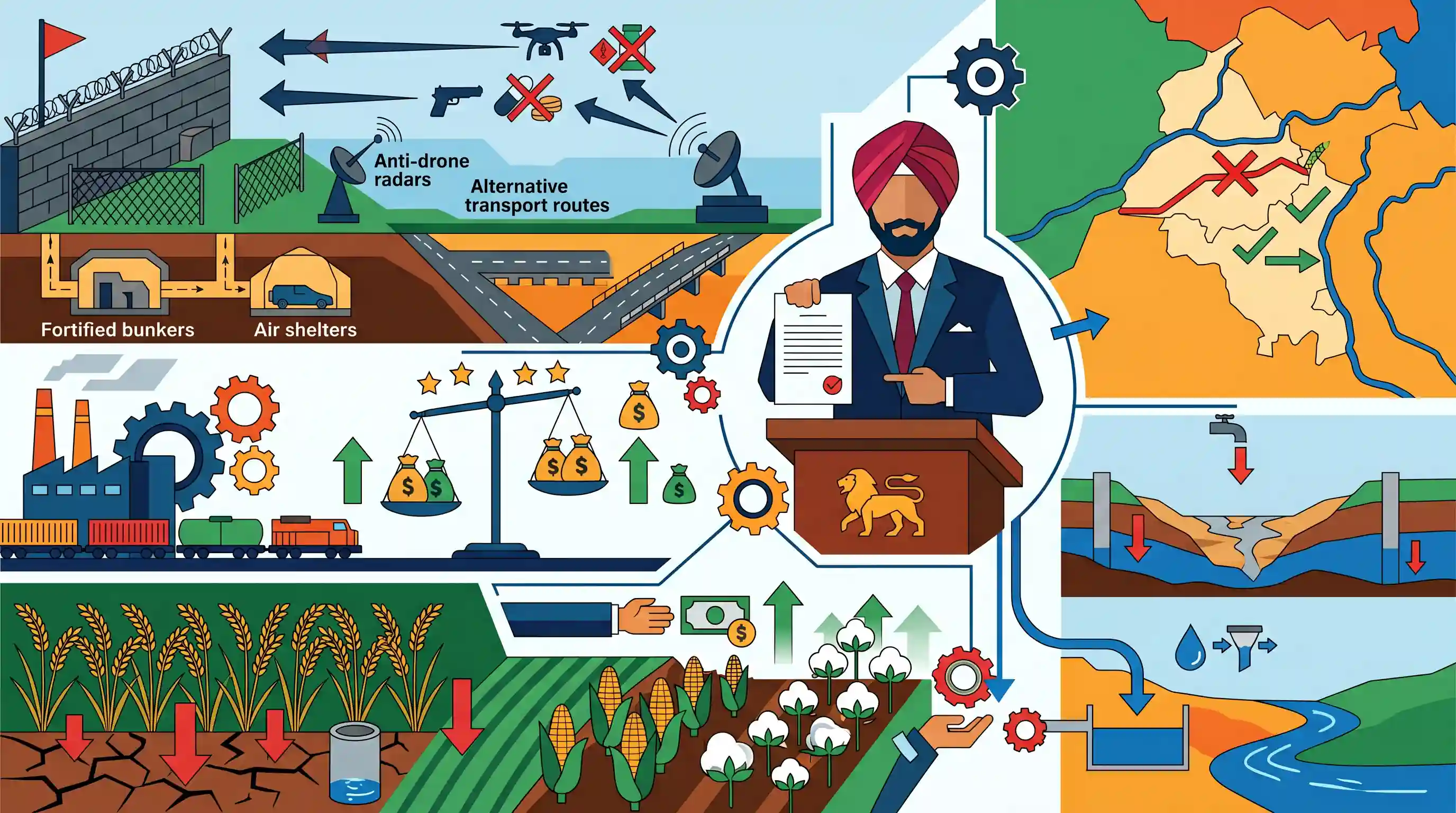
Punjab Chief Minister Bhagwant Mann recently presented a detailed charter of demands to a visiting NITI Aayog delegation. The wide-ranging discussion focused heavily on internal security, regional economic revitalization, and sustainable agriculture. Given the state's 553-km sensitive international border with Pakistan, Mann strongly advocated for transforming these border districts into 'war-resilient' zones. This would require central assistance to equip the area with underground bunkers, air shelters, alternative transport routes, and advanced anti-drone technology to actively counter cross-border smuggling of drugs and arms. Economically, he sought special industrial incentives and freight subsidies akin to those given to neighboring states like Himachal Pradesh and Uttarakhand to prevent the flight of capital. On the agricultural front, Mann highlighted the urgent need for crop diversification away from water-guzzling paddy to prevent alarming groundwater depletion, asking for targeted central support for alternative crops like kharif maize and cotton. Furthermore, he emphasized Punjab's acute water shortage, formally opposing the Satluj Yamuna Link (SYL) canal project and proposing a Yamuna-Sutlej-Link (YSL) as an alternative to augment the state's deficit river basins.
Key Points
- Punjab CM Bhagwant Mann urged NITI Aayog to help make border districts (sharing 553 km with Pakistan) 'war-resilient' by constructing bunkers, air shelters, and emergency operations centers.
- Demanded a special economic package and freight subsidies for Punjab on par with neighboring hilly and border states to check industrial flight and promote agro-processing.
- Advocated for crop diversification away from paddy to save groundwater, seeking cash incentives for maize and compensation for cotton farmers affected by pink bollworm.
- Reiterated opposition to the Satluj Yamuna Link (SYL) canal due to water scarcity in the Ravi, Beas, and Sutlej rivers, proposing a Yamuna-Sutlej-Link (YSL) instead.
- Highlighted the internal security threat posed by cross-border drones smuggling drugs and weapons, seeking funds for jammers and higher compensation for farmers cultivating land beyond the border fence.
Important Terms
NITI Aayog

India's premier policy think tank that replaced the Planning Commission in 2015. It fosters 'Cooperative Federalism' by involving states in policy-making and providing strategic advice.
UPSC context
GS-2: Governance and Statutory Bodies; crucial for understanding the Centre-State relationship and cooperative federalism.
Satluj Yamuna Link (SYL) Canal
A proposed 214-km canal to share Ravi-Beas river waters between Punjab and Haryana. It is a flashpoint for inter-state water disputes and legal battles under Article 262.
UPSC context
GS-2: Inter-State Relations; tests knowledge of water sharing, riparian rights, and constitutional adjudication mechanisms.
Crop Diversification
Shifting from monocultures (like paddy) to varied crops like maize or pulses. It aims to reduce groundwater depletion, restore soil health, and mitigate market risks for farmers.
UPSC context
GS-3: Agriculture; vital for sustainability, food security, and environmental conservation topics.
Bhakra Beas Management Board (BBMB)
A statutory body managing the Bhakra-Nangal and Beas projects. It regulates water and power supply to Punjab, Haryana, Rajasthan, Himachal Pradesh, Delhi, and Chandigarh.
UPSC context
GS-2: Federal structure; relevant due to controversies over state representation and administrative control of regional resources.
War-resilient Infrastructure
A border management strategy involving the construction of bunkers, air shelters, and alternate routes to ensure civilian safety and logistical continuity during military conflicts or shelling.
UPSC context
GS-3: Internal Security and Border Management; focuses on defensive preparedness and civilian protection in sensitive zones.
Production Linked Incentive (PLI)
A central scheme offering financial incentives to manufacturers for incremental sales of products made in India. Punjab seeks its expansion to agro-processing to boost industrial growth.
UPSC context
GS-3: Indian Economy; key for industrial policy, manufacturing competitiveness, and self-reliance (Atmanirbhar Bharat).
Prelims Trap
"NITI Aayog has the statutory authority to sanction and allocate special economic packages to border states."
NITI Aayog is strictly an advisory think tank. Unlike the erstwhile Planning Commission, it possesses no financial allocation powers; granting special economic packages or fund disbursal is managed by the Finance Ministry.
Static Concepts Connected
How are inter-state river water disputes adjudicated under the Indian Constitution?
- Article 262: Empowers Parliament to provide for the adjudication of any dispute or complaint regarding the use, distribution, or control of waters of inter-state rivers.
- Statutory Mechanism (1956): Under this Act, the Central government can constitute ad-hoc tribunals to resolve water disputes between states when negotiations fail.
- Judicial Review: While Article 262 allows Parliament to bar Supreme Court jurisdiction over these disputes, the SC can still hear matters via Special Leave Petitions (Article 136).
What are the primary anti-drone technologies used in border management?
- RF Jamming: Disrupts the communication link between the drone and its operator, forcing the UAV to hover, land, or return to its origin.
- GPS Spoofing: Transmits fake GPS coordinates to the drone's navigation system, tricking it into flying off-course or landing in a designated safe zone.
- Directed Energy Weapons: Uses high-energy lasers or high-power microwaves to physically damage the drone's structure or fry its internal electronics.
Cross-Topic Patterns
Agri-Water-Security Nexus
Punjab's groundwater crisis, driven by MSP-backed paddy, damages the rural economy. This distress makes unemployed border-region youth increasingly susceptible to the cross-border narco-terror networks facilitated by drone smuggling.
Civilian Infrastructure as Border Security
The demand for civilian bunkers and war-resilient border zones reflects a strategic shift in border management, aligning conceptually with the Vibrant Villages Programme designed for the Sino-Indian border.

Expect a 2026 Mains question linking the MSP regime's ecological cost (groundwater) to border security vulnerabilities (narco-terrorism).
Linked PYQs · 5
Linked PYQs · 5
- 2023MainsGS3
The use of unmanned aerial vehicles (UAVs) by our adversaries across the borders to ferry arms/ammunitions, drugs, etc., is a serious threat to the internal security. Comment on the measures being taken to tackle this threat.
- 2020MainsGS3
For effective border area management, discuss the steps required to be taken to deny local support to militants and also suggest ways to manage favourable perception among locals.
- 2020MainsGS3
Analyze internal security threats and transborder crimes along Myanmar, Bangladesh and Pakistan borders including Line of Control (LoC). Also discuss the role played by various security forces in this regard.
- 2021MainsGS3
What are the present challenges before crop diversification? How do emerging technologies provide an opportunity for crop diversification?
- 2025MainsGS3
Examine the factors responsible for depleting groundwater in India. What are the steps taken by the government to mitigate such depletion of groundwater?
