Political controversy over VIP security withdrawal in Bihar
Source:The Hindu ↗
Why It Matters
The incident serves as a case study for analyzing the intersection of political rivalry and administrative machinery in India. It raises questions relevant to GS Paper 2 (Governance, Transparency, Electoral Representation) and GS Paper 4 (Ethics in Public Administration, Non-partisanship) regarding the objective allocation of state resources (like VIP security) versus allegations of political vendetta.
Summary
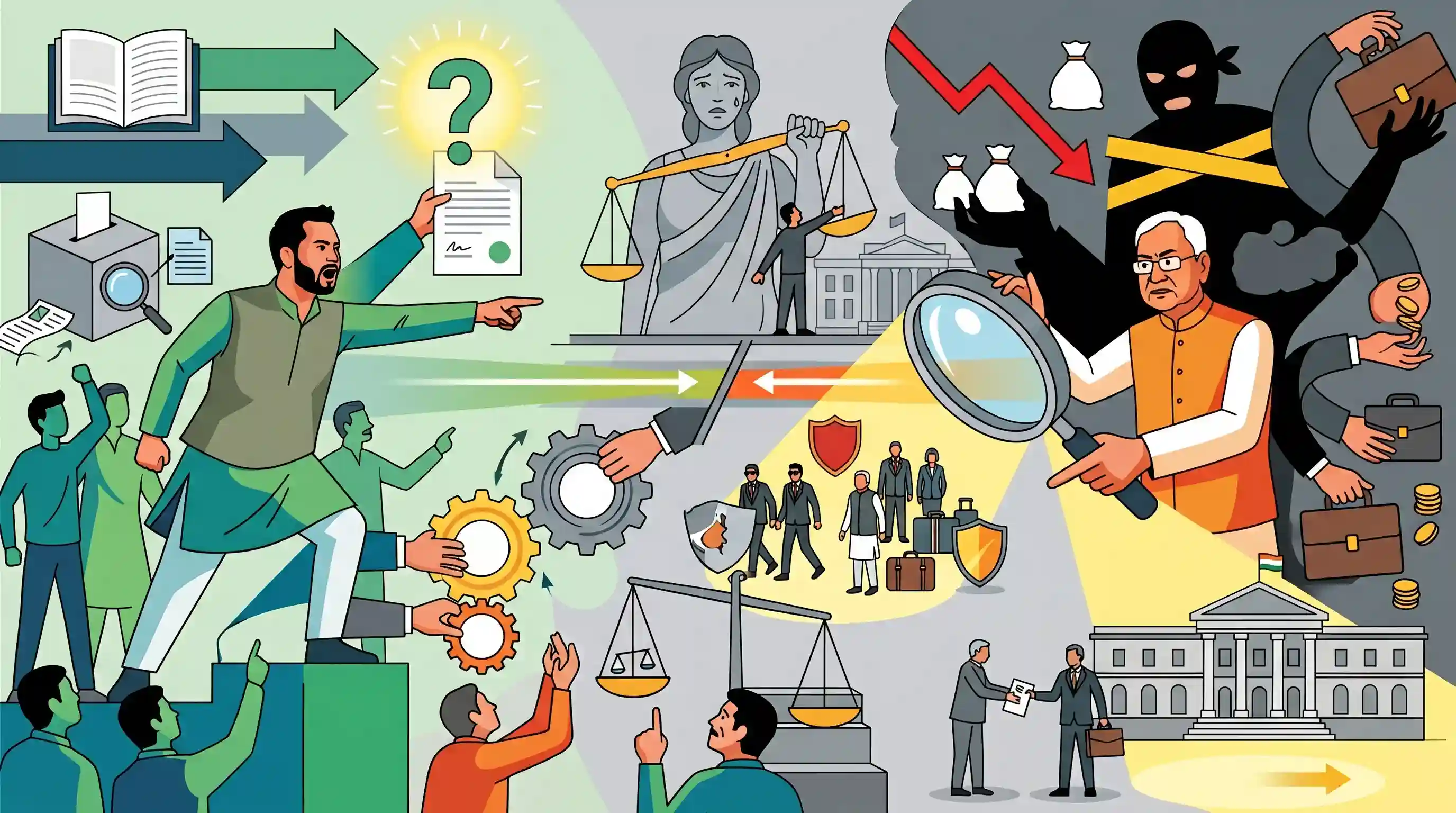
RJD leader Tejashwi Yadav has strongly criticized the Bihar government for withdrawing the Z+ security cover of former Chief Ministers Lalu Prasad and Rabri Devi, and for issuing notices to vacate their government bungalow. Yadav framed these administrative actions as politically motivated diversionary tactics by Chief Minister Nitish Kumar designed to draw attention away from the state's pressing issues, such as severe economic strain, rising crime, and corruption. Furthermore, Yadav questioned the educational qualifications of Nitish Kumar's son, raising the issue of electoral transparency. From a UPSC perspective, this political clash touches on the ethical use of state machinery, the debate over political partisanship in administrative decisions, and the transparency mandated by the Representation of the People Act regarding candidate disclosures.
Key Points
- RJD leader Tejashwi Yadav accused Bihar CM Nitish Kumar of using administrative actions like the withdrawal of Z+ security for Lalu Prasad and Rabri Devi as diversionary tactics.
- He alleged these moves are meant to distract the public from substantive governance failures, including an empty state treasury, inflation, crime, and corruption.
- Yadav also raised questions about discrepancies in the educational qualifications declared by Nitish Kumar's son, Nishant Kumar, referencing electoral affidavits and transparency norms.
- The controversy highlights recurring political debates over the partisan use of state machinery (VIP security cover, government accommodation) for political vendetta.
Important Terms
Representation of the People Act, 1951

The primary legislation governing the conduct of elections in India, covering candidate qualifications, disqualifications, and the registration of political parties.
UPSC context
GS Paper II: Salient features of the RPA; essential for understanding electoral reforms and democratic integrity.
Z+ Security
The highest tier of personal security in India, comprising approximately 55 personnel from elite forces like the CRPF or NSG, assigned based on high threat perception.
UPSC context
GS Paper II/III: Internal security and the administrative allocation of state resources for VVIP protection.
Non-partisanship
A foundational civil service value requiring officials to perform duties without bias or favor toward any political party, maintaining administrative neutrality.
UPSC context
GS Paper IV: Ethics and Foundational Values for Civil Service; tests administrative integrity and professionalism.
Governance and Accountability
The mechanisms of decision-making (Governance) and the obligation of public officials to remain answerable to the public for their actions (Accountability).
UPSC context
GS Paper II: Transparency & accountability; core to good governance and effective public administration.
Electoral Transparency
The process of ensuring voters have access to candidate information, including assets, criminal records, and educational qualifications, to enable informed voting.
UPSC context
GS Paper II: Electoral reforms and the 'Right to Know' under the framework of RPA 1951.
Bharatiya Janata Party (BJP)
A recognized National Party in India, meeting Election Commission criteria such as recognition in four states or securing specific vote/seat thresholds in Lok Sabha.
UPSC context
GS Paper II: Political parties and their recognition criteria by the Election Commission of India.
Rashtriya Janata Dal (RJD)
A recognized State Party in Bihar, meeting ECI performance criteria such as securing 6% of votes and winning at least two Assembly seats.
UPSC context
GS Paper II: Role of regional parties and ECI recognition status in India's federal structure.
Prelims Trap
Filing false educational qualifications in an election affidavit constitutes a 'corrupt practice' under Section 123 of the RPA, 1951.
While it is a punishable offence under Section 125A, the Supreme Court ruled it is not a 'corrupt practice', as educational qualifications do not primarily drive voter choices in India.
Static Concepts Connected
What are the legal consequences of filing false educational qualifications in election affidavits?
- Section 125A (RPA): Penalizes concealing or giving false information with imprisonment up to six months, or a fine, or both.
- Not a Corrupt Practice: SC ruled it is an offence, but not a 'corrupt practice' under Section 123, since Indian voters do not primarily vote based on a candidate's education.
- Voter's Right to Know: The requirement flows from Article 19(1)(a), giving voters the fundamental right to know a candidate's background to make informed choices.
What is the Supreme Court's stance on government bungalows for former Chief Ministers?
- Lok Prahari Case: In 2018, the SC struck down state legislation that allowed the indefinite retention of government bungalows by former Chief Ministers.
- Article 14 Violation: The Court held that post-tenure, former CMs are common citizens; continuing special housing privileges violates the Right to Equality.
- Public Trust Doctrine: The SC emphasized that public property belongs to the public and cannot be perpetually appropriated by former officials for private use.
Cross-Topic Patterns
Electoral disclosures + Right to Privacy
Mandating candidate disclosures (criminal, financial, educational) often clashes with the fundamental Right to Privacy (Puttaswamy), forming a recurring GS2 analytical theme.
VIP security + Executive discretion
The deployment of Central Armed Police Forces for VIP security (Yellow Book guidelines) bridges GS3 internal security with GS4 ethics regarding non-partisanship in administration.

The technical distinction between 'electoral offences' (Sec 125A) and 'corrupt practices' (Sec 123) under RPA is a prime 2026 Prelims target.
Linked PYQs · 5
Linked PYQs · 5
- 2020MainsGS2
There is a need for simplification of procedure for disqualification of persons found guilty of corrupt practices under the Representation of Peoples Act". Comment.
- 2019MainsGS2
On what grounds a people's representative can be disqualified under the Representation of Peoples Act, 1951? Also mention the remedies available to such person against his disqualification.
- 2022MainsGS2
Discuss the procedures to decide the disputes arising out of the election of a Member of the Parliament or State Legislature under The Representation of the People Act, 1951. What are the grounds on which the election of any returned candidate may be declared void ? What remedy is available to the aggrieved party against the decision ? Refer to the case laws.
- 2016MainsGS4
Why should impartiality and non-partisanship be considered as foundational values in public services, especially in the present day socio-political context ? Illustrate your answer with examples.
- 2024MainsGS2
The Doctrine of Democratic Governance makes it necessary that the public perception of the integrity and commitment of civil servants becomes absolutely positive. Discuss.
