Quit India movement: Bihar pays tribute to secretariat freedom martyrs
Source:theprint ↗
Why It Matters
The 1942 Patna Secretariat firing is a critical and frequently tested event in BPSC examinations. Remembering the exact date (August 11), the names of the seven martyrs, and the associated British officer (W G Archer) is vital for state-specific history questions. The execution of Khudiram Bose in Muzaffarpur is another key regional landmark in the Indian freedom struggle.
Summary
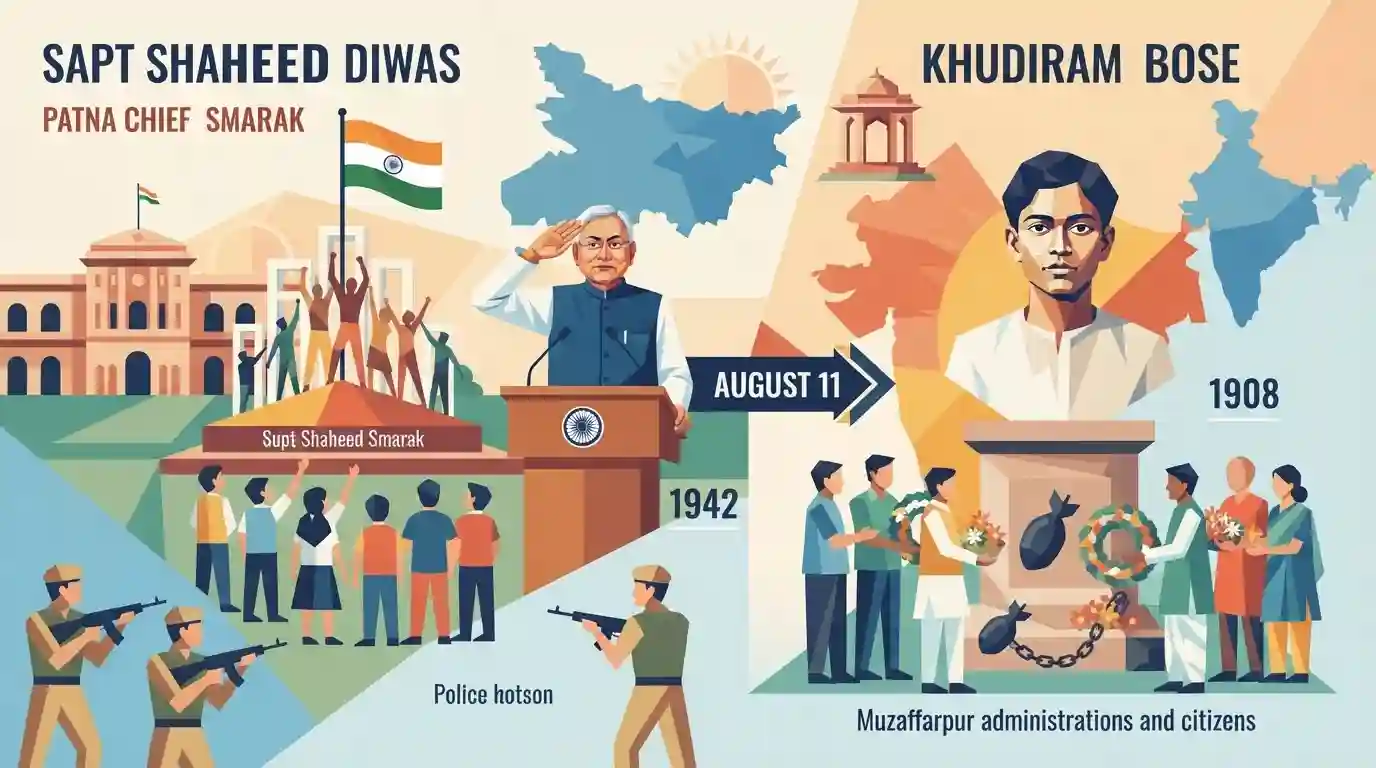
Bihar Chief Minister Nitish Kumar inaugurated a state function to observe 'Sapt Shaheed Diwas', honoring seven students martyred during the Quit India Movement. The students were killed on August 11, 1942, when police opened fire on them as they attempted to hoist the Indian national flag at the Patna Secretariat. In a related historical commemoration, the Muzaffarpur administration paid tributes to revolutionary Khudiram Bose on the 111th anniversary of his execution, which also occurred on August 11, 1908.
Key Points
- Bihar Chief Minister Nitish Kumar paid tribute to the seven student martyrs of the Quit India Movement on 'Sapt Shaheed Diwas' (August 11).
- On August 11, 1942, seven students were killed in police firing ordered by Patna District Magistrate W G Archer while attempting to hoist the national flag at the Patna Secretariat.
- The seven martyrs commemorated are Umakant Prasad Singh, Ramanand Singh, Satish Prasad Jha, Jagatpati Kumar, Devipada Chaudhary, Rajendra Singh, and Ram Govind Singh.
- Concurrently, the Muzaffarpur district administration marked the 111th anniversary of the execution of revolutionary Khudiram Bose, who was hanged on August 11, 1908.
Important Terms
Quit India Movement

A mass civil disobedience campaign launched by Mahatma Gandhi on August 8, 1942, demanding an immediate end to British rule. It is famously associated with the 'Do or Die' call.
UPSC context
Crucial for GS Paper 1 (Freedom Struggle). Tests knowledge of causes, leadership vacuum, parallel governments, and unprecedented mass participation.
Sapt Shaheed Diwas
Observed on August 11 in Bihar to commemorate seven students martyred in 1942. They were killed by police firing while trying to unfurl the national flag at the Patna Secretariat.
UPSC context
Relevant for GS Paper 1 and State PSCs. Highlights regional contributions and youth participation during the Quit India Movement.
Khudiram Bose
An Indian revolutionary who was executed by the British at just 18 years old on August 11, 1908, for his involvement in the Muzaffarpur Conspiracy Case.
UPSC context
Important for GS Paper 1 (Freedom Struggle). Illustrates the early phase of revolutionary extremism and youth sacrifice for independence.
Muzaffarpur Conspiracy Case
A 1908 revolutionary plot in which Khudiram Bose and Prafulla Chaki attempted to assassinate British magistrate Douglas Kingsford by throwing a bomb, but mistakenly killed two British women instead.
UPSC context
Tests knowledge of early 20th-century revolutionary terrorism in GS Paper 1, specifically the actions of Bengal revolutionaries against oppressive officials.
Prelims Trap
Khudiram Bose was executed in 1908 for successfully assassinating British Magistrate Douglas Kingsford.
They threw a bomb believing Kingsford was inside the carriage, but accidentally killed two innocent British women (Mrs. and Miss Kennedy). Kingsford escaped unharmed.
Static Concepts Connected
What was the Muzaffarpur Conspiracy Case (1908)?
- The Target: Khudiram Bose and Prafulla Chaki attempted to assassinate the unpopular Chief Presidency Magistrate, Douglas Kingsford.
- Accidental Casualties: The bomb hit the wrong carriage, accidentally killing two British women instead of Kingsford.
- The Outcome: Chaki committed suicide to evade arrest; Bose was tried and hanged on August 11, 1908.
How did the Quit India Movement manifest in Bihar?
- Student Leadership: Following the arrest of top leaders (Operation Zero Hour), students led processions and hoisted flags.
- Patna Secretariat Firing: Seven students (Sapt Shaheed) were shot dead on Aug 11, 1942, by order of DM W.G. Archer at Patna Secretariat.
- Underground Networks: Jayaprakash Narayan escaped Hazaribagh jail and formed 'Azad Dasta' (guerrilla band) in Nepal to disrupt British infrastructure.
Cross-Topic Patterns
Regional martyrs in Quit India
The 'Sapt Shaheed' of Bihar mirrors sacrifices by Matangini Hazra (Bengal) and Kanaklata Barua (Assam), highlighting the decentralized, leaderless mass-participation of the 1942 movement.
Revolutionary extremism Phase I vs II
Khudiram Bose's actions reflect the early 'individual heroic' phase, contrasting with Phase II (HSRA) which shifted towards broader socio-economic goals beyond targeted assassinations.

Expect match-the-following Prelims questions linking lesser-known regional martyrs (Sapt Shaheed, Kanaklata Barua) to their movements.
Linked PYQs · 4
Linked PYQs · 4
- 2023BPSC_PRELIMSGS1
The Quit India Movement in 1942 witnessed significant contributions from leaders of Bihar. Which prominent Bihar leader was known as the ‘Bihar Kesari’ and actively participated in the Quit India Movement?
- 2008BPSC_PRELIMSGS1
Quit India movement began on:
- 2024-EBPSC_PRELIMSGS1
Who gave the slogan “DO OR DIE” and when?
- 2019BPSC_PRELIMSGS1
Which revolutionaries were hanged in the 'Kakori Train Robbery Case'?
