Gujarat CM gives call for Viksit Gujarat for Viksit Bharat
Source:the-print ↗
Why It Matters
The article outlines the holistic policy framework of the Gujarat government, integrating industrial growth with extensive social welfare and tribal empowerment initiatives. Understanding these specific state policies, alongside related national schemes like PMJAY and PMAY, is crucial for answering questions on governance, public policy, and socio-economic development in the GPSC Prelims.
Summary
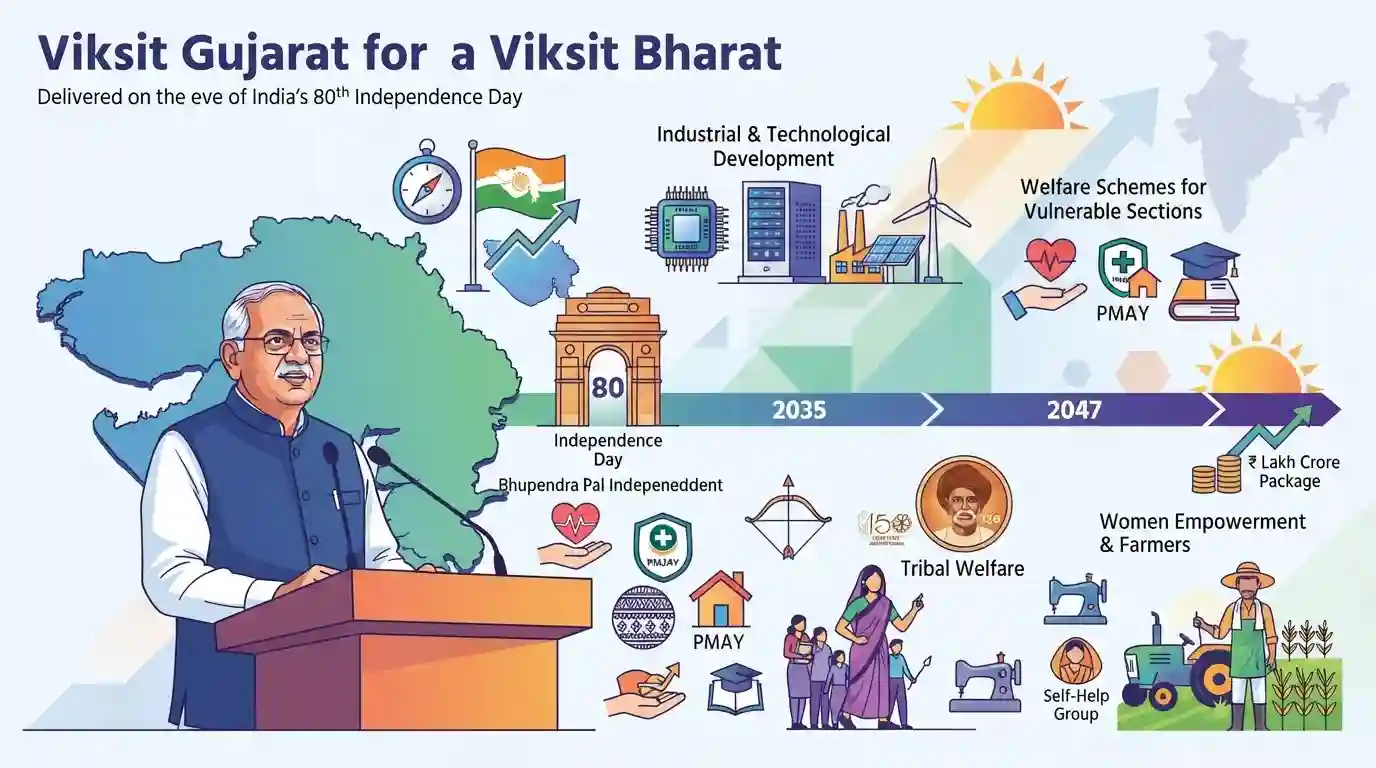
On the eve of the 80th Independence Day, Gujarat Chief Minister Bhupendra Patel delivered an address in Amreli, calling for the realization of a 'Viksit Gujarat for a Viksit Bharat'. By targeting milestones in 2035 (Gujarat's 75th formation year) and 2047 (India's centenary of independence), the government aims to empower the poor, youth, farmers, and women. The Chief Minister highlighted progress in industrial and technological sectors, including operational semiconductor plants and strategic frameworks like the Industrial Policy 2026 and Data Centre Policy. He also emphasized comprehensive social development through welfare schemes such as PMJAY and PMAY, a substantial Rs 2 lakh crore tribal welfare package coinciding with Bhagwan Birsa Munda's 150th birth anniversary, and environmental campaigns like Mission LiFE.
Key Points
- Gujarat is aligning its development goals with its 75th formation year in 2035 and India's centenary of independence in 2047 under the vision 'Viksit Gujarat for a Viksit Bharat'.
- The state's policies focus on empowering the poor, youth, farmers, and women through targeted initiatives like Lakhpati Didi, She-Startup, and Mukhyamantri Paushtik Alpahar Yojana.
- Industrial and technological growth is being propelled by three newly operational semiconductor plants, the Industrial Policy 2026, the Data Centre Policy, and the Shipbuilding and Ship Repair Policy.
- Tribal welfare remains a priority, underscored by the Vanbandhu Kalyan Yojana and a Rs 2 lakh crore tribal welfare package announced in connection with the 150th birth anniversary of Bhagwan Birsa Munda (Janjatiya Gaurav Diwas).
- Sustainable development is being championed through environmental initiatives such as Mission LiFE, Ek Ped Maa Ke Naam, and Catch the Rain.
Important Terms
Lakhpati Didi

A central initiative under DAY-NRLM aiming to financially empower rural Self-Help Group (SHG) women by ensuring they earn a sustainable annual household income of at least ₹1 lakh through skill training and credit access.
UPSC context
GS Paper 2 (Social Justice). Tests knowledge of women’s economic empowerment, SHGs, and poverty alleviation strategies.
Ayushman Bharat Vay Vandana
An extension of the AB-PMJAY scheme providing an additional free health insurance coverage of ₹5 lakh annually specifically for all senior citizens aged 70 and above, regardless of their socio-economic status.
UPSC context
GS Paper 2 (Health, Vulnerable Sections). Relevant for universal health coverage and geriatric welfare policies.
Industrial Policy 2026
A state framework aiming to transform Gujarat into a $3.5 trillion economy by 2047. It focuses on new-age sectors, R&D hubs, and offers heavy capital and operational subsidies for sustainable, innovation-driven industrialization.
UPSC context
GS Paper 3 (Industrial Policy). Highlights state-level manufacturing strategies, R&D incentives, and Make in India alignment.
Data Centre Policy
A policy to establish Gujarat as a digital hub by targeting 7.5 GW of hyperscale green AI data centre capacity. It offers fiscal incentives but mandates that 51% of operational electricity must come from renewable energy.
UPSC context
GS Paper 3 (IT, Infrastructure). Tests knowledge of digital infrastructure, green energy integration, and AI readiness.
Mukhyamantri Paushtik Alpahar Yojana
A supplementary nutrition scheme in Gujarat providing a calorie and protein-rich breakfast to over 40 lakh pre-primary to Class 8 students in government schools, complementing the PM Poshan mid-day meal scheme.
UPSC context
GS Paper 2 (Education, Health). Important for human capital development, child malnutrition interventions, and early education outcomes.
Shipbuilding and Ship Repair Policy
A strategic policy to expand Gujarat’s maritime manufacturing by developing Integrated Mega Shipbuilding Parks, offering capital assistance, and aiming to elevate the state's capacity to 5 million deadweight tonnage by 2047.
UPSC context
GS Paper 3 (Infrastructure). Tests knowledge of India's blue economy, maritime manufacturing, and coastal development.
Prelims Trap
"Lakhpati Didi is a flagship initiative administered by the Ministry of Women and Child Development."
It is actually implemented under the Deendayal Antyodaya Yojana-National Rural Livelihoods Mission (DAY-NRLM) by the Ministry of Rural Development, focusing on SHGs.
Static Concepts Connected
What were the core causes and outcomes of the Munda Ulgulan (1899-1900)?
- Khuntkatti system: British policies and outsiders (dikus) dismantled the traditional 'Khuntkatti' (joint land ownership) system of the Munda tribe, replacing it with exploitative zamindari.
- Birsa's leadership: Birsa Munda mobilized followers through a politico-religious movement targeting British officials, missionaries, and money-lenders to establish 'Munda Raj'.
- Key outcome: The uprising forced the British to pass the Chotanagpur Tenancy Act (1908), which restricted the transfer of tribal land to non-tribals.
How do state-level policies supplement the central India Semiconductor Mission (ISM)?
- Capital top-ups: States like Gujarat offer additional capital subsidies (e.g., an extra 20%) on top of the Centre's 50% fiscal support for setting up semiconductor fabs.
- Utility subsidies: States provide critical operational support, including heavily subsidized power, high-quality water, and land in dedicated tech clusters to offset the high costs of ATMP units.
Cross-Topic Patterns
State Tech Hubs + Quad Supply Chains
State-level semiconductor hubs (like Dholera) anchor India's strategic commitments in the Quad Semiconductor Supply Chain Initiative to reduce import reliance on China.
Historical Anniversaries + Tribal Welfare
UPSC frequently links tribal historical figures (like Birsa Munda) to modern governance tools such as PESA, the Forest Rights Act, and dedicated state sub-plans.
Mission LiFE + Behavioral Economics
Mission LiFE represents the application of behavioral economics (Nudge Theory) in global climate action, shifting the focus from top-down mandates to decentralized citizen participation.

Birsa Munda's 150th anniversary makes tribal land rights (Chotanagpur Tenancy Act, PESA) highly probable for Prelims 2026.
Linked PYQs · 5
Linked PYQs · 5
- 2025GPSC_PRELIMSGS1
Which of the following statements is/are correct regarding the G-SAFAL scheme?
- 2022GPSC_PRELIMSGS1
Which of the following schemes facilitates bank loans to at least one Scheduled Caste/ Scheduled Tribe borrower and at least one woman borrower per bank branch for setting up greenfield enterprises?
- 2025GPSC_PRELIMSGS1
Which of the following statements are correct regarding the economy of Gujarat according to the Socio-Economic Review, 2024-2025 of Gujarat? 1. Gujarat has consistently contributed over 8% to India's GST collections, highlighting its economic vitality and strength. 2. During the year 2022-23, Gujarat stood first in handling total cargo among the states of India. 3. According to the results of Annual Survey of Industries (ASI) 2022-23, Gujarat is first in the country in Industrial Production and Fixed Capital.
- 2025GPSC_PRELIMSGS1
Which of the following policies or programs are aimed at improving governance at the state and central level? 1. Digital India Mission 2. Smart Cities Mission 3. Direct Benefit Transfer (DBT) Scheme 4. Pradhan Mantri Awas Yojana (PMAY) Select the correct answer using the codes given below:
- 2021GPSC_PRELIMSGS1
Which of the following statements are correct regarding tribal uprisings during British Government in India? 1. Rampa Rebellion was against new restrictive forest regulations of the British Government. 2. Bankim Chandra Chatterjee's Anand Math was based on the Sanyasi Rebellion. 3. During Munda Rebellion, Birsa Munda declared himself as the representative of God.
