Bihar Higher Education Expansion Across Blocks for Women
Source:The Hindu ↗
Why It Matters
The article highlights state-led decentralization and targeted investment in higher education and skill development, serving as a key case study for GS2 (Social Justice/Education policies) and GS3 (Demographic dividend and employment).
Summary
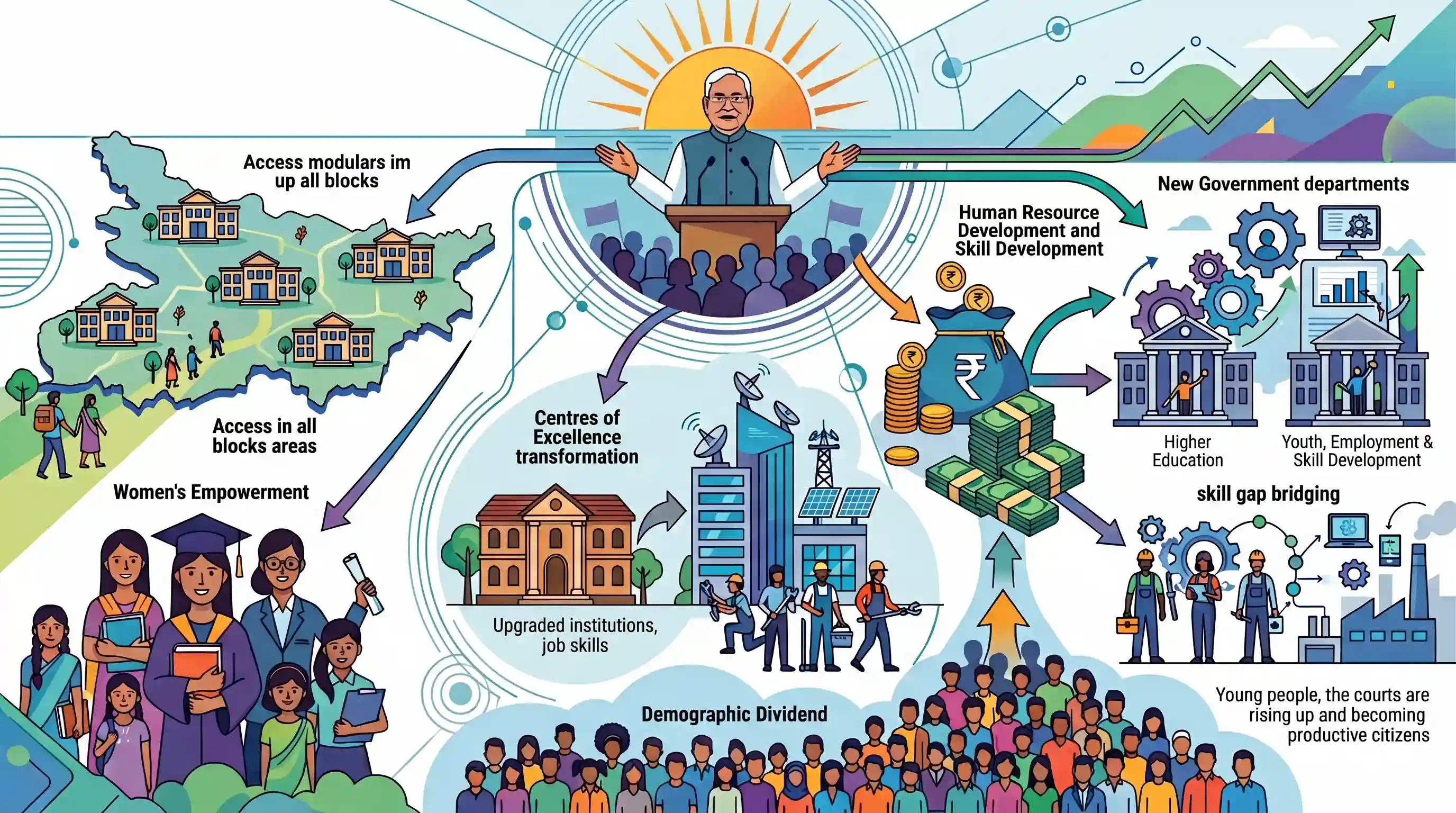
Bihar Chief Minister Nitish Kumar has announced the establishment of degree colleges across all 534 blocks of the state under the "Unnat Shiksha, Ujjwal Bhavishya" scheme, a core component of the newly launched "Saat Nischay-3" program (2025-2030). In the initial phase, 213 colleges will be opened, primarily aimed at improving access to higher education for girls and rural youth. Additionally, 55 older institutions will be upgraded to "Centres of Excellence" to impart employment-oriented education and bridge the skill gap. Emphasizing human resource development, the state budget allocated a substantial ₹68,216.95 crore to the Education and the newly created Higher Education departments. The government has also established a dedicated department for Youth, Employment & Skill Development to leverage the state's demographic dividend.
Key Points
- Bihar CM Nitish Kumar announced the opening of degree colleges in all 534 blocks of the State to improve higher education accessibility, especially for girls.
- The initiative is part of the "Unnat Shiksha, Ujjwal Bhavishya" resolve under the ambitious "Saat Nischay-3" (2025-30) program.
- In the first phase, colleges will be established in 213 blocks that currently lack constituent or affiliated degree colleges, with academic sessions starting in July 2026.
- 55 established educational institutions will be upgraded into "Centres of Excellence" to provide employment-oriented education and enhance skill development.
- Reflecting its priority on human resource development, the state budget allocated ₹68,216.95 crore to the Education and newly-formed Higher Education departments.
- The Bihar government recently established three new departments: Youth, Employment & Skill Development; Higher Education; and Civil Aviation.
Important Terms
Saat Nischay-3

Bihar’s governance framework (2025–2030) comprising seven resolves, including industrial growth and employment, aimed at doubling per-capita income and creating one crore jobs.
UPSC context
GS II (Governance) and III (Economy); tests knowledge of sub-national development models and state-led socio-economic interventions.
Unnat Shiksha, Ujjwal Bhavishya
The fourth resolve under Bihar’s Saat Nischay-3 program, focusing on universalizing higher education access by establishing degree colleges in every block and creating "Centres of Excellence."
UPSC context
GS II (Social Justice/Education); tests understanding of decentralized education infrastructure and human resource development.
Mukhyamantri Mahila Rozgar Yojana
A Bihar government scheme providing a ₹10,000 initial grant and up to ₹2 lakh additional funding to one woman per family to foster entrepreneurship and economic independence.
UPSC context
GS II (Women Empowerment); tests knowledge of gender-centric economic policies and rural livelihood initiatives.
Higher Education Department (Bihar)
A specialized administrative wing created in 2025 to focus on university reforms, qualitative improvements in learning, research, and technical education across Bihar.
UPSC context
GS II (Governance); relevant for administrative reorganization to achieve sector-specific development outcomes.
Youth, Employment & Skill Development Department
A department established in 2025 to streamline vocational training and skill-building initiatives, supporting Bihar's target of creating one crore employment opportunities.
UPSC context
GS III (Employment/Skill Development); relevant for discussions on demographic dividend and institutional capacity building.
Civil Aviation Department (Bihar)
A new department created in 2025 to manage Bihar's expanding aviation infrastructure, including new airports under the UDAN scheme and regional air connectivity improvements.
UPSC context
GS III (Infrastructure); tests understanding of state-level infrastructure diversification and regional connectivity.
Prelims Trap
Higher education is exclusively a Union Subject under the Seventh Schedule.
While coordination/standards of higher education (Entry 66) is a Union subject, education itself is on the Concurrent List (42nd Amendment). States have broad powers to establish colleges.
Static Concepts Connected
How is Education distributed in the 7th Schedule of the Constitution?
- Concurrent List: Education was moved from the State List to the Concurrent List by the 42nd Constitutional Amendment Act, 1976.
- Union List (Entry 66): Entry 66 gives the Centre exclusive power over coordination and determination of standards in institutions for higher education or research.
- Other Union Entries: Entries 63-65 cover institutions of national importance and specialized professional/technical training institutions.
What is the Gross Enrolment Ratio (GER) and the NEP 2020 target for it?
- GER Definition: It is the total enrollment in higher education (regardless of age) as a percentage of the eligible official population (18-23 years).
- NEP 2020 Target: The National Education Policy (NEP) 2020 aims to increase the GER in higher education to 50% by 2035.
Cross-Topic Patterns
Demographic Dividend vs. Employability
State initiatives linking block-level degrees to 'Centres of Excellence' highlight the national shift from mere enrollment (GER) to employability, addressing India's structural youth unemployment.
Spatial decentralization and female FLFP
Proximity of block-level colleges addresses spatial and safety barriers for rural women, acting as a crucial stepping stone to translate education into higher Female Labour Force Participation (FLFP).

Expect a 2026 Mains question on spatial decentralization of higher education as a tool to boost Female Labor Force Participation (FLFP).
Linked PYQs · 3
Linked PYQs · 3
- 2023MainsGS2
Skill development programmes have succeeded in increasing human resources supply to various sectors. In the context of the statement analyse the linkages between education, skill and employment.
- 2023MainsGS2
The crucial aspect of development process has been the inadequate attention paid to Human Resource Development in India. Suggest measures that can address this inadequacy.
- 2014MainsGS3
While we flaunt India's demographic dividend, we ignore the dropping rates of employability. What are we missing while doing so? Where will the jobs that India desperately needs come from? Explain.
