Andhra Pradesh Population Management Policy to address low fertility
Source:newsonair ↗
Why It Matters
Provides critical insights into regional demographic shifts in Southern India, shifting from population control policies of the past to pro-natalist or demographic management strategies to handle ageing and labor scarcity.
Summary
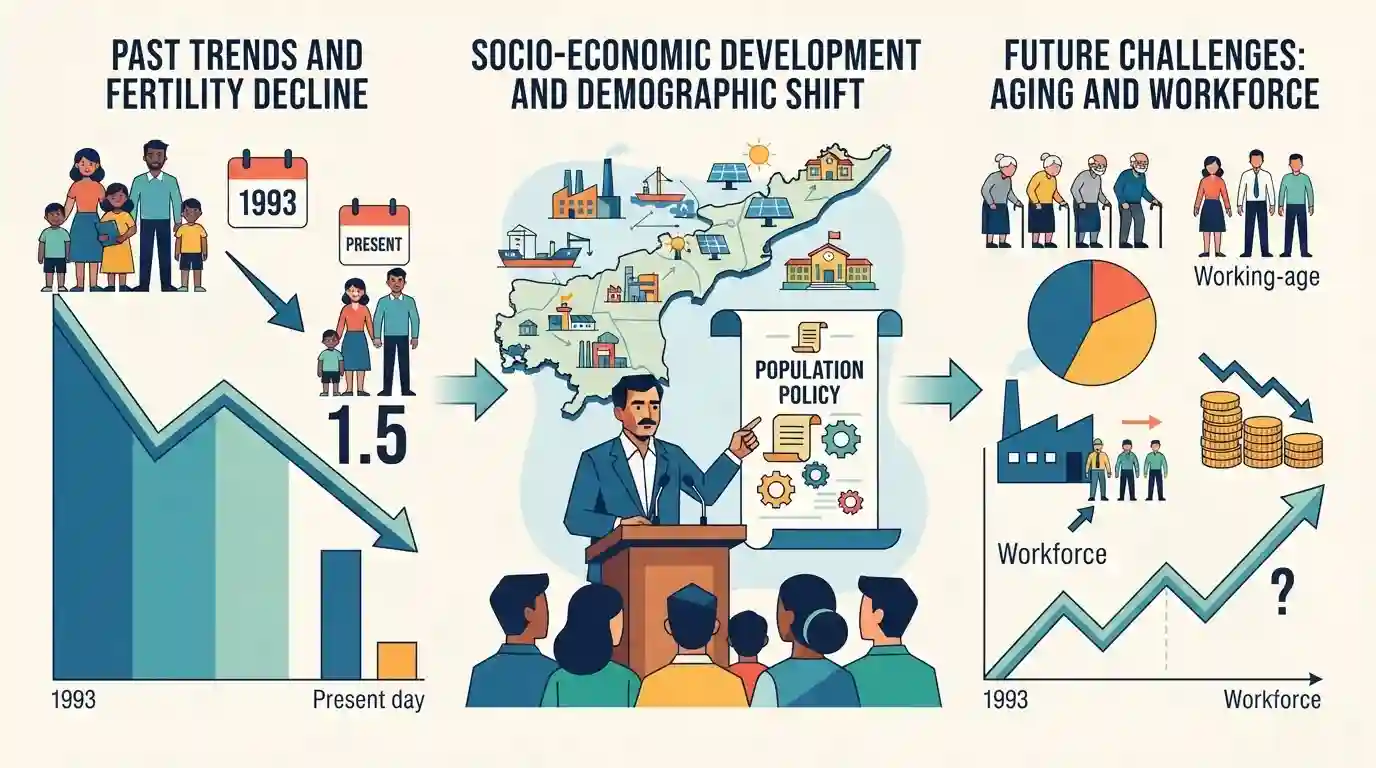
Chief Minister N. Chandrababu Naidu announced that Andhra Pradesh is formulating a Population Management Policy to address plunging fertility rates—down from 3.0 in 1993 to 1.5—and impending demographic challenges like an aging populace and workforce reduction.
Key Points
- Andhra Pradesh Chief Minister N. Chandrababu Naidu announced the preparation of a pioneering 'Population Management Policy' to address declining fertility rates.
- The state's Total Fertility Rate (TFR) has dropped sharply from 3.0 in 1993 to about 1.5, falling below the replacement level of 2.1.
- The policy aims to be finalized by the end of March and implemented starting April 1 to counteract future demographic challenges, ageing population, and workforce shortages.
Important Terms
Population Management Policy

A state government initiative introduced by Andhra Pradesh to reverse declining fertility rates, address aging populations, and provide financial incentives for larger families.
UPSC context
Important for APPSC Group 1/2 under Socio-Economic Development and Demographic Trends in Andhra Pradesh.
Government of Andhra Pradesh
The executive organ of the state of Andhra Pradesh responsible for formulating state policies, drafting legislations, and managing state administration.
UPSC context
Relevant for APPSC Polity and Governance papers focusing on state-level policy formulation and administration.
Andhra Pradesh State Assembly
The state legislature of Andhra Pradesh comprising the Legislative Assembly and Legislative Council, responsible for enacting state laws.
UPSC context
Important for APPSC Polity questions on legislative procedure and governance structures in the state.
Static Concepts Connected
What are the key demographic indicators used in India's National Family Health Survey (NFHS)?
- Replacement Level: Total fertility rate (TFR) measures the average number of children born to a woman over her lifetime, with 2.1 as the replacement level.
- Health Metrics: Infant Mortality Rate (IMR) and Maternal Mortality Ratio (MMR) track child survival and maternal health across states.
- Sex Ratios: Sex ratio at birth and operational sex ratios indicate gender preference and demographic balance across cohorts.
Cross-Topic Patterns
Demographic Transition & State Economy Linkages
AP's shift from family planning to pronatalist incentives mirrors global trends in East Asia and Southern Europe facing sub-replacement TFRs and workforce shortages.

Expect matching questions on AP's TFR figures (1.5 vs 2.1 replacement) and pronatalist welfare packages like 'Pillale Sampada'.
Linked PYQs · 1
Linked PYQs · 1
- 2024APPSC_PRELIMSGS1
Which of the following statement/statements is/are valid regarding the socio-economic status of Andhra Pradesh ? I. Andhra Pradesh won the Best State Award of ICAR - National Research Center for Banana (NRCB) for export promotion. II. Andhra Pradesh GSDP growth rate has been registering a decline in recent times owing to repeated lower returns in certain sub-sectors of the Service Sector. III. For the FY 2024 - 25, the Revenue Deficit is budgeted higher than the Fiscal Deficit in terms of percentage of Andhra Pradesh GSDP. IV. The technology used by the Government of Andhra Pradesh while conducting resurvey of landholdings is referred to as 'Continuously Operating Reference Stations (CORS)' technology. Select the correct answer using the codes given below :
