Maharishi Sandipani Shraddha Parv Celebrated Across Madhya Pradesh
Source:indian-masterminds ↗
Why It Matters
Questions related to the cultural heritage of Madhya Pradesh, historical personalities like Maharishi Sandipani (and his association with Ujjain), and the implementation of the National Education Policy (NEP) 2020 are prominent in the MPPSC State Service Prelims. This current affair uniquely bridges ancient MP history with modern educational governance.
Summary
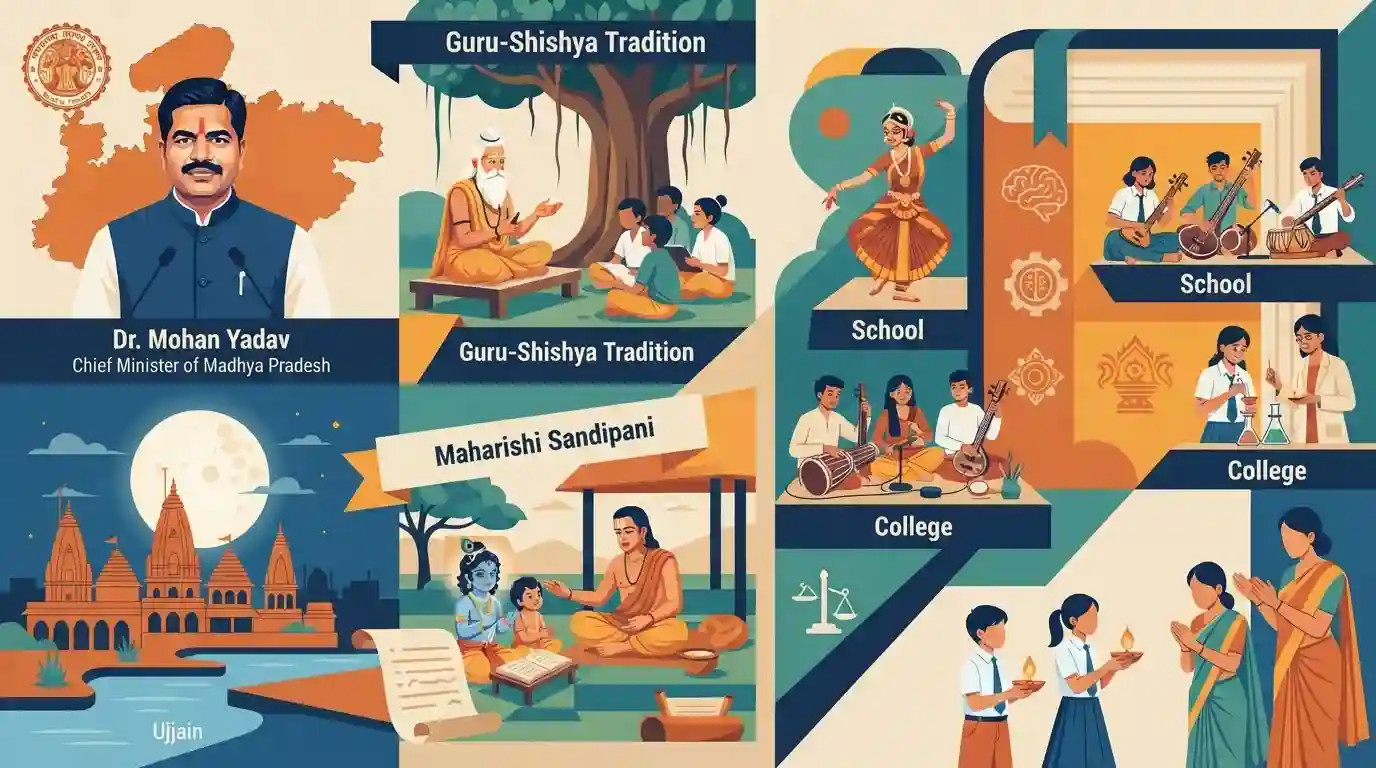
Madhya Pradesh Chief Minister Dr. Mohan Yadav has announced that Guru Purnima will be observed as 'Maharishi Sandipani Shraddha Parv' in schools, colleges, and technical institutions across the state. The festival honors the ancient Guru-Shishya tradition, drawing inspiration from Maharishi Sandipani, the revered guru of Lord Krishna, whose ashram is situated in Ujjain. The two-day celebration will feature various cultural and academic activities designed to instill respect for teachers and connect students with India's rich cultural heritage. Furthermore, the initiative is closely aligned with the National Education Policy (NEP) 2020, aiming to revive the ethos of the ancient Gurukul system and integrate traditional Indian knowledge frameworks into contemporary education.
Key Points
- Madhya Pradesh Chief Minister Dr. Mohan Yadav announced that Guru Purnima will be celebrated as 'Maharishi Sandipani Shraddha Parv' across all educational institutions in the state.
- The initiative aims to honor the Guru-Shishya parampara (teacher-disciple tradition) and emphasize Indian cultural values.
- Maharishi Sandipani was the guru of Lord Krishna, and his famous ashram is located in Ujjain, Madhya Pradesh, a significant cultural and historical fact for state exams.
- The celebration aligns with the ideals of the National Education Policy (NEP) 2020, focusing on integrating ancient knowledge systems and the Gurukul tradition into modern education.
- Two days of special events, such as essay writing, debates, and honoring teachers, will be organized by various education departments in the state.
Important Terms
National Education Policy (NEP) 2020

India's comprehensive education framework replacing the 1986 policy. It emphasizes holistic, multidisciplinary learning and specifically advocates for the integration of traditional Indian Knowledge Systems (IKS) into modern contemporary education.
UPSC context
GS Paper 2 (Education). Tests knowledge of educational reforms, human resource development, and indigenous knowledge promotion.
Maharishi Sandipani Shraddha Parv
A state-wide celebration in Madhya Pradesh coinciding with Guru Purnima. It aims to honor the Guru-Shishya tradition, promote ancient Indian knowledge systems, and align educational practices with the NEP 2020.
UPSC context
GS Paper 1 (Culture) & Current Affairs. Tests awareness of state-level cultural preservation and educational initiatives.
Maharishi Sandipani
A revered ancient Indian sage and the guru of Lord Krishna, Balarama, and Sudama. His historic ashram in Ujjain remains a focal point for Vedic education and cultural preservation today.
UPSC context
GS Paper 1 (Indian Heritage and Culture). Tests knowledge of important historical personalities and ancient educational centers.
Guru-Shishya Tradition
An ancient Indian educational framework where knowledge, spirituality, and ethical values are transmitted directly from a teacher (Guru) to a disciple (Shishya) through continuous mentorship and face-to-face learning.
UPSC context
GS Paper 1 (Culture) & GS Paper 4 (Ethics). Tests understanding of traditional value systems and moral foundations in education.
Indian Knowledge Systems (IKS)
The repository of ancient Indian wisdom spanning philosophy, mathematics, science, medicine, and arts. The NEP 2020 seeks to revive and integrate this holistic framework into modern pedagogical curriculums.
UPSC context
GS Paper 1 (Culture) & GS Paper 2 (Education). Tests knowledge of indigenous intellectual heritage and its contemporary relevance.
Prelims Trap
"Guru Purnima (Asadha Purnima) commemorates Lord Buddha's enlightenment at Bodh Gaya."
False. Buddha's enlightenment (Nirvana) is celebrated on Vaishakha Purnima (Buddha Purnima). Asadha Purnima (Guru Purnima) marks his first sermon at Sarnath.
Static Concepts Connected
What are the major events in Buddha's life associated with specific Purnima (full moon) days?
- Vaishakha Purnima: Marks Buddha's birth, his enlightenment (Nirvana) at Bodh Gaya, and his death (Mahaparinirvana) at Kushinagar.
- Asadha Purnima: Known as Guru Purnima in Hinduism; in Buddhism, it marks Buddha's first sermon at Sarnath (Dharma Chakra Pravartana).
How does the National Education Policy (NEP) 2020 approach Indian Knowledge Systems (IKS)?
- Curriculum Integration: Mandates the integration of ancient Indian sciences, arts, and linguistic traditions into contemporary school and higher education curricula.
- Pedagogical Shift: Emphasizes holistic, multidisciplinary learning inspired by the ancient Gurukul ethos, promoting values like the Guru-Shishya parampara.
Cross-Topic Patterns
NEP 2020 + Intangible Heritage
State-level festivals like MP's Sandipani Parv act as localized, real-world implementations of NEP 2020’s mandate to integrate indigenous knowledge frameworks (IKS) into modern pedagogy.
Ujjain: Ancient Education Hub
Beyond Sandipani Ashram, Ujjain (ancient Avanti) was historically pivotal for astronomy (Jai Singh II's observatory) and literature (Kalidasa in Chandragupta II's court), making it a frequent map-based question topic.

Expect a multi-statement Prelims question mixing the Hindu (Vyasa) and Buddhist (First Sermon) significance of Asadha/Guru Purnima.
Linked PYQs · 2
Linked PYQs · 2
- 2025MPPSC_PRELIMSGS1
While living in which Ashram did a person have to perform the rituals of Panch Mahayagya ?
- 2020MPPSC_PRELIMSGS1
Akanksha Scheme is related to
