Shri Krishna Tirth Projects and Cultural Tourism in MP
Source:indian-masterminds ↗
Why It Matters
MPPSC Prelims regularly features questions on state-specific art and culture, tourist destinations, and religious corridors (such as Mahakal Lok or new Tirth projects), alongside questions testing the deep functional details and objectives of flagship schemes like the Mukhyamantri Ladli Behna Yojana.
Summary
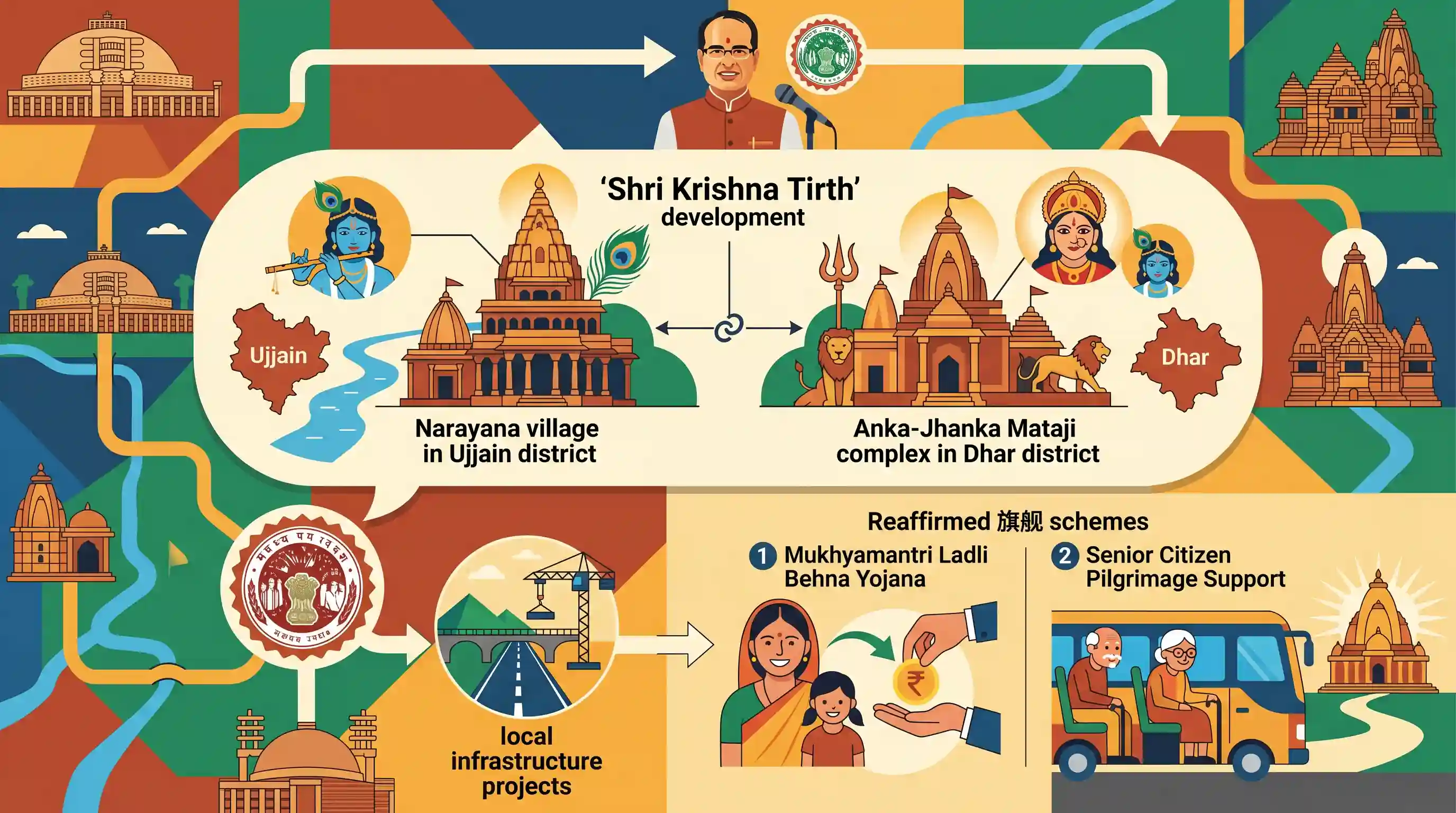
Madhya Pradesh Chief Minister Dr. Mohan Yadav announced the development of 'Shri Krishna Tirth' pilgrimage centers at sites associated with Lord Krishna—specifically at Narayana village in Ujjain district and the Anka-Jhanka Mataji complex in Dhar district. The announcement, made during a religious event in Tankariya village, was coupled with local infrastructure projects and a reaffirmation of the state's flagship schemes, including the Mukhyamantri Ladli Behna Yojana and senior citizen pilgrimage support.
Key Points
- Madhya Pradesh Chief Minister Dr. Mohan Yadav announced the development of 'Shri Krishna Tirth' pilgrimage corridors in sites associated with Lord Krishna's life.
- The two primary sites designated for development as Shri Krishna Tirth projects are Narayana village in Ujjain district and the Anka-Jhanka Mataji complex in Dhar district.
- The announcement was made during the concluding ceremony of a seven-day Shrimad Bhagwat Katha in Tankariya village (Ujjain), highlighting the role of religious discourses in promoting social harmony and spiritual growth.
- The CM announced local infrastructure initiatives, including paved roads connecting Tankariya Panth village to Lepad and Ranapur Phatak, alongside funding for a local Gaushala (cow shelter) and Dharmashala shed.
- The government reaffirmed the regular disbursal of financial assistance under the Mukhyamantri Ladli Behna Yojana (specifically a financial gift/shagun during Raksha Bandhan) and continued pilgrimage support for senior citizens.
Important Terms
Shri Krishna Tirth Projects

A cultural tourism initiative by the Madhya Pradesh government to develop and preserve grand pilgrimage sites associated with Lord Krishna's life, including key locations like Narayana village in Ujjain and the Anka-Jhanka Mataji complex in Dhar.
UPSC context
GS Paper I (Indian Heritage & Culture); tests understanding of state-driven regional heritage tourism, cultural preservation, and corridor development projects.
Mukhyamantri Ladli Behna Yojana
A flagship welfare scheme in Madhya Pradesh launched in 2023 providing monthly financial assistance of ₹1,500 to eligible women via Direct Benefit Transfer to enhance their socio-economic self-reliance, health, and nutrition.
UPSC context
GS Paper II (Social Justice & Welfare Schemes); tests knowledge of gender empowerment initiatives, financial inclusion, and state-led DBT welfare models.
Mukhyamantri Teerth Darshan Yojana
A state-sponsored scheme in Madhya Pradesh launched in 2012 that provides eligible, non-taxpaying senior citizens (60+) with fully funded travel, food, and logistics for pilgrimages to designated spiritual destinations across India.
UPSC context
GS Paper II (Welfare Schemes for Vulnerable Sections); tests understanding of social security, geriatric care, and state welfare support for elderly populations.
Sandipani Ashram
An ancient Gurukul complex in Ujjain, Madhya Pradesh, historically and mythologically renowned as the sacred hermitage where Lord Krishna, Balarama, and Sudama received their education and mastered sixty-four arts under Sage Sandipani.
UPSC context
GS Paper I (Ancient Indian History & Culture); tests knowledge of India's traditional Gurukul systems, historical education, and major cultural pilgrimage sites.
Prelims Trap
Historical and scriptural events of Krishna's life, such as his education and Rukmini's elopement, are geographically confined only to Uttar Pradesh and Gujarat.
Madhya Pradesh holds crucial scriptural sites: Sandipani Ashram (Ujjain) for his education, Narayan Dham for his friendship with Sudama, and Amjhera (Dhar) for the Rukmini Haran episode.
Static Concepts Connected
What is the historical significance of Vaishnavism and Bhagavata heritage in ancient Madhya Pradesh?
- Heliodorus Pillar: Located in Vidisha, this 2nd-century BCE pillar erected by a Greek ambassador is the earliest epigraphical evidence of the Bhagavata sect.
- Avantika (Ujjain): Mentioned in Puranas as a major seat of learning (Sandipani Gurukul) and one of the seven sacred Puris (Sapta Puri) of Hinduism.
- Gupta Art Influence: The region witnessed transition to classical Hindu temple architecture, especially Vaishnava cave temples at Udayagiri showing Varaha incarnation.
How do unconditional direct benefit transfers (DBTs) impact rural micro-economies?
- Multiplier Effect: Direct cash transfers quickly increase disposable income in rural households, stimulating localized demand for basic goods and services.
- Financial Inclusion: Promotes formal banking habits among rural women, driving active ownership of Jan Dhan accounts and improving creditworthiness.
Cross-Topic Patterns
Epigraphy and state-sponsored cultural heritage
Connecting ancient epigraphical discoveries like the Heliodorus Pillar to modern pilgrimage corridors, illustrating how states leverage historical geography to boost spiritual tourism.
Gendered DBT and nutrition outcomes
Analysing how schemes like Ladli Behna bypass structural household disparities, ensuring cash liquidity directly translates into improved maternal and child nutritional outcomes.

Modern cultural corridors linked to ancient Vaishnavism (like Sandipani & Heliodorus) likely to be integrated into GS-1 heritage questions.
Linked PYQs · 2
Linked PYQs · 2
- 2025MPPSC_PRELIMSGS1
The objective of "Mukhyamantri Ladli Behna Yojana" implemented in entire Madhya Pradesh, in addition to economic self-reliance is:
- 2022MPPSC_PRELIMSGS1
What amount will be given to eligible women under "Ladli Bahna Yojana" of the Madhya Pradesh Government?
