Madhya Pradesh to Inaugurate 70 Sandipani Schools for Value Education
Source:indianmasterminds ↗
Why It Matters
The scheme highlights Madhya Pradesh's focus on combining modern high-quality education with ancient Indian philosophical values, celebrating local cultural icons like Guru Sandipani, and fostering inclusive education in tribal regions.
Summary
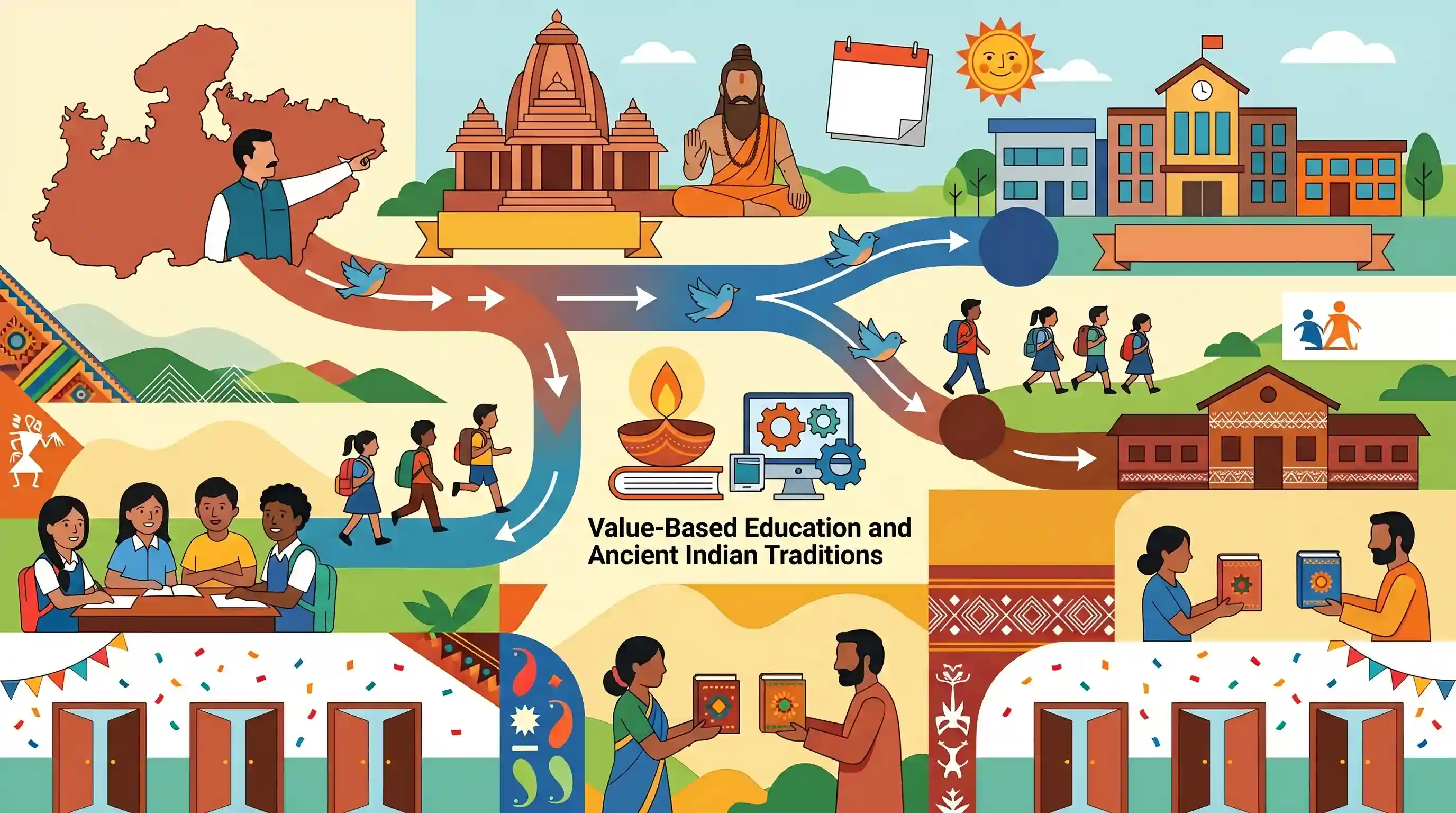
Madhya Pradesh Chief Minister Dr. Mohan Yadav has directed the rapid, grand inauguration of 70 newly established Sandipani Schools across the state by July 15, 2026. Spearheaded by the School Education (46 schools) and Tribal Affairs (24 schools) departments, the initiative is aligned with the 'School Chalein Abhiyan' to provide modern, value-based, and non-discriminatory education. Inspired by Guru Sandipani's ancient ashram in Ujjain, the state plans to publish educational booklets on his teachings and hold celebrations on Guru Purnima.
Key Points
- Madhya Pradesh Chief Minister Dr. Mohan Yadav directed the School Education and Tribal Affairs Departments to organize a grand inauguration of 70 newly established 'Sandipani Schools' by July 15, 2026.
- Out of the 70 new Sandipani Schools, 46 schools are under the jurisdiction of the School Education Department, while 24 fall under the Tribal Affairs Department.
- The launch of these schools is integrated with the ongoing 'School Chalein Abhiyan' (School Enrollment Campaign), aiming to promote high-quality, modern, and value-based education.
- The schools are named after Guru Sandipani, the revered sage of the ancient ashram in Ujjain where Lord Krishna, Balarama, and Sudama studied. He is celebrated as an early advocate of social equality.
- A dedicated pocket book detailing the life, teachings, and values of Guru Sandipani will be published by the government and distributed to students.
- To honor the traditional guru-disciple heritage, the state will observe Guru Purnima on July 29, 2026, with main events planned in one Sandipani School in every district.
Important Terms
School Chalein Abhiyan

A mass public enrollment and educational outreach campaign in Madhya Pradesh designed to bring out-of-school children into formal schooling, maximize enrollment, and achieve zero primary-level dropout rates.
UPSC context
GS Paper II: Social Justice. Evaluates state interventions for universalizing elementary education and managing human resources.
Sandipani School Initiative
A flagship educational initiative in Madhya Pradesh that establishes model state schools (formerly CM Rise) to provide integrated, high-quality, modern, and value-based education.
UPSC context
GS Paper II: Governance and Education. Tests model-based institutional reforms in the public school system.
Guru Sandipani
An ancient Indian sage whose ashram in Ujjain served as a legendary Gurukul where Lord Krishna, Balarama, and Sudama received inclusive, non-discriminatory education.
UPSC context
GS Paper I: Indian Culture. Evaluates ancient Indian educational systems, philosophy, and historical heritage.
Tribal Affairs Department, Madhya Pradesh
The state administrative department responsible for the socio-economic and educational development of Scheduled Tribes, managing dedicated welfare schools, hostels, and scholarship programs.
UPSC context
GS Paper II: Welfare Schemes. Analyzes institutional mechanisms targeting vulnerable tribal groups' development.
School Education Department, Madhya Pradesh
The nodal state department responsible for primary, secondary, and higher secondary education policy, digital learning reforms, and management of the public school network.
UPSC context
GS Paper II: Governance and Education. Assesses state-level educational administration and public service delivery.
Prelims Trap
The historic Sandipani Ashram in Ujjain is situated on the banks of the Kshipra River, a major tributary of the Narmada.
The Kshipra River is a tributary of the Chambal River (which flows into the Yamuna), not the Narmada River, despite flowing through central Madhya Pradesh.
Static Concepts Connected
What is the geographical and ecological profile of the Kshipra (Shipra) River?
- Source and Course: Originates in the Kakri Bardi hills of Indore and flows north across the Malwa Plateau to join the Chambal River.
- Cultural Significance: One of the four sacred sites hosting the Simhastha Kumbh Mela every 12 years in Ujjain; highly revered in Puranic literature.
- River Interlinking: Water from the Narmada River is lifted and gravity-fed into the Kshipra source to maintain perennial flow under the Narmada-Kshipra Simhastha Link Project.
How do ITDPs and MADA pockets structure tribal welfare administration in India?
- ITDP/ITDA framework: Socio-economic development blocks launched in the Fifth Five-Year Plan, covering areas with a tribal concentration of 50% or more.
- MADA pockets: Modified Area Development Approach pockets target smaller, contiguous pockets of tribal population (usually 10,000+ total population with 50%+ STs) outside ITDP areas.
- Constitutional linkage: Administered under the Fifth Schedule of the Constitution, empowering the Governor to modify laws and requiring Tribes Advisory Councils.
Cross-Topic Patterns
Indigenous pedagogy vs. Constitutional secularism
Balancing the shift toward indigenous educational heritages (like Gurukul values) with Article 28's constitutional restrictions on religious instruction in state-funded or aided institutions.
River rejuvenation + Heritage tourism
Connecting the ecological health of the Kshipra River (via the Narmada-Kshipra Link Project) to the preservation and tourism of Ujjain's cultural heritage corridor.

Questions may pair Malwa plateau river systems (Kshipra-Chambal) with the cultural geography of ancient Gurukuls and Jyotirlingas.
Linked PYQs · 2
Linked PYQs · 2
- 2013MPPSC_PRELIMSGS1
On which riverside the temple 'Mahakaal' in ujjan is situated?
- 2025MPPSC_PRELIMSGS1
How many total major and medium Integrated Tribal Development Projects are in existence in Madhya Pradesh in 2023-24?
