Karnataka tax devolution campaign and fiscal federalism demands
Source:The Hindu ↗
Why It Matters
Debates over the criteria for horizontal and vertical tax devolution are central to India's fiscal federalism. State grievances regarding cesses shrinking the divisible pool and the penalization of demographic performance directly intersect with GS2 Centre-State relations, making it a highly probable area for both Prelims and Mains questions.
Summary
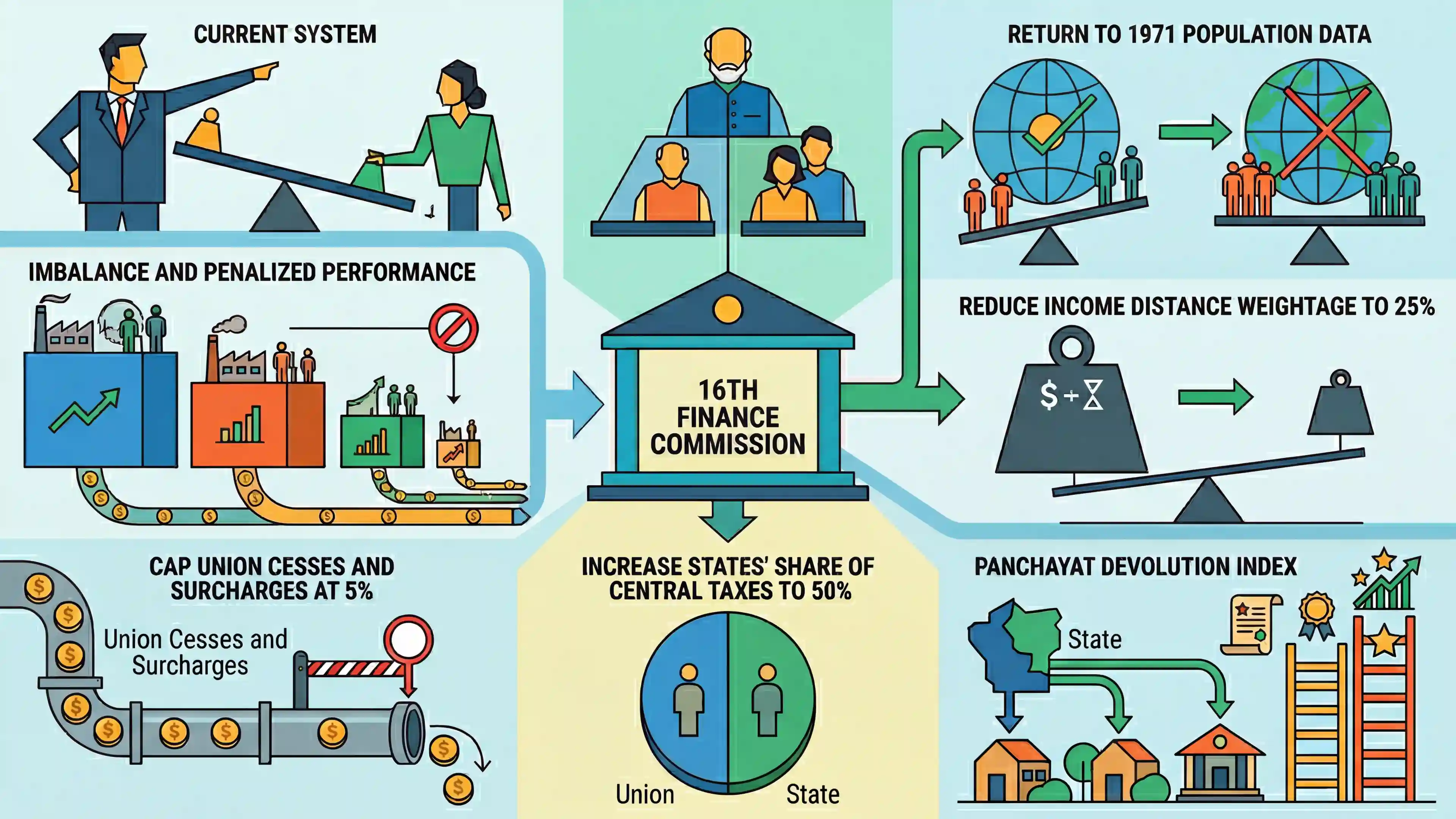
Karnataka Chief Minister Siddaramaiah launched the 'Justice for Karnataka — Fair Share, Strong Federalism' campaign, urging the 16th Finance Commission to address structural imbalances in tax devolution. The state claims the current system penalizes performing states, demanding a return to 1971 population data, a reduction in the income distance weightage to 25%, and capping Union cesses and surcharges at 5%. Additionally, it called for increasing the states' share of Central taxes to 50% and introducing a Panchayat devolution index to reward local governance.
Key Points
- Karnataka has launched a 'Justice for Karnataka' campaign ahead of the Union Budget to advocate for a fairer share in Central tax devolution.
- The state argues that the current formula penalizes states performing well in development and population control, leading to a drop in its tax share from 4.71% to 3.64%.
- Key demands to the 16th Finance Commission include returning to the 1971 population census for weightage and cutting the income distance criterion weight from 45% to 25%.
- Karnataka proposes a new 'Panchayat devolution index' to incentivize decentralization and requested special grants for ecology and the Kalyana Karnataka region.
- The state further urged the Centre to cap cesses and surcharges at 5% to expand the divisible tax pool, and to increase the states' overall tax share to 50%.
Important Terms
Fiscal Federalism

The financial relationship between the Union and State governments, governing the distribution of taxation powers, expenditure responsibilities, and the sharing of revenues through institutional mechanisms like the Finance Commission.
UPSC context
Relevant for GS Paper II (Centre-State Relations) and GS Paper III (Indian Economy); tests understanding of India's federal structure.
16th Finance Commission
A constitutional body appointed under Article 280 to recommend the share of central taxes for states and horizontal distribution criteria for the five-year period from 2026-27 to 2030-31.
UPSC context
Essential for GS Paper II (Constitutional Bodies); tests knowledge of fiscal architecture and recent recommendations affecting state finances.
Tax Devolution
The process of sharing Union tax revenues with states. It includes Vertical Devolution (Centre to States share) and Horizontal Devolution (distribution among individual states based on various criteria).
UPSC context
Core topic for GS Paper III (Public Finance); tests ability to analyze equity versus efficiency in resource allocation.
Divisible Pool
The net proceeds of central taxes shareable with states under Article 270, calculated after excluding collection costs and revenues from cesses and surcharges.
UPSC context
Technical term in GS Paper III (Public Finance); important for understanding the actual volume of funds available for states.
Cesses and Surcharges
Additional levies (cess for specific purposes, surcharges for general revenue) that the Union government retains entirely, as they are not legally part of the shareable divisible pool.
UPSC context
Key issue in GS Paper II/III; tests understanding of current friction points in fiscal federalism and state revenue losses.
Income Distance
A horizontal devolution criterion measuring the gap between a state's per capita income and that of top-performing states, intended to provide more funds to poorer states to ensure equity.
UPSC context
GS Paper III topic; tests knowledge of the formulaic approach to reducing regional disparities in India.
Justice for Karnataka — Fair Share, Strong Federalism campaign
A state-led advocacy movement seeking to address perceived systemic inequities in tax devolution and demanding reforms to prevent 'penalizing' economically and demographically performing states.
UPSC context
Current affairs context for GS Paper II; illustrates regional political-economic challenges to the existing federal framework.
Prelims Trap
All taxes and cesses collected by the Union government form the divisible pool distributed to states.
Under Article 270, cesses and surcharges are explicitly excluded from the divisible pool. This is precisely why states demand a 5% cap to prevent the Centre from bypassing revenue sharing.
Static Concepts Connected
What is the 'Income Distance' criterion in horizontal tax devolution?
- Definition: The difference between a state's per capita income and the per capita income of the state with the highest per capita income.
- Objective: Promotes fiscal equity by allocating more funds to poorer states, helping them bridge historical developmental and infrastructure deficits.
- State Grievance: It holds the highest weightage (45% under the 15th FC), which economically prosperous states argue unfairly penalizes their growth and efficiency.
What constitutes the Divisible Pool of Central Taxes?
- Constitutional Basis: Mandated by Article 270, it comprises the gross tax revenue of the Union government meant to be shared with the states.
- Strict Exclusions: Explicitly excludes cesses, surcharges levied under Article 271, and the administrative cost of tax collection.
- Role of FC: Distributed vertically (Centre vs. States) and horizontally (among States) strictly based on the recommendations of the Finance Commission (Article 280).
Cross-Topic Patterns
Demography vs. Fiscal Federalism
Southern states achieving replacement-level TFR early face reduced tax shares. This links geography's demographic transition models directly to polity's fiscal devolution debates.
Decentralization and the 3Fs
The demand for a 'Panchayat Devolution Index' links macro fiscal policy to the micro success of the 73rd Amendment, specifically the transfer of Funds, Functions, and Functionaries.

16th Finance Commission devolution criteria, specifically income distance and the 2011 census, is a highly probable 2026 Prelims MCQ area.
Linked PYQs · 5
Linked PYQs · 5
- 2023PrelimsGS1
Consider the following: 1. Demographic performance 2. Forest and ecology 3. Governance reforms 4. Stable government 5. Tax and fiscal efforts For the horizontal tax devolution, the Fifteenth Finance Commission used how many of the above as criteria other than population area and income distance?
- 2025PrelimsGS1
Which of the following statements with regard to recommendations of the 15th Finance Commission of India are correct? I. It has recommended grants of ₹ 4,800 crores from the year 2022-23 to the year 2025-26 for incentivizing States to enhance educational outcomes. II. 45% of the net proceeds of Union taxes are to be shared with States. III. ₹ 45,000 crores are to be kept as performance-based incentive for all States for carrying out agricultural reforms. IV. It reintroduced tax effort criteria to reward fiscal performance. Select the correct answer using the code given below.
- 2025MainsGS2
Examine the evolving pattern of Centre-State financial relations in the context of planned development in India. How far have the recent reforms impacted the fiscal federalism in India?
- 2024MainsGS2
What changes has the Union Government recently introduced in the domain of Centre-State relations ? Suggest measures to be adopted to build the trust between the Centre and the States and for strengthening federalism.
- 2018MainsGS2
How is the Finance Commission of India constituted? What do you know about the terms of reference of the recently constituted Finance Commission? Discuss.
