Uniform Civil Code Bill Introduced in Madhya Pradesh Assembly
Source:The Hindu ↗
Why It Matters
The introduction of the UCC at the state level touches upon Article 44 (DPSP) of the Constitution and ongoing debates about personal laws versus uniform codes. Furthermore, the procedural aspects of the State Legislature, the role of the Speaker, and issues of political accountability (corruption allegations against the CM) are highly relevant for the Polity syllabus in civil services exams.
Summary
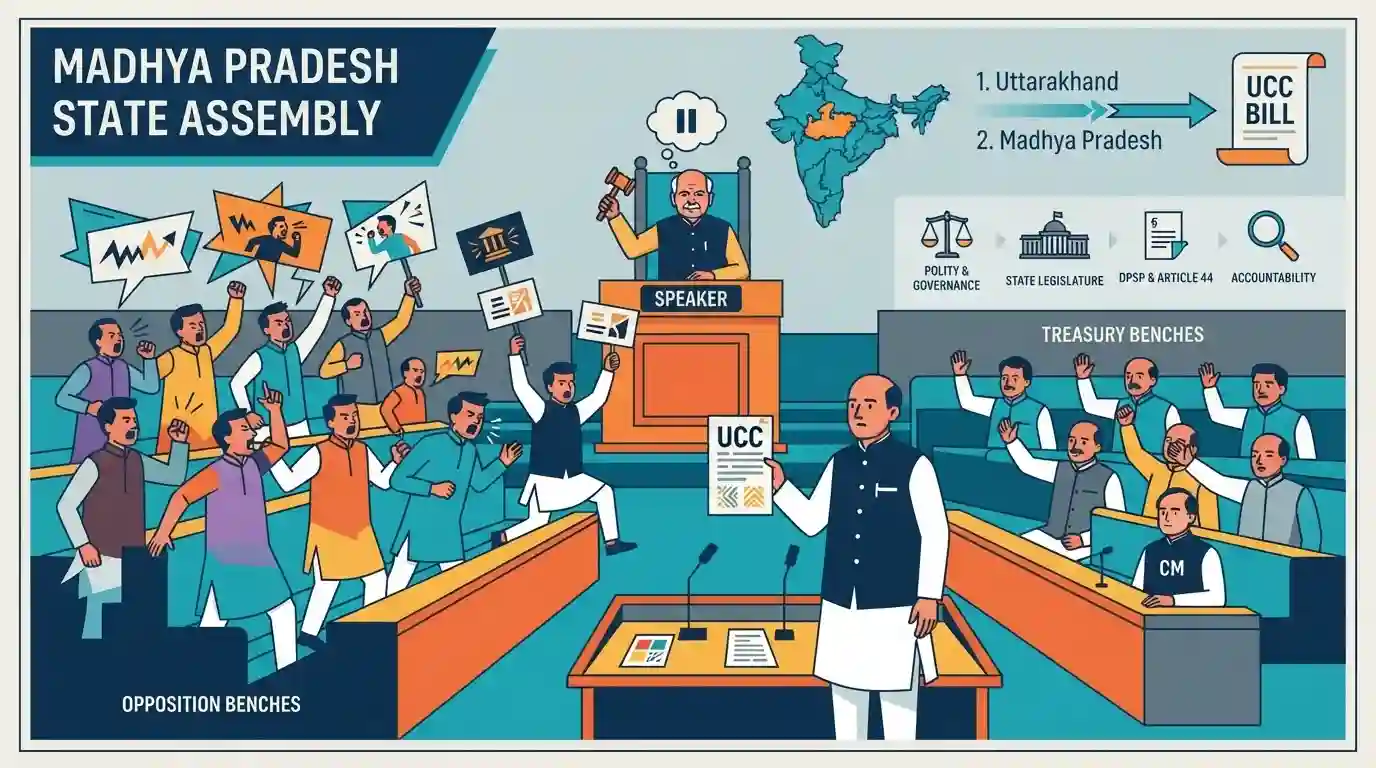
The Madhya Pradesh government has introduced the Uniform Civil Code (UCC) Bill in the State Assembly, becoming the second state in India to take this step after Uttarakhand. The introduction of the Bill occurred amidst severe disruptions by the Congress opposition, who demanded the resignation of Chief Minister Mohan Yadav over allegations of land purchase irregularities by his family in Ujjain. The legislative proceedings were marked by sloganeering in the well of the House, leading Speaker Narendra Singh Tomar to adjourn the session multiple times. The intersection of the UCC Bill's introduction and political controversy highlights significant developments in state polity and governance.
Key Points
- The Madhya Pradesh government introduced the Uniform Civil Code (UCC) Bill, 2026, in the State Legislative Assembly, making it the second state after Uttarakhand to do so.
- The assembly witnessed massive protests by the opposition Congress party, demanding the resignation of Chief Minister Mohan Yadav over alleged irregularities in land purchases in Ujjain.
- Amid the ruckus and adjournment of the House by Speaker Narendra Singh Tomar, Parliamentary Affairs Minister Ramniwas Rawat moved the UCC Bill.
- The opposition Congress has formed a fact-finding committee to investigate the alleged land scam connected to the Chief Minister's family.
Important Terms
Uniform Civil Code (UCC) Bill, 2026

A legislative draft introduced in Madhya Pradesh establishing a common civil framework. It bans polygamy, mandates registration of live-in relationships, ensures equal inheritance, and exempts tribal communities from its ambit.
UPSC context
GS Paper 2 (State Legislature/Polity). Relevant for evaluating state-level enactment of Article 44 and implications for federalism.
Uniform Civil Code (Article 44)
A constitutional objective under Article 44 aiming to replace religious personal laws with a common set of civil laws governing marriage, divorce, inheritance, and adoption for all citizens.
UPSC context
GS Paper 2 (Polity). Tests knowledge of DPSP, secularism, and debates between minority rights and legal uniformity.
Adjournment
The temporary suspension of a legislative sitting by the presiding officer. It halts the current business of the House for a specified time, such as hours or days, until reconvening.
UPSC context
GS Paper 2 (Parliament/State Legislature). Tests understanding of legislative procedures, contrasting it with prorogation and dissolution.
Directive Principles of State Policy (DPSP)
Guidelines in Part IV of the Constitution directing the state to establish social and economic democracy. Though non-justiciable, they are considered fundamental in the governance of the country.
UPSC context
GS Paper 2. Essential for questions comparing non-justiciable state obligations with legally enforceable Fundamental Rights.
Well of the House
The central open area in a legislative chamber between the presiding officer's podium and members' seats. Protesting legislators frequently enter this space, violating house rules and causing procedural disruptions.
UPSC context
GS Paper 2 (Legislature). Highlights issues of parliamentary productivity, decorum, accountability, and the disciplinary powers of the Speaker.
Prelims Trap
Only Parliament can enact a Uniform Civil Code under Article 44.
Article 12 defines "State" to include state legislatures. Under Entry 5 of the Concurrent List, states share power to legislate on personal laws, enabling state-level UCCs.
Static Concepts Connected
Under what constitutional provisions can States enact a Uniform Civil Code?
- Concurrent List (Entry 5): Grants both Centre and States power to legislate on marriage, divorce, adoption, and succession.
- Article 12 & 44: The term "State" in Part IV (DPSP) includes state governments, allowing them to endeavour to secure a UCC.
- Article 254(2): Requires Presidential assent for any state UCC to legally override existing central personal laws (e.g., Hindu Marriage Act).
How do state UCC laws address tribal rights and customs?
- Blanket Exemptions: Recently passed and proposed state UCCs (Uttarakhand, MP) explicitly exempt Scheduled Tribes (STs) to protect their distinct identities.
- Constitutional Harmony: Exemptions avoid direct conflict with Fifth/Sixth Schedule administrative models and special provisions under Article 371 safeguarding tribal customs.
Cross-Topic Patterns
UCC + Tribal Customary Protections
State UCCs exempting STs reveal the constitutional balancing act between Article 44 (uniformity) and Part XXI / 5th & 6th Schedule provisions safeguarding tribal customary laws.
Presidential Assent + Concurrent List Dynamics
The requirement of Article 254(2) for state UCCs to override central personal laws mirrors federal conflicts previously seen in state-level farm laws and labor code amendments.

Expect a 2026 Prelims multi-statement question testing State legislative competence (Entry 5, List III) vs Parliament for enacting UCCs.
Linked PYQs · 5
Linked PYQs · 5
- 2013MPPSC_PRELIMSGS1
The 'Directive Principles' are ____
- 2023MPPSC_PRELIMSGS1
The Directive Principles of State Policy are explained in Part IV of the Indian Constitution. This system has been taken from the Constitution of which country ?
- 2023MPPSC_PRELIMSGS1
Who decides whether a bill is a money bill or not in the State ?
- 2005MPPSC_PRELIMSGS1
The orders of prorogation of the State Legislative Assembly are given by
- 2021MPPSC_PRELIMSGS1
Who is included in the Committee to recommend name for the appointment of Chairperson and Members of State Human Rights Commission?
