State Power Generation Capacity Expansion and Pumped Storage Projects
Source:deccan-chronicle ↗
Why It Matters
Highlights significant state-level interventions in energy infrastructure, mirroring national priorities like expanding renewable energy (solar, wind, pumped storage), utilizing digital technologies to reform DISCOMs, and implementing crucial central schemes (PM KUSUM and PM Surya Ghar) for sustainable agricultural and domestic energy independence.
Summary
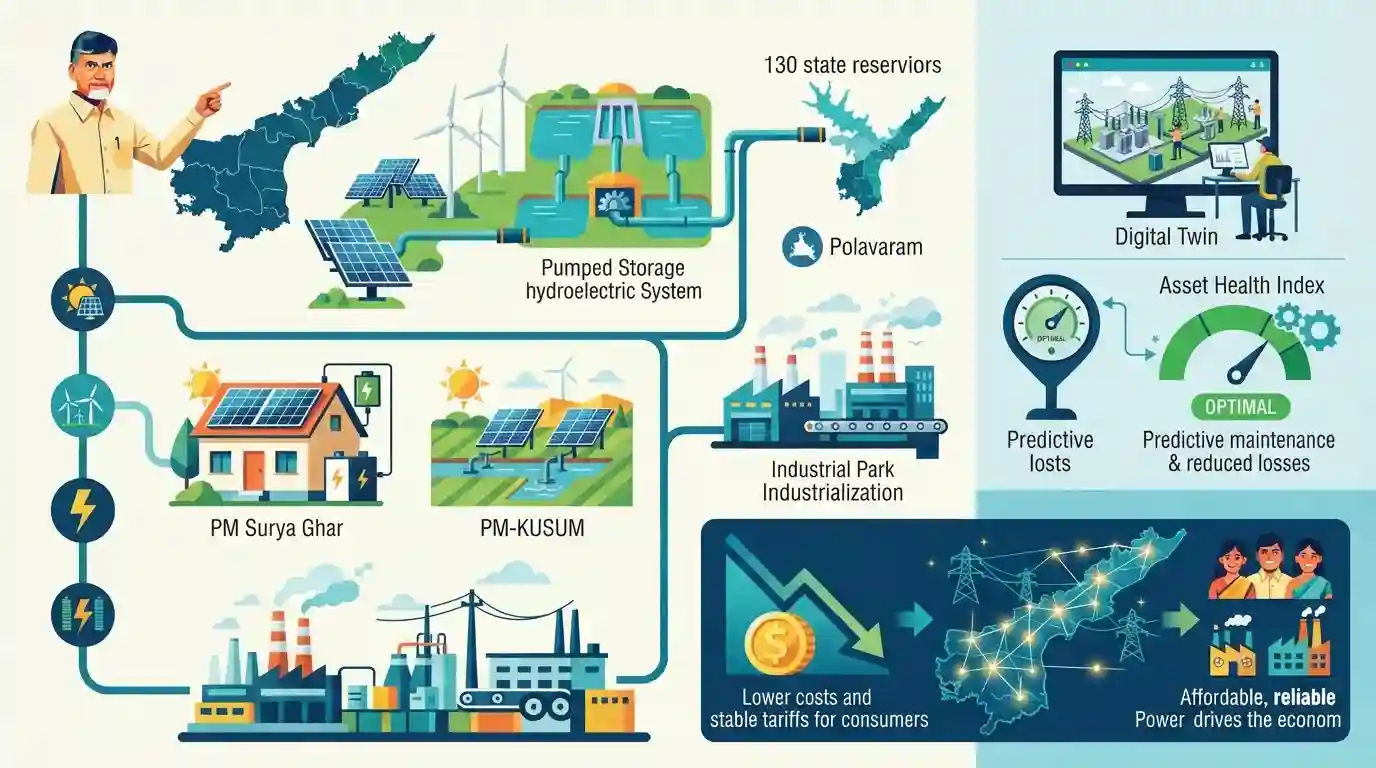
Andhra Pradesh Chief Minister N Chandrababu Naidu has directed state officials to urgently formulate comprehensive plans for expanding power generation capacity to meet the demands of rapid industrialization. Emphasizing a shift towards renewable and reliable energy, the government plans to integrate solar, wind, and pumped storage projects, specifically exploring pumped storage at 130 state reservoirs including Polavaram. The State aims to vigorously implement central programs such as PM Surya Ghar and PM-KUSUM to boost solar rooftop installations and agricultural solar capacity. Furthermore, power utilities are set to adopt cutting-edge 'Digital Twin' and 'Asset Health Index' technologies to optimize grid performance, reduce distribution losses, and ensure the state can provide power at a lower cost without increasing consumer tariffs.
Key Points
- Andhra Pradesh expects electricity consumption to double every six years due to rapid industrialization, prompting a comprehensive plan to increase generation capacity.
- The State plans to study the feasibility of establishing Pumped Storage Hydroelectric Projects across 130 reservoirs, including the Polavaram project.
- Ambitious targets have been set under central schemes: reaching 6 lakh connections by September under PM Surya Ghar and seeking an additional 2000 MW capacity under the PM-KUSUM scheme.
- Advanced digital solutions, such as 'Digital Twin' and 'Asset Health Index' systems, are being adopted by state power utilities to proactively manage equipment health and reduce distribution losses.
- The CM emphasized integrating solar, wind, and pumped storage resources to reduce the average power purchase cost to Rs 4 per unit by 2029 without hiking consumer tariffs.
Important Terms
PM Surya Ghar Muft Bijli Yojana

A central government scheme offering financial subsidies for installing residential rooftop solar systems, aiming to provide up to 300 units of free electricity per month to 1 crore households.
UPSC context
GS-3 (Energy, Infrastructure). Important for India's renewable energy decentralization, reducing grid dependence, and achieving net-zero emission targets.
PM-KUSUM Scheme
A national initiative providing subsidized standalone solar agricultural pumps and solarizing grid-connected pumps. It enhances farmers' income by allowing them to sell surplus solar power back to the grid.
UPSC context
GS-3 (Agriculture, Energy, Environment). Tests the nexus between rural energy security, reducing agricultural diesel dependency, and doubling farmers' income.
Pumped Storage Projects (PSP)
A hydroelectric energy storage system that pumps water to an upper reservoir using surplus electricity, and releases it through turbines to generate power during peak electricity demand.
UPSC context
GS-3 (Energy Infrastructure). Crucial for maintaining grid stability and addressing the intermittency of renewable energy sources like wind and solar.
Digital Twin Technology
An advanced technology that creates a continuously synchronized virtual replica of a physical asset or system. In power grids, it uses AI and real-time data for simulation and predictive maintenance.
UPSC context
GS-3 (Science & Technology, Infrastructure). Tests awareness of emerging digital technologies (Industry 4.0) optimizing public infrastructure and resource management.
Asset Health Index (AHI)
A composite metric used by utilities to evaluate the real-time condition, performance, and remaining useful life of infrastructure equipment, enabling predictive maintenance rather than reactive repairs to prevent failures.
UPSC context
GS-3 (Infrastructure). Relevant for understanding modernization reforms in power distribution companies (DISCOMs) to minimize aggregate technical and commercial (AT&C) losses.
Prelims Trap
"Pumped storage hydroelectric projects act as net power generators adding surplus base-load to the grid."
PSH acts as a massive energy storage system (a battery), not a net generator. Due to efficiency losses, it consumes more energy during pumping than it generates.
Static Concepts Connected
How does Pumped Storage Hydroelectricity (PSH) work and why is it crucial?
- Mechanism: Water is pumped to an upper reservoir during low demand (using cheap surplus power) and released to generate power during peak demand.
- Grid balancing: It acts as a massive utility-scale battery, smoothing out the intermittency of solar and wind power to ensure grid stability.
- Energy dynamics: It is a net consumer of electricity due to pumping losses, but essential for peaking power and frequency regulation.
What are the three core components of the PM-KUSUM scheme?
- Component A: Setting up decentralized, ground-mounted, grid-connected renewable power plants (up to 2 MW) on barren/fallow land by farmers.
- Component B: Installation of standalone, off-grid solar agriculture pumps to replace diesel pumps in off-grid areas.
- Component C: Solarization of existing grid-connected agriculture pumps, allowing farmers to use solar power and sell surplus to DISCOMs.
Cross-Topic Patterns
Smart Grids & DISCOM revival
Integrating 'Digital Twins' reflects the shift from purely financial DISCOM bailouts (like UDAY) to tech-driven operational efficiency (RDSS) to curb India's persistently high AT&C losses.
Water-Energy Nexus & Multipurpose Projects
Leveraging existing large reservoirs like Polavaram for Pumped Storage highlights the growing water-energy nexus, maximizing infrastructure utility for grid stability without triggering new ecological clearance burdens.

Expect a multi-statement question linking grid stability, Pumped Storage Hydro mechanics, and PM-KUSUM components in 2026 Prelims.
Linked PYQs · 3
Linked PYQs · 3
- 2024APPSC_PRELIMSGS1
The Interim Union Budget (FY25) has proposed initiatives to boost India's Green Energy Sector. Which of the following proposals are connected with developing India's Green Energy ? I. Viability Gap Funding (VGF) for utilizing solar energy projects II. To set up coal gasification and liquefaction capacity of 100MT by 2030 III. Optional blending of Compressed Bio Gas (CBG) in Compressed Natural Gas (CNG) for transport and Piped Natural Gas (PNG) for domestic purposes IV. Provision of financial assistance for procurement of biomass aggregation machinery V. Setting up of a payment security system for expanding the bio-manufacturing system in the country Select the correct answer using the codes given below :
- 2024APPSC_PRELIMSGS1
Which of the following statement/statements is/are incorrect regarding the Andhra Pradesh Industrial Policy 2023 - 27? I. To achieve a minimum contribution of 25% by industry in the State GDP II. To provide end-to-end facilitation in 2 weeks III. To envisage ten (10) priorities of accomplishment IV. To focus on becoming a 'Plug and Play State' for investments V. Ensuring land allotment by APIIC within a period of 2 weeks upon receipt of application Select the answer using the codes given below :
- 2024APPSC_PRELIMSGS1
Which of the following statements are valid in connection with Andhra Pradesh Green Hydrogen and Green Ammonia Policy (2023)? I. The objective is to target Green Energy production up to the capacity of 1 MPTA (Million Tonnes Per Annum) or Green Ammonia production up to the capacity of 2-0 MTPA in the next five years. II. New and Renewable Energy Development Corporation of A.P. Ltd (NREDCAP) shall act as a Nodal Agency under this policy. III. All the Ports in the State have infrastructure for storing liquid nitrogen which can then be utilized for storing Green Hydrogen for exporting to other countries. IV. The Policy prohibits the production of Green Hydrogen/Green Ammonia by using Renewable Energy and/or Biomass from 'Third-Party/Power exchange'. Select the correct answer using the codes given below :
