Uttarakhand Anti Copying Law Applied in University Paper Leak Arrest
Source:ommcomnews ↗
Why It Matters
It highlights a major governance measure taken by the Uttarakhand state government to curb corruption in the recruitment process through stringent legislation, which is highly relevant for state-specific policy and administration topics in UKPSC exams.
Summary
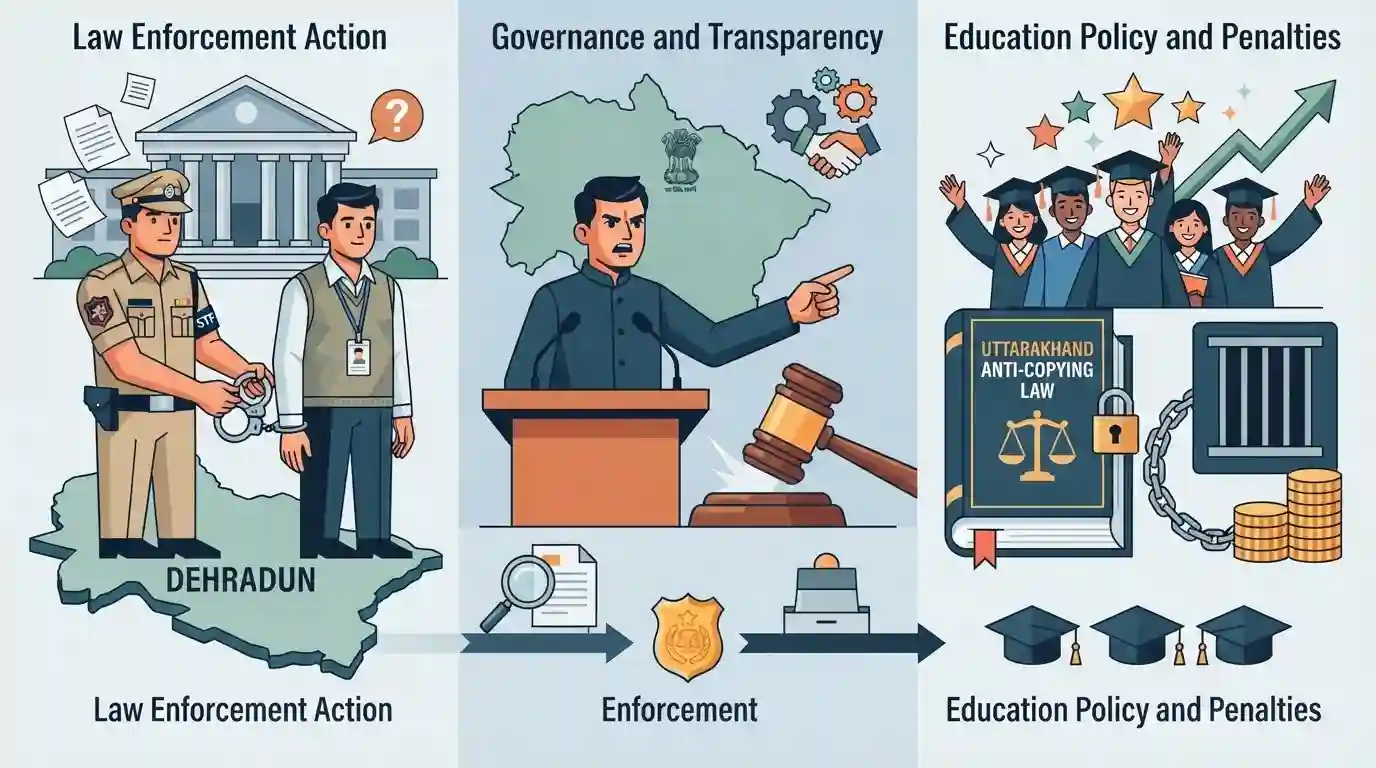
An assistant professor was arrested in Dehradun by the Special Task Force (STF) for involvement in the UTU paper leak case under Uttarakhand's strict Anti-Copying Law. Chief Minister Pushkar Singh Dhami emphasized the state's zero-tolerance policy toward exam irregularities, affirming the government's commitment to securing a fair future for the youth. The anti-copying law, heralded as the country's strictest, includes severe penalties such as life imprisonment and hefty fines.
Key Points
- An assistant professor was arrested by the STF in Dehradun in connection with the Uttarakhand Technical University (UTU) paper leak case.
- The arrest was made under Uttarakhand's stringent new anti-copying law, showcasing the state's severe crackdown on examination malpractices.
- Chief Minister Pushkar Singh Dhami reiterated the state's zero-tolerance policy towards corruption and compromises involving the youth's future.
- The Uttarakhand anti-copying law is considered the strictest in the country, featuring provisions for life imprisonment, fines up to Rs 10 crore, and making the offense cognizable and non-bailable.
Important Terms
Uttarakhand Anti-Copying Law (2023)

Formally the Uttarakhand Competitive Examination Act, 2023, this strict state legislation penalizes recruitment exam malpractices with severe punishments, including up to life imprisonment and multi-crore fines for organized conspirators.
UPSC context
Relevant to GS-II (State Legislation; Governance) as a strict policy mechanism ensuring transparency and meritocracy in public recruitment.
Special Task Force (STF)
Elite, specialized police units constituted by individual Indian state governments to handle complex threats like organized crime, terrorism, and sophisticated cheating mafias, operating beyond standard district policing capabilities.
UPSC context
Crucial for GS-III (Internal Security), illustrating the role of specialized law enforcement bodies in dismantling organized, inter-state criminal syndicates.
Uttarakhand Technical University (UTU)
Officially Veer Madho Singh Bhandari Uttarakhand Technical University, it is a state technical university in Dehradun that faced exam cancellations and arrests following a highly publicized paper leak scandal.
UPSC context
Serves as a contemporary case study for GS-II (Education; Governance) highlighting vulnerabilities in institutional examination integrity and institutional accountability.
Prelims Trap
The Public Examinations (Prevention of Unfair Means) Act, 2024, automatically governs all state public service commission exams.
The Central Act of 2024 applies only to central bodies (like UPSC, SSC, NTA, IBPS, and Railways). State competitive exams are governed by respective state laws, not the Central Act, unless a state formally adopts it.
Static Concepts Connected
What is the constitutional division of power regarding education and state exams?
- Concurrent List: Education, including technical and university education, falls under the Concurrent List (Entry 25), allowing both Centre and States to legislate.
- State List: State public services and State Public Service Commissions fall under the exclusive legislative domain of States (Entry 41).
What do cognizable, non-bailable, and non-compoundable mean in criminal law?
- Cognizable: Police can arrest the accused without a warrant and initiate investigations without prior court authorization.
- Non-Bailable: Bail is not an absolute right; its grant remains subject to judicial discretion based on case gravity.
- Non-Compoundable: The charges cannot be dropped through a mutual compromise or out-of-court settlement between parties.
Cross-Topic Patterns
Recruitment delays and demographic dividend
Frequent paper leaks delay state recruitments, leading to age-barring of aspirants and compounding educated youth unemployment.
Technology in public examinations
To prevent institutional collusion, states are shifting to computer-based testing, AI-proctoring, and secure digital question paper transmission systems.

2026 GS2 may compare the Central Public Examinations Act, 2024 with state laws on candidate exemptions and jurisdictional limits.
Linked PYQs · 2
Linked PYQs · 2
- 2025UKPSC_PRELIMSGS1
Consider the following statements with reference to Uttarakhand and choose the correct answer: 1. The executive of Uttarakhand includes Governor as the head of the state. 2. It also includes the Chief Minister and his/her council of ministers.
- 2025UKPSC_PRELIMSGS1
Consider the following statements about Uttarakhand Human Rights Commission and choose the correct option from the options given below: 1. Uttarakhand Human Rights Commission came into existence on May 13, 2013. 2. The objectives of UHRC was to bring about greater accountability and transparency in governance.
