Uttarakhand Pollution Control Board Plastic Free Campaign
Source:newsarenaindia ↗
Why It Matters
This article is highly relevant for UKPSC Prelims as it covers both national biodiversity milestones (India's 70% share of global tigers, International Tiger Day) and Uttarakhand-specific environmental governance (efforts by the State Pollution Control Board to ban single-use plastics). It highlights the delicate balance between ecology and economy in a vulnerable Himalayan ecosystem, a recurring theme in state civil service examinations.
Summary
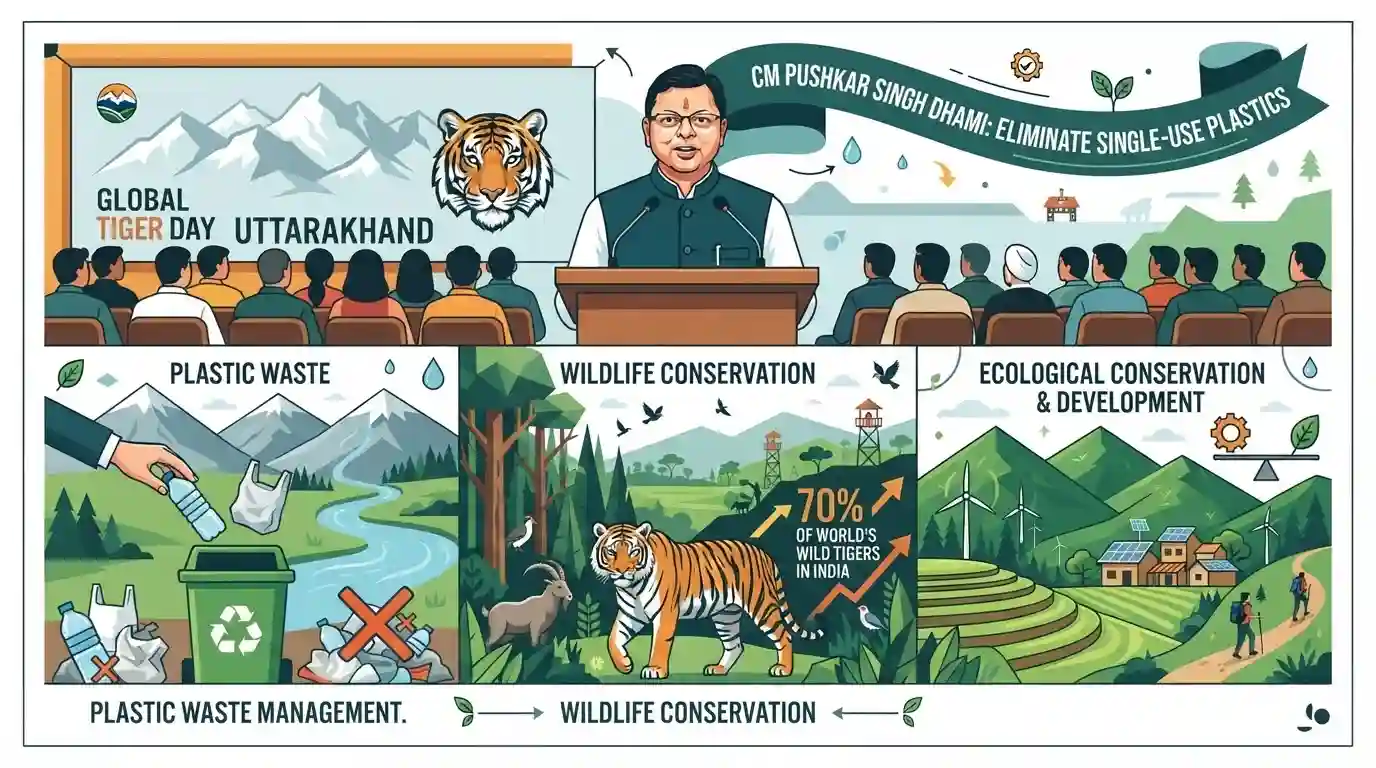
On Global Tiger Day, Uttarakhand Chief Minister Pushkar Singh Dhami urged the public to completely eliminate single-use plastics to protect the state's environment and wildlife. Speaking at a workshop hosted by the Uttarakhand Pollution Control Board, he emphasized the critical need to balance ecological conservation with economic development in the Himalayan state. Dhami also highlighted India's success in tiger conservation, noting that the country hosts approximately 70% of the world's wild tiger population, an achievement closely linked to robust forest preservation efforts.
Key Points
- Uttarakhand Chief Minister Pushkar Singh Dhami addressed a state-level workshop on Global Tiger Day, urging strict enforcement of the ban on single-use plastics.
- The event was organized by the Uttarakhand Pollution Control Board to combat plastic pollution and promote environmental conservation.
- Dhami highlighted the necessity of balancing the state's economy with its fragile Himalayan ecology.
- The CM noted the critical role of forest preservation in protecting wildlife, pointing out that India is home to nearly 70% of the global wild tiger population.
Important Terms
Project Tiger

A Centrally Sponsored Scheme launched in 1973 by the Ministry of Environment, Forest and Climate Change to protect endangered tigers by establishing dedicated tiger reserves across India.
UPSC context
GS Paper 3 (Biodiversity). Tests knowledge of in-situ conservation schemes, the role of NTCA, and species recovery efforts.
Single-Use Plastic Ban
A nationwide prohibition enforced from July 1, 2022, under the Plastic Waste Management Rules, banning the manufacture, import, distribution, and use of identified single-use plastic items with high littering potential.
UPSC context
GS Paper 3 (Environment). Tests understanding of waste management regulations, Extended Producer Responsibility (EPR), and pollution control.
Uttarakhand Pollution Control Board (UKPCB)
A statutory body established under the Water Act (1974) and Air Act (1981) to implement environmental laws, control emissions, and enforce regulations like the single-use plastic ban in Uttarakhand.
UPSC context
GS Paper 2 (Statutory Bodies) & GS Paper 3. Tests the institutional framework for state-level environmental regulation and enforcement.
Global Tiger Day
An annual event observed on July 29 to promote a global system for protecting the natural habitats of tigers and to raise public awareness for tiger conservation issues.
UPSC context
Prelims & GS Paper 3 (Environment). Tests awareness of key international environmental dates, wildlife conservation, and India's global leadership role.
Prelims Trap
State Pollution Control Boards are established under the Environment (Protection) Act, 1986.
SPCBs and the CPCB were established under the Water (Prevention and Control of Pollution) Act, 1974, though they enforce rules under the EPA 1986.
Static Concepts Connected
What is the Core-Buffer strategy under the Wildlife (Protection) Act?
- Core Zone: Inviolate areas strictly for wildlife conservation, kept free from human settlements, biotic disturbances, and forestry operations.
- Buffer Zone: Peripheral areas promoting coexistence between wildlife and local communities, allowing regulated forest resource use.
- Legal Backing: Delineated under the Wildlife (Protection) Act, 1972 on the basis of scientific and objective criteria.
How are single-use plastics regulated under Indian law?
- Nodal Legislation: Governed by the Plastic Waste Management Rules under the Environment (Protection) Act, 1986.
- Thickness Mandate: Plastic carry bags must currently be at least 120 microns thick to facilitate collection and recycling.
- EPR Framework: Extended Producer Responsibility (EPR) mandates producers, importers, and brand owners to manage their end-of-life plastic waste.
Cross-Topic Patterns
Carrying Capacity of Hill Stations
The accumulation of SUPs in Himalayan tiger reserves underscores the conflict between mass ecotourism and fragile topography, aligning with recent Supreme Court queries on the carrying capacity of Himalayan states.
Microplastics in Terrestrial Food Webs
Single-use plastic degradation in forest buffers leads to soil microplastics, potentially causing endocrine disruption in herbivores and bioaccumulating in apex predators like tigers.

Expect a 2026 mixed-statement question linking Project Tiger's statutory backing (NTCA) with the enforcement agency for the SUP ban (SPCB).
Linked PYQs · 4
Linked PYQs · 4
- 2024UKPSC_PRELIMSGS1
Which of the following National Park of Uttarakhand has been included in Project Tiger Scheme in 2015 ?
- 2025UKPSC_PRELIMSGS1
Consider the following statements and select the correct answer from the options given below : Statement 1 : Uttarakhand is highly vulnerable to climate change. Statement 2 : Climate change is causing water stress and depleting biodiversity in Uttarakhand.
- 2021UKPSC_PRELIMSGS1
In which year 'The Air (Prevention and Control of Pollution) Act was enacted?
- 2025UKPSC_PRELIMSGS1
Match the items given in Column-I and II : | Column-I | Column-II | |---|---| | A. Biomagnification | 1. Synthesis of ozone | | B. Electrostatic precipitation | 2. Solid waste | | C. Landfills | 3. Concentration build up at successive trophic levels | | D. Stratosphere | 4. Particulate matter | Codes : A B C D
