Uttarakhand Focuses On Green Energy And Agricultural Development
Source:humaaribaat ↗
Why It Matters
For the UKPSC PCS Prelims, understanding state-specific policies, exact locations of solar power initiatives (Malna, Uttarkashi), and venues of major events (Lohia Head Ground, Pantnagar) is crucial. These topics directly align with the state economy, geography, and rural development syllabus.
Summary
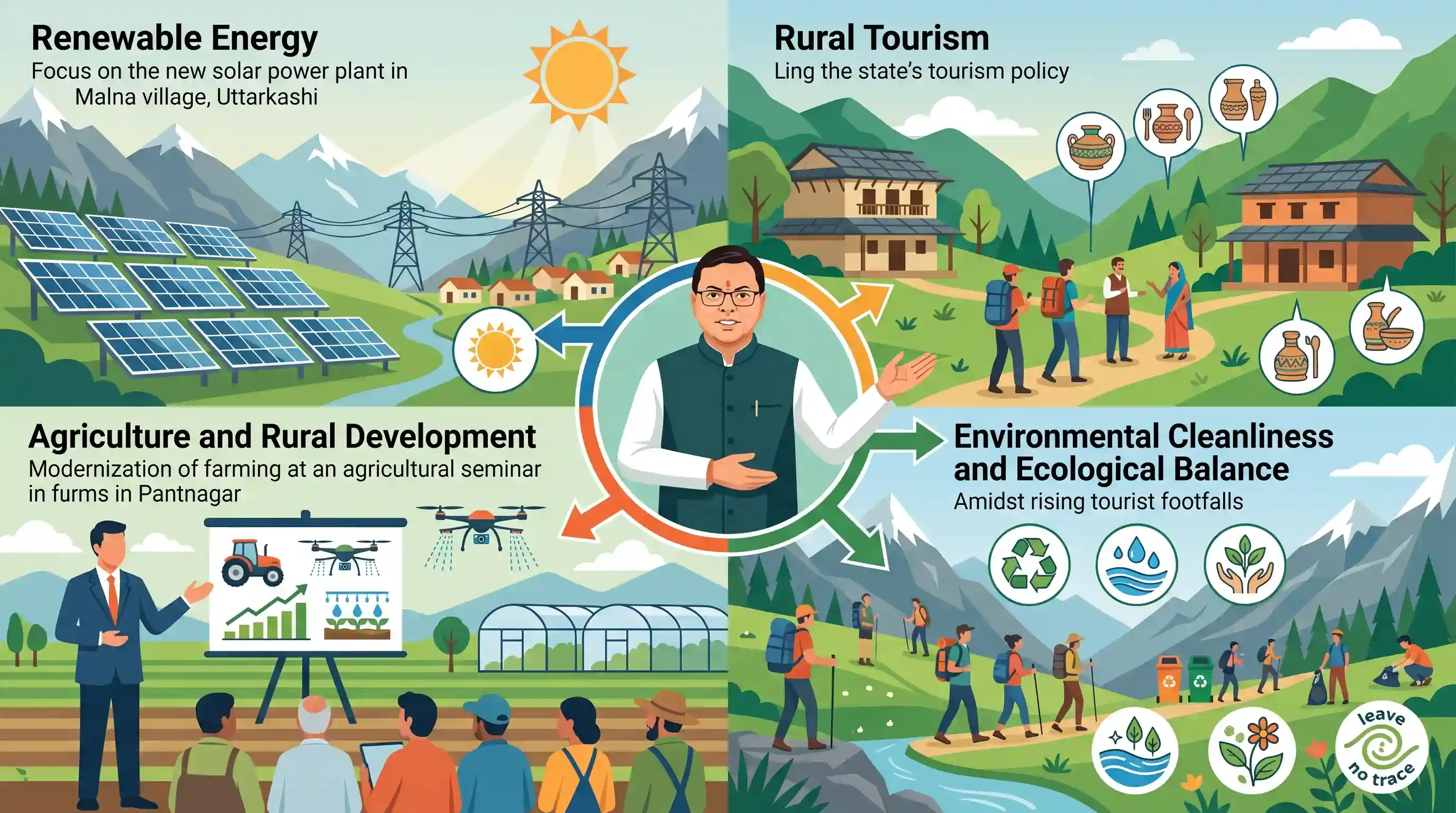
This article details the multi-dimensional development initiatives launched by Uttarakhand Chief Minister Pushkar Singh Dhami. These initiatives focus on the promotion of green energy through a new solar power plant in Malna village (Uttarkashi), bolstering rural tourism via the state's tourism policy, and modernizing farming at an agricultural seminar in Pantnagar. Additionally, it highlights the need for maintaining environmental cleanliness and ecological balance amid rising tourist footfalls.
Key Points
- A new solar power plant has been established in Malna village, located in the remote Uttarkashi district, to support green energy goals and rural electrification.
- Uttarakhand's tourism policy is actively being utilized to boost rural tourism, open up self-employment opportunities, and elevate the economy of small mountain villages.
- An agricultural seminar and exhibition was inaugurated by CM Pushkar Singh Dhami at the Lohia Head Ground in Pantnagar to connect farmers with advanced technologies and modern cultivation techniques.
- The editorial perspective emphasizes the urgent need for a zero-tolerance policy against littering and pollution to preserve Uttarakhand's unique spiritual and ecological landscape amidst expanding tourism.
Important Terms
Uttarakhand Tourism Policy 2023

A policy operational until 2030 aimed at boosting sustainable tourism, developing new destinations, and attracting private investments through regional subsidies and stamp duty exemptions.
UPSC context
GS Paper III (Economy and Infrastructure); tests regional development, sustainable tourism strategies, and infrastructure creation in fragile ecosystems.
Carrying Capacity
The maximum population size, tourist footfall, or developmental pressure an ecosystem can sustainably support without causing significant degradation or long-term ecological damage.
UPSC context
GS Paper I & III (Geography & Environment); tests ecological conservation, sustainable urbanization, and disaster mitigation in vulnerable terrains.
G.B. Pant University of Agriculture and Technology
India's first agricultural university, established in 1960 in Pantnagar, which pioneered high-yielding variety seed testing and served as a crucial hub for the Green Revolution.
UPSC context
GS Paper III (Agriculture); tests the history of the Green Revolution, modern agro-technology transfer, and institutional contributions to food security.
Renewable Energy in Himalayan States
Clean energy generation (primarily hydro and solar) adapted for mountainous regions to foster rural electrification, reduce carbon emissions, and build climate resilience in eco-sensitive zones.
UPSC context
GS Paper III (Infrastructure and Energy); tests clean energy transition, challenges of infrastructure building in complex terrains, and sustainable development.
Prelims Trap
The mountainous region of Uttarakhand, covering 86% of its territory, accounts for the majority of the state's net sown agricultural area.
While 86% of Uttarakhand is mountainous, agriculture is heavily concentrated in the 14% plains (mainly Udham Singh Nagar), which host the majority of net sown area.
Static Concepts Connected
What are the ecological and economic features of Hill Agriculture in India?
- Structural limitations: Physiographic constraints limit modern mechanization due to steep slopes, high soil erosion vulnerability, rainfed farming, and tiny, fragmented landholdings.
- Resilient systems: Traditional practices like 'Baranaja' (growing 12 crops together) provide ecological resilience and food security, though commercial yields remain low.
- Socio-economic impact: Low agricultural productivity in steep mountain terrains drives youth out-migration, creating 'ghost villages' and demographic shifts to plains.
What is 'Carrying Capacity' in the context of sustainable mountain tourism?
- Carrying Capacity: It is the biophysical threshold beyond which an ecosystem's resources degrade and cannot support further human or tourism activities sustainably.
- Eco-tourism Framework: Ministry of Tourism's guidelines advocate community-led, low-impact tourism to preserve biodiversity while creating localized economic opportunities.
- Solid waste crisis: High tourist footfalls outpace waste processing capacity in fragile terrains, leading to critical plastic pollution in major river sources.
Cross-Topic Patterns
Himalayan Ecology vs. Mass Tourism
Links GS-3 environmental conservation with tourism economics, highlighting how rising tourist footprint overstretches the carrying capacity of ecologically fragile mountain corridors.
Intra-state Economic Divergence
Analyzes the developmental disparity between highly mechanized agricultural plains and subsistence-driven hill economies, driving regional migration patterns.

Mains 2026 may ask to evaluate the ecological 'carrying capacity' of Himalayan states balancing tourism-led GSDP growth with fragile terrain safety.
Linked PYQs · 4
Linked PYQs · 4
- 2024UKPSC_PRELIMSGS1
UTDB is established in Uttarakhand to promote:
- 2025UKPSC_PRELIMSGS1
Which of the following districts of Uttarakhand has the highest agricultural land ?
- 2016UKPSC_PRELIMSGS1
The biggest Hydro-Electric Project of Uttarakhand State is:
- 2025UKPSC_PRELIMSGS1
Consider the following statements and select the correct answer from the options given below : Statement 1 : Uttarakhand is highly vulnerable to climate change. Statement 2 : Climate change is causing water stress and depleting biodiversity in Uttarakhand.
