Uttarakhand Sanctions Two Hundred Eighty Nine Crore for Infrastructure
Source:indian-masterminds ↗
Why It Matters
The financial sanction highlights the dual focus of the Uttarakhand government on modern urban/academic infrastructure and critical ecological/disaster management, which is highly relevant given the state's severe vulnerability to natural hazards and human-wildlife conflicts.
Summary
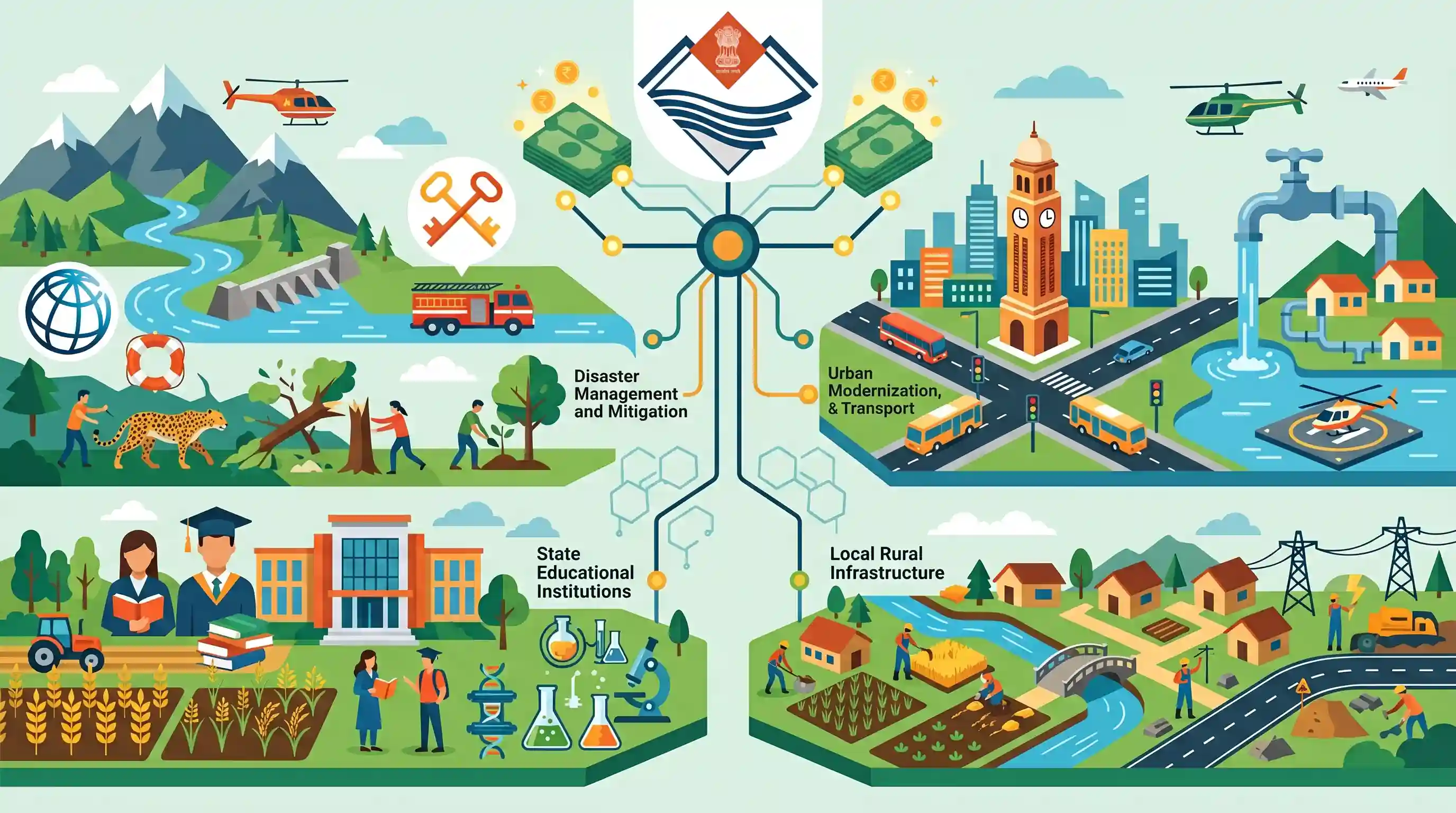
Uttarakhand Chief Minister Pushkar Singh Dhami has approved ₹289 crore to finance a wide array of developmental, transport, and disaster-relief projects across the state. Major highlights of this allocation include ₹75 crore for the World Bank-assisted disaster management project 'U-PRIEP', ₹30 crore under the SDRF for human-wildlife conflict and ecological damages, and ₹75 crore for Govind Ballabh Pant University of Agriculture and Technology. The developmental drive also supports urban modernization in Dehradun, drinking water schemes in Mussoorie, aviation safety at Sahastradhara helipad, and local rural infrastructure.
Key Points
- Chief Minister Pushkar Singh Dhami sanctioned ₹289 crore for state-wide infrastructure, transport, aviation, and disaster mitigation projects.
- ₹75 crore has been sanctioned for the World Bank-assisted disaster management project 'U-PRIEP' to enhance relief and infrastructure.
- ₹30 crore under the State Disaster Response Fund (SDRF) is earmarked for compensation against human-wildlife conflicts, crop damage, house damage, and livestock loss.
- Govind Ballabh Pant University of Agriculture and Technology, Pantnagar received a ₹75 crore first installment (of a ₹150 crore total package) for academic research and infrastructure.
- Dehradun city's traffic modernization, road safety, and junction improvements received ₹33.45 crore, alongside a ₹2.81 crore project to supply treated STP water to Rashtrapati Ashiana.
- Other notable allocations include ₹4.24 crore for Mussoorie's drinking water scheme, ₹5 crore for a 33/11 kV power substation in Gangolihat, and road connectivity improvements near the Khakra Crocodile Trail in Khatima.
Important Terms
State Disaster Response Fund (SDRF)

The primary fund available to Indian states, constituted under the Disaster Management Act, 2005, to provide immediate financial relief during centrally notified disasters.
UPSC context
GS Paper 3 (Disaster Management). Tests intergovernmental fiscal relations, relief mechanisms, and disaster mitigation strategies.
Govind Ballabh Pant University of Agriculture and Technology
India's first agricultural university, established in Pantnagar, Uttarakhand, in 1960. It was inaugurated by Jawaharlal Nehru and is considered the harbinger of India's Green Revolution.
UPSC context
GS Paper 3 (Agriculture). Tests agricultural education, institutional research, and the history of India's Green Revolution.
Jawahar Navodaya Vidyalaya
A system of central residential schools established under the National Policy on Education, 1986, to provide high-quality modern education to talented children, predominantly from rural areas.
UPSC context
GS Paper 2 (Education/Social Justice). Tests government schemes for human resource development, educational equity, and rural-urban integration.
Uttarakhand Civil Aviation Development Authority
A state authority established in 2013 to develop sustainable aviation infrastructure, facilitate regional air connectivity, and manage crucial helicopter rescue flights during mountain disasters.
UPSC context
GS Paper 3 (Infrastructure/Disaster Management). Tests aviation policy, regional connectivity schemes, and the utility of air rescue in mountainous terrains.
U-PRIEP
A World Bank-assisted disaster management project in Uttarakhand designed to reinforce relief systems, construct climate-resilient infrastructure, and enhance rehabilitation support for affected communities.
UPSC context
GS Paper 3 (Disaster Management). Tests multilateral aid models, climate-resilient development, and state-level disaster rehabilitation frameworks.
Prelims Trap
Human-Wildlife Conflict is a federally notified natural disaster under the national guidelines of the Disaster Management Act, 2005.
While states like Uttarakhand have declared HWC a "state-level disaster" to utilize SDRF funds, it is not on the central list of notified disasters under the DM Act, 2005. States utilize a 10% discretionary quota for local disasters.
Static Concepts Connected
What is the State Disaster Response Fund (SDRF) and how is it financed?
- Statutory Basis: SDRF is established under Section 48(1)(a) of the Disaster Management Act, 2005, as the primary fund available to State Governments for responding to notified disasters.
- Funding Split: The Central Government contributes 75% for general category states and 90% for special category states (hilly/Himalayan states like Uttarakhand).
- State-Specific Disasters: States can use up to 10% of their annual SDRF allocation for state-specific disasters not on the Union's disaster list, subject to MHA approval.
What are the official Presidential Retreats of India and their geographical significance?
- The Three Retreats: Rashtrapati Nilayam in Hyderabad (Telangana), Rashtrapati Niwas in Shimla (Himachal Pradesh), and Rashtrapati Ashiana in Dehradun (Uttarakhand).
- National Integration: They represent democratic and national integration, symbolizing the President’s presence and reach across the southern, northern, and Himalayan regions of India.
- Historical Status: These properties belong entirely to the state and are historically linked to the colonial era, such as the Viceregal Lodge in Shimla and the Commandant's Bungalow in Dehradun.
Cross-Topic Patterns
Green Revolution + Agrarian Institutions
GBPUAT's development of high-yielding seeds connects the evolution of state agricultural universities directly to GS-3 technology missions and the institutional history of the Green Revolution.
Wildlife Conservation + Eco-Tourism Models
The Kakra Crocodile Trail showcases how local eco-entrepreneurship models reconcile the protection of Vulnerable Muggers (Schedule I) with tourism, bridging conservation and local economic development.

SDRF financing rules for state-specific disasters vs. central disaster lists likely to feature in a comparative 2026 prelims question.
Linked PYQs · 2
Linked PYQs · 2
- 2025UKPSC_PRELIMSGS1
Consider the following statements and select the correct answer from the options given below : Statement 1 : Uttarakhand is highly vulnerable to climate change. Statement 2 : Climate change is causing water stress and depleting biodiversity in Uttarakhand.
- 2025UKPSC_PRELIMSGS1
Consider the following statements and select the correct answer from the options given below : Statement 1 : The State Council for Climate Change (SCCC) of Uttarakhand was established in the year 2011. Statement 2 : The responsibility of preparing Uttarakhand Action Plan on Climate Change (UAPCC) was given to the State Revenue Department.
