Ekal Mahila Swarojgar Yojana Phase Two Launched in Uttarakhand
Source:indianmasterminds ↗
Why It Matters
Specific state government schemes, particularly those targeting vulnerable groups like single women and initiatives like the Uniform Civil Code (UCC), are core topics for the UKPSC PCS Prelims. Understanding the beneficiaries, financial outlays (e.g., 75% subsidy), and related schemes (like Lakhpati Didi) is highly testable.
Summary
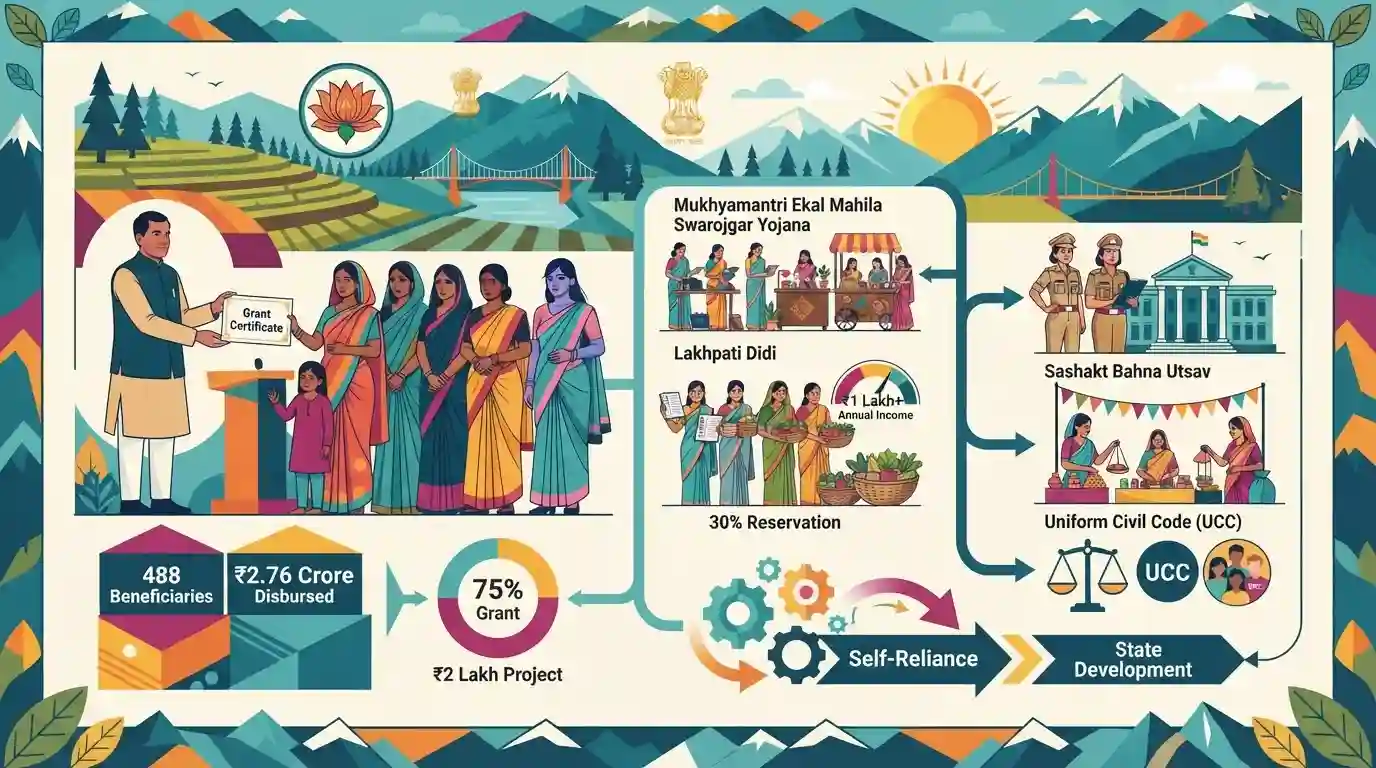
Uttarakhand Chief Minister Pushkar Singh Dhami has launched the second phase of the 'Mukhyamantri Ekal Mahila Swarojgar Yojana', a scheme designed to empower single women, including widows, destitute, divorced, acid attack survivors, and transgender persons. Under this phase, 488 beneficiaries received ₹2.76 crore to start self-employment ventures. The state provides a 75% grant on projects up to ₹2 lakh. Dhami emphasized that empowering women is crucial for state development and highlighted other ongoing initiatives such as the 'Lakhpati Didi' scheme, 30% horizontal reservation for women in state government jobs, the 'Sashakt Bahna Utsav Yojana', and the recent passage of the Uniform Civil Code (UCC) aimed at ensuring equal rights.
Key Points
- Uttarakhand CM Pushkar Singh Dhami launched the second phase of the Mukhyamantri Ekal Mahila Swarojgar Yojana in Dehradun, distributing ₹2.76 crore to 488 single women.
- The scheme aims to make single, widowed, abandoned, divorced women, acid attack survivors, and transgender persons self-reliant by providing project approvals up to ₹2 lakh with a 75% government subsidy.
- Other state women empowerment initiatives include the 'Sashakt Bahna Utsav Yojana', 'Mukhyamantri Udyamshala Yojana', and the 'Lakhpati Didi' scheme (which has already benefited 2.65 lakh women).
- Uttarakhand has also implemented a 30% horizontal reservation for women in government jobs and passed the Uniform Civil Code (UCC) to secure equal rights for women.
Important Terms
Mukhyamantri Ekal Mahila Swarojgar Yojana

A Uttarakhand state scheme promoting self-employment among single, widowed, divorced, and destitute women. It provides a 75% subsidy on business projects up to ₹2 lakh to help them become financially independent.
UPSC context
Important for GS Paper 2 (Welfare Schemes). Tests knowledge of state-level policies targeting vulnerable women's economic empowerment.
Lakhpati Didi
An initiative under DAY-NRLM aiming to empower rural women in Self-Help Groups (SHGs) by enabling them to earn a sustainable annual household income of at least ₹1 lakh through diversified livelihoods.
UPSC context
Highly relevant for GS Paper 2 (SHGs, Poverty Alleviation) and GS 3 (Inclusive Growth). Tests rural development interventions.
Uniform Civil Code (UCC)
A unified legal framework under Article 44 replacing religious personal laws with common rules for marriage, divorce, and inheritance. Uttarakhand recently became the first state in independent India to enact it.
UPSC context
Critical for GS Paper 2 (Polity, DPSP). Highlights debates on constitutional principles, gender justice, and religious freedom.
Sashakt Bahna Utsav Yojana
A Uttarakhand government scheme providing wider market access for local products manufactured by women's Self-Help Groups (SHGs) through the organization of block-level exhibitions and marketing events.
UPSC context
Relevant for GS Paper 2 (Role of SHGs) and State PCS. Tests understanding of market linkage and rural women's empowerment.
Prelims Trap
"The Uttarakhand Uniform Civil Code (UCC) applies uniformly to all residents of the state."
Section 2 of the Uttarakhand UCC Act explicitly exempts Scheduled Tribes (STs) from its provisions to protect their indigenous customary rights.
Static Concepts Connected
What is the difference between horizontal and vertical reservations in India?
- Vertical Reservation: Provided under Article 16(4) for social groups (SC/ST/OBC/EWS). These constitute distinct, non-overlapping quotas.
- Horizontal Reservation: Provided under Article 15(3) for groups like women or PwD. This quota cuts across the vertical categories.
- Interlocking mechanism: Candidates selected under horizontal quotas are adjusted against their respective vertical categories, ensuring overall caps are maintained (Saurav Yadav case).
Can a State Legislature enact a Uniform Civil Code (UCC)?
- Concurrent List: Personal laws (marriage, divorce, inheritance) fall under Entry 5 of the Concurrent List (List III) of the Seventh Schedule.
- State Competence: States can legislate on personal laws, provided they receive Presidential assent under Article 254(2) if the law is repugnant to existing Central laws.
- Directive Principles: While Article 44 envisages a UCC for all citizens throughout India, it does not legally bar state-level codifications.
Cross-Topic Patterns
SHGs and Rural Credit Penetration
Schemes like 'Lakhpati Didi' connect directly to the broader GS3 theme of microfinance, financial inclusion, and the role of Self-Help Groups (SHGs) in poverty alleviation and rural economic restructuring.
Domicile Quotas & Article 16 Constraints
Uttarakhand's 30% horizontal quota for state-domiciled women touches the recurring GS2 debate over state legislative overreach, as only Parliament can constitutionally mandate domicile-based employment quotas under Article 16.

State-level UCCs (Concurrent List) and domicile-based horizontal reservations are highly likely to feature in 2026 Polity Prelims.
Linked PYQs · 3
Linked PYQs · 3
- 2024UKPSC_PRELIMSGS1
How many of the following women M.L.A.s were there in the first Legislative Assembly of Uttarakhand ?
- 2024UKPSC_PRELIMSGS1
As per census 2011, which of the following district of Uttarakhand had lowest female literacy rate ?
- 2025UKPSC_PRELIMSGS1
Arrange the following social welfare schemes in chronological order: i. Integrated Rural Development Programme (IRDP) ii. Rural Employment Generation Programme (REGP) iii. Prime Minister Rojgar Yojana (PMRY) iv. Rural Landless Employment Guarantee Programme (RLEGP)
