Haldwani Ramlila Ground Purification Sparks Caste Controversy
Source:newindianexpress ↗
Why It Matters
The incident touches upon core constitutional values, specifically Article 17 (Abolition of Untouchability), and highlights the socio-political dynamics of caste and gender representation in India, making it relevant for Polity and Social Justice sections in the exam.
Summary
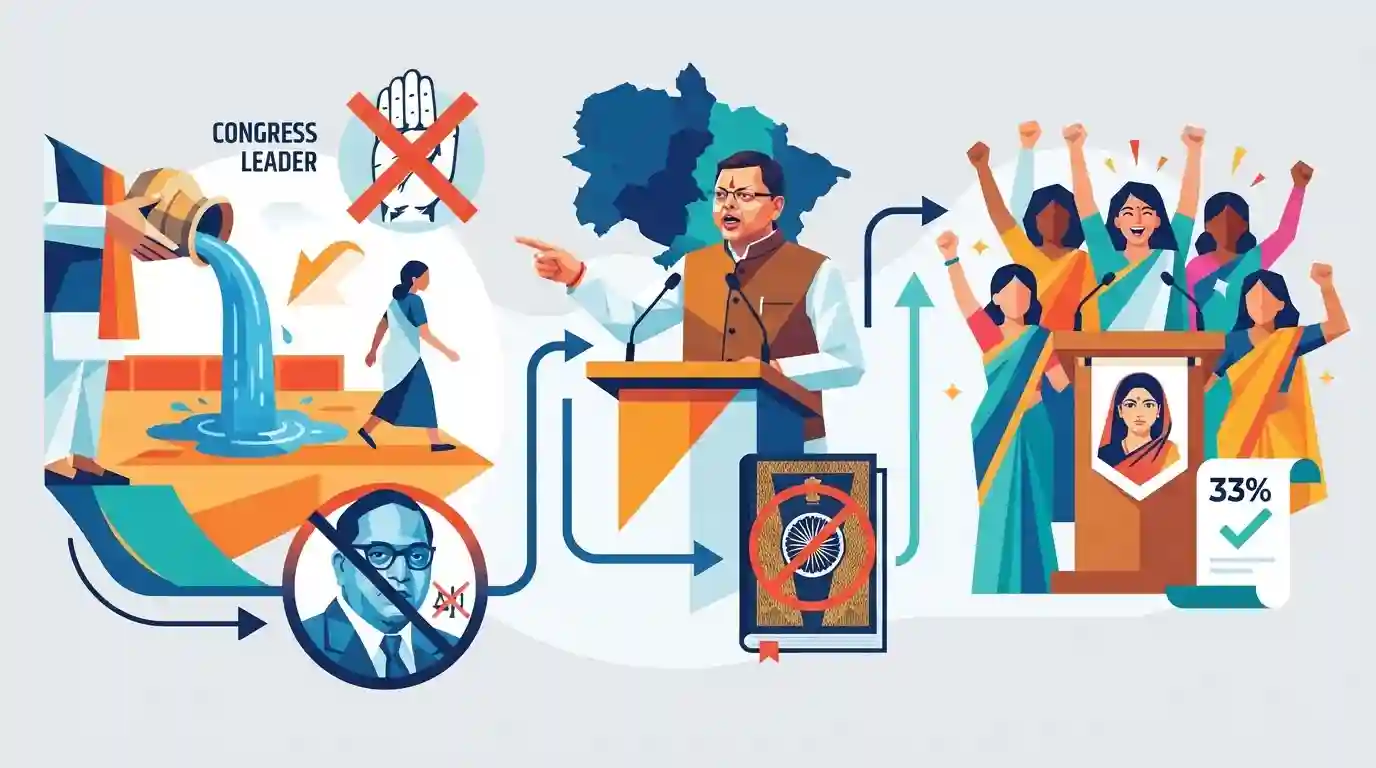
Uttarakhand Chief Minister Pushkar Singh Dhami has heavily criticized the Congress party, accusing it of perpetuating caste discrimination and untouchability. The allegations stem from an incident in Haldwani where a Congress leader reportedly 'purified' the Ramlila ground with Ganga water after a Dalit woman offered prayers there to celebrate the recent passage of the Nari Shakti Vandan Adhiniyam (Women's Reservation Bill). Dhami invoked the constitutional ideals of Dr B R Ambedkar, condemning the act as a regressive insult to Dalits and a violation of the constitutional mandate against untouchability.
Key Points
- Uttarakhand CM Pushkar Singh Dhami accused the Congress party of practicing caste politics over the alleged 'purification' of a Ramlila ground in Haldwani.
- The controversy erupted after a local Congress leader purportedly 'purified' the venue using Ganga water following prayers by a Dalit woman celebrating the passage of the Nari Shakti Vandan Adhiniyam.
- Dhami invoked Dr B R Ambedkar, stating that such actions violate the constitutional principles against untouchability (enshrined in Article 17) and undermine social harmony.
- The incident highlights ongoing political and social tensions regarding caste discrimination and the symbolic representation of marginalized communities in public spaces.
Important Terms
Nari Shakti Vandan Adhiniyam

The Constitution (106th Amendment) Act, 2023, which reserves one-third of seats for women in the Lok Sabha, state legislative assemblies, and the Delhi Assembly, aiming to ensure greater female political representation.
UPSC context
GS Paper 2 (Polity). Tests knowledge of recent constitutional amendments, legislative reservations, and women's empowerment initiatives.
Article 17 of the Constitution
A Fundamental Right under Part III of the Indian Constitution that explicitly abolishes the practice of "untouchability" in any form, making its enforcement a legally punishable offense.
UPSC context
GS Paper 2 (Fundamental Rights). Crucial for questions on social justice, constitutional safeguards, and protecting marginalized communities.
Dr. B.R. Ambedkar
An eminent jurist and social reformer who served as India's first Law Minister and chaired the Constituent Assembly's Drafting Committee, earning the title of "Chief Architect of the Indian Constitution."
UPSC context
GS Paper 1 & 2 (History/Polity). Tests the philosophical foundations of the Constitution and historical social reform movements.
Dalit
A term historically denoting the oppressed or "untouchable" castes in India, now officially categorized as Scheduled Castes (SCs) under the Constitution for affirmative action and statutory protection against discrimination.
UPSC context
GS Paper 2 (Vulnerable Sections). Relevant for understanding caste dynamics, social justice, and laws like the Prevention of Atrocities Act.
Prelims Trap
The Indian Constitution explicitly defines the term 'Untouchability' under Article 17.
Neither the Constitution nor the Protection of Civil Rights Act explicitly defines 'Untouchability'. The judiciary has clarified it refers to historical social disabilities imposed by birth, not literal/temporary boycotts.
Static Concepts Connected
What are the legal mechanisms enforcing Article 17 (Abolition of Untouchability)?
- PCR Act 1955: The Protection of Civil Rights Act, 1955 prescribes punishments for enforcing religious or social disabilities on the ground of untouchability.
- PoA Act 1989: The SC/ST (Prevention of Atrocities) Act, 1989 provides stricter penalties to prevent specific hate crimes and atrocities against marginalized castes.
- Nature of offences: Offences related to untouchability under these acts are considered both cognizable and non-compoundable to ensure strict enforcement.
What are the key provisions of the Nari Shakti Vandan Adhiniyam (106th CAA)?
- 33% Reservation: Inserts Articles 330A and 332A to reserve 33% of seats for women in the Lok Sabha and State Legislative Assemblies respectively.
- Delimitation dependency: The Act mandates that the 33% reservation will come into effect only after a delimitation exercise based on the first census conducted post-enactment.
- Sunset clause: The reservation is granted for an initial period of 15 years, requiring parliamentary extension to continue thereafter.
Cross-Topic Patterns
Women's Reservation intersecting with caste quotas
The 106th Amendment embeds intersectionality by mandating 33% reservation for women explicitly within the already existing SC/ST quotas (under Articles 330 and 332) in legislative bodies.
Art 17's dependence on statutory enforcement
Unlike many Fundamental Rights, Article 17 is not self-executing. It requires specific parliamentary legislation (like the PCR Act, 1955) enacted under Article 35(a)(ii) to prescribe punishments for offences.

Expect a multi-statement question testing the 106th CAA (Nari Shakti) provisions alongside the statutory framework enforcing Article 17.
Linked PYQs · 4
Linked PYQs · 4
- 2005UKPSC_PRELIMSGS1
Which Article of the Constitution of India is related to Untouchability?
- 2025UKPSC_PRELIMSGS1
Which of the following Central Ministries are responsible for the implementation of Protection of Civil Right Rules, 1977 ? 1. Ministry of Home Affairs 2. Ministry of Social Justice | Empowerment 3. Ministry of Minority Affairs 4. Ministry of Tribal Affairs
- 2024UKPSC_PRELIMSGS1
How many of the following women M.L.A.s were there in the first Legislative Assembly of Uttarakhand ?
- 2025UKPSC_PRELIMSGS1
At which place the fourth conference of 'Kumaon Parisad' was held ?
