Maharashtra Proposes Industrial Township Status for MIDC Villages
Source:Indian Express ↗
Why It Matters
The proposal to grant 'Industrial Township' status touches upon Article 243Q of the Indian Constitution, which allows state governors to exempt such industrial areas from having a traditional municipality. This serves as a practical example for UPSC aspirants on how state administrations balance local governance with the ease of doing business and rapid infrastructure development.
Summary
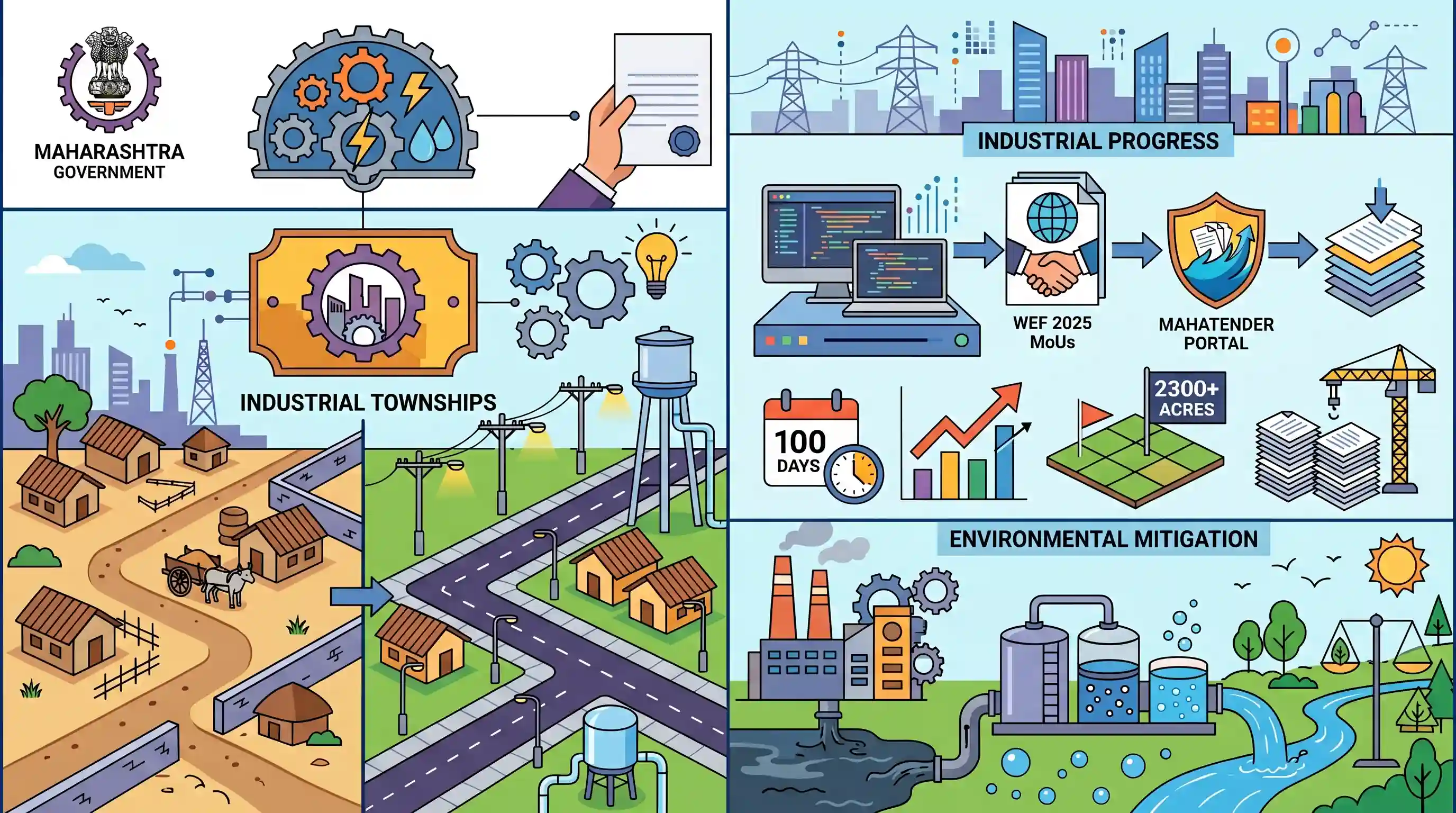
Maharashtra Chief Minister Devendra Fadnavis has mooted a policy to confer 'Industrial Township' status on villages hosting MIDC industrial areas. The move aims to expedite local infrastructure development—such as water, roads, and electricity—by providing specialized governance focus. The state government also reported strong progress on industrial infrastructure and investment, highlighting that 47 industrial MoUs from WEF 2025 are being actively processed via the MahaTender portal. Under a 100-day action plan, land acquisition targets were surpassed at 110%, with over 2,300 acres allotted. Additionally, environmental mitigation efforts were noted with the commissioning of a sewage treatment plant in Butibori.
Key Points
- Maharashtra CM Devendra Fadnavis proposed formulating a policy to grant 'Industrial Township' status to villages with MIDC areas to accelerate local development.
- The status would expedite essential infrastructure projects such as water supply, roads, electricity, and other industrial services.
- The state has achieved 110% of its land acquisition target and allotted 2,346 acres of industrial land under its 100-day action plan.
- Out of 63 MoUs signed at the World Economic Forum 2025, 47 are industrial; land allotment for these is actively progressing via the MahaTender portal.
- A 5 MLD sewage treatment plant has been commissioned at Butibori to support sustainable industrial operations.
Important Terms
Industrial Township (Article 243Q)

A designated urban area where an industrial establishment provides municipal services. Under Article 243Q, the Governor can exempt such areas from forming a traditional municipality.
UPSC context
GS II (Local Self-Government). Relates to the 74th Amendment and administrative flexibility for industrial zones.
Maharashtra Industrial Development Corporation (MIDC)
The nodal agency of the Maharashtra government established in 1962 to develop industrial estates, infrastructure, and parks to attract investment.
UPSC context
GS III (Industrial Policy). A key model for state-led industrialization and Special Planning Authorities.
World Economic Forum (WEF)
An international NGO based in Switzerland that hosts an annual meeting in Davos, facilitating public-private cooperation and global economic diplomacy.
UPSC context
GS II (International Institutions). Tests knowledge of global economic platforms and state-level investment diplomacy.
MahaTender Portal
The official e-procurement system of the Maharashtra government used for transparent bidding, project tracking, and processing industrial MoUs.
UPSC context
GS II (e-Governance). Illustrates ICT use in government transparency and Ease of Doing Business.
Competitive Federalism
A framework where states compete to attract investment through policy reforms, infrastructure, and ease of doing business, driving national economic growth.
UPSC context
GS II (Federalism). Relates to the evolving economic relationship between Indian states and the Centre.
Prelims Trap
Areas declared as 'Industrial Townships' must retain an elected municipal council to govern local infrastructure.
Under Article 243Q, the Governor notifying an area as an 'Industrial Township' explicitly exempts it from forming an elected municipality, as the industrial establishment provides the municipal services.
Static Concepts Connected
What is the Constitutional provision for creating 'Industrial Townships'?
- Article 243Q: Introduced by the 74th Amendment, it generally mandates three types of municipalities but provides a crucial exemption for industrial areas.
- Governor's Notification: The Governor can legally exempt an area from constituting a municipality if an industrial establishment is already providing municipal services.
- Bypassing Elected Bodies: The exemption effectively removes the area from the purview of traditional, elected local self-government, transferring administration to an industrial authority.
How do Common Effluent Treatment Plants (CETPs) support industrial clusters?
- Cost Sharing: CETPs allow small and medium enterprises (SMEs) in industrial estates to share the high capital and operational costs of wastewater treatment.
- Toxicity Neutralization: Unlike regular municipal STPs, CETPs are specially designed to neutralize heavy metals and complex chemical effluents before discharging into rivers.
Cross-Topic Patterns
Industrial Townships vs. Local Democracy
Bypassing Part IX/IXA via Article 243Q creates friction with local panchayats. This mirrors structural governance debates seen in SEZs, Cantonment Boards, and 5th Schedule areas.
E-Governance in Industrial Land Allotment
State portals like MahaTender reflect a national push towards digital land banks (e.g., India Industrial Land Bank) to remove bottlenecks, ensure transparency, and improve Ease of Doing Business.

Expect a Prelims question on Article 243Q exemptions, contrasting the governance of Industrial Townships with Cantonment Boards.
Linked PYQs · 4
Linked PYQs · 4
- 2024MainsGS2
Analyse the role of local bodies in providing good governance at local level and bring out the pros and cons merging the rural local bodies with the urban local bodies.
- 2015MainsGS3
There is a clear acknowledgement that Special Economic Zones (SEZs) are a tool of industrial development, manufacturing and exports. Recognizing this potential, the whole instrumentality of SEZs requires augmentation. Discuss the issues plaguing the success of SEZs with respect to taxation, governing laws and administration.
- 2023MainsGS3
Faster economic growth requires increased share of the manufacturing sector in GDP, particularly of MSMEs. Comment on the present policies of the Government in this regard.
- 2024MainsGS3
Industrial pollution of river water is a significant environmental issue in India. Discuss the various mitigation measures to deal with this problem and also the government's initiatives in this regard.
