District SWAGAT Public Grievance Redressal Review in Gujarat
Source:indianmasterminds ↗
Why It Matters
Technology-driven public grievance redressal platforms (like SWAGAT in Gujarat and PRAGATI at the Central level) are critical examples of e-governance. Understanding these models is highly relevant for questions on transparency, accountability, and the practical implementation of citizen-centric administration.
Summary
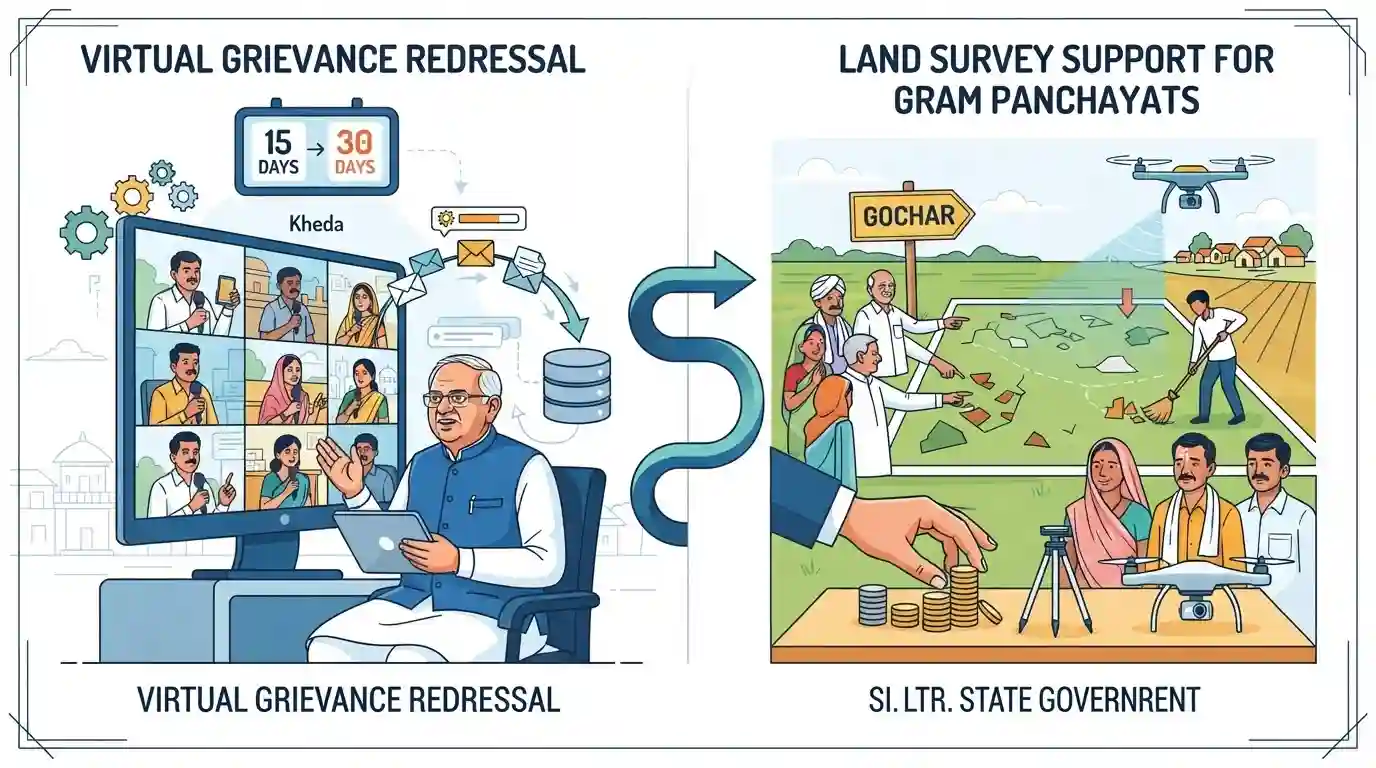
Gujarat Chief Minister Bhupendra Patel conducted a virtual surprise visit to the District SWAGAT (State Wide Attention on Grievances by Application of Technology) programme, reviewing grievance redressal in Kheda district. He directed officials to resolve pending public issues within 15 to 30 days to bolster citizens' faith in the local administration. Additionally, to combat encroachment on public grazing lands, he announced that the state government will cover the land survey costs if Gram Panchayats are unable to afford them.
Key Points
- Gujarat Chief Minister Bhupendra Patel made a virtual surprise visit to the District SWAGAT programme to review the public grievance redressal mechanism in Kheda district.
- SWAGAT (State Wide Attention on Grievances by Application of Technology) is a tech-driven initiative aimed at ensuring the prompt and transparent resolution of public issues.
- The Chief Minister directed district officials to resolve all pending grievances and applications within a fixed timeframe of 15 to 30 days.
- Addressing issues of gauchar (public grazing land) encroachment, the CM instructed that the state government will bear the cost of DILR surveys if a Gram Panchayat lacks the necessary funds.
- The initiative underscores the state's commitment to good governance by building citizens' confidence in local administrative machinery and ensuring accountability.
Important Terms
SWAGAT (State Wide Attention on Grievances by Application of Technology)

An e-governance initiative by the Gujarat government launched in 2003. It leverages technology to enable citizens to directly report grievances to the Chief Minister, ensuring quick, transparent, and time-bound resolution of public issues.
UPSC context
Important for GS Paper II (e-Governance, transparency, and accountability) as a successful model of citizen-centric grievance redressal.
Gram Panchayat
The grassroots executive body of the Panchayati Raj system in India. Elected by the Gram Sabha, it is responsible for village-level administration, implementing development programs, and providing local civic amenities.
UPSC context
Crucial for GS Paper II (Local Self-Government) when discussing democratic decentralization, rural governance, and grassroots empowerment.
District Inspector of Land Records (DILR)
A state-level administrative official responsible for overseeing rural and urban land surveys, updating property records, mapping land for acquisition, and resolving local boundary disputes at the district level.
UPSC context
Relevant to GS Paper II and III (Governance, Land Reforms) concerning transparent local land administration, survey costs, and digitized property records.
Prelims Trap
Public grazing lands (gauchar) fall under the exclusive administrative jurisdiction of the State Revenue Department.
Under the 73rd Amendment (Article 243G and 11th Schedule), the management and protection of Common Property Resources like grazing lands are delegated to Gram Panchayats, not the Revenue Department.
Static Concepts Connected
What is the constitutional mandate for Panchayats regarding Common Property Resources?
- Article 243G: Mandates state legislatures to endow Panchayats with powers and authority to function as effective institutions of local self-government.
- 11th Schedule: Lists 29 functional items, including 'Fuel and fodder', 'Social forestry', and 'Maintenance of community assets', encompassing public grazing lands.
- Financial Autonomy: CPRs like village ponds and grazing lands are crucial sources for generating independent non-tax revenue for local bodies.
What are the core pillars of e-governance platforms like PRAGATI?
- Pro-active Governance: Top executives directly monitor delayed projects and grievances, bypassing traditional bureaucratic red tape to force systemic responsiveness.
- Multi-modal Integration: Combines digital data management, video conferencing, and geo-spatial technologies to simultaneously connect multiple tiers of administration.
- Time-bound Accountability: Establishes fixed, transparent timelines for dispute and grievance resolution, enhancing citizen trust in the local administrative machinery.
Cross-Topic Patterns
PRI finances & CPR encroachment
The state having to fund basic land surveys reveals the severe lack of independent non-tax revenue among Gram Panchayats, crippling their ability to manage and protect community assets.
Sub-national models scaling up
Gujarat's 2003 SWAGAT initiative directly served as the architectural blueprint for the Union Government's PRAGATI platform launched in 2015, highlighting how sub-national governance experiments scale nationally.

The intersection of Gram Panchayat financial dependency and their inability to protect Common Property Resources is a strong 2026 GS2 theme.
Linked PYQs · 1
Linked PYQs · 1
- 2017GPSC_PRELIMSGS1
The Multi Purpose and Multi model platform PRAGATI (Pro Active Governance and Timely Implementation) launched in March 2015 aims to
