Rajasthan CM Unveils Four Digital Governance Projects
Source:thetimesofindia ↗
Why It Matters
The launch of dedicated AI-ML and AVGC policies along with WhatsApp-based e-governance service delivery represents a major shift toward automated, localized, and tech-driven public administration in Rajasthan, which is highly relevant for state-level administrative and technology-oriented GS questions.
Summary
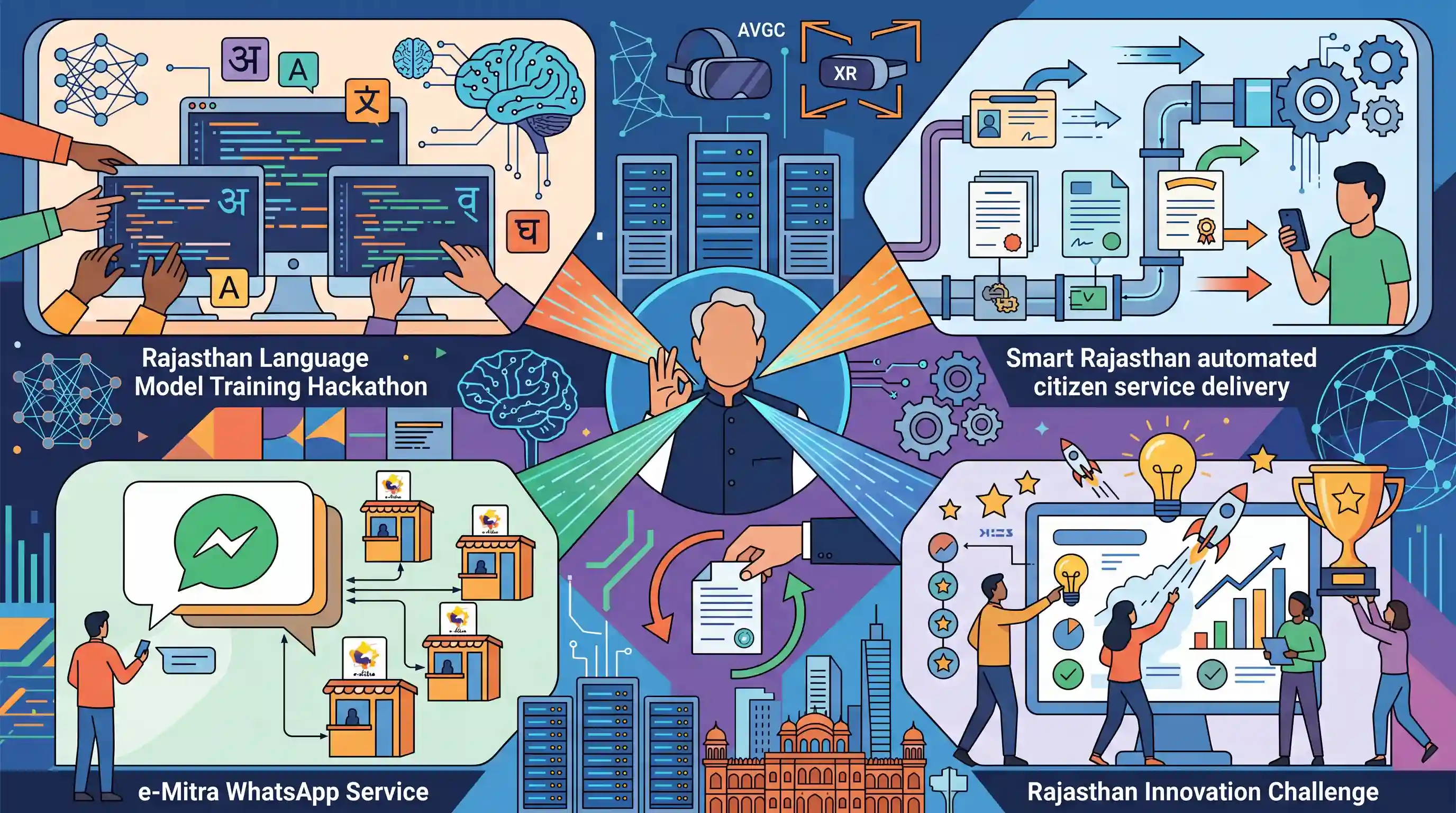
Rajasthan Chief Minister Bhajan Lal Sharma launched four key digital governance initiatives—the Rajasthan Language Model Training Hackathon, the Smart Rajasthan automated citizen service delivery platform, the Rajasthan Innovation Challenge, and the e-Mitra WhatsApp Service—during the 29th National Conference on e-Governance in Jaipur. The Chief Minister highlighted Rajasthan's digital ecosystem, including the Rajasthan Sampark grievance portal, the newly adopted Rajasthan AI-ML Policy 2026, the AVGC and XR Policy, and the state's vision to become a major hub for AI and data centres.
Key Points
- Chief Minister Bhajan Lal Sharma inaugurated the 29th National Conference on e-Governance at the Rajasthan International Centre (RIC) in Jaipur.
- Four major digital governance projects were launched: the Rajasthan Language Model Training Hackathon, the Smart Rajasthan automated service delivery platform, the Rajasthan Innovation Challenge, and the e-Mitra WhatsApp Service.
- The e-Mitra WhatsApp Service (via mobile number 94610-62705) allows citizens to access 27 governance services, such as water/electricity bill payments and EWS certificate applications, directly on WhatsApp.
- The Rajasthan AI-ML Policy 2026 has been adopted to scale the deployment of artificial intelligence across governance, healthcare, education, agriculture, and industrial sectors.
- The state's AVGC and XR Policy and the AI and Quantum Computing Mission are designed to boost job creation and skill development for youth in animation, visual effects, gaming, extended reality, and advanced computing.
- The Rajasthan Sampark portal is currently resolving 2.5 lakh to 3 lakh public grievances every month, and the state-wide e-Mitra network spans over 79,000 kiosks offering more than 900 digital services.
- Rajasthan aims to become India's preferred destination for AI and data centres through single-window clearances, land availability, and investor-friendly ecosystems.
Important Terms
Rajasthan AI-ML Policy 2026

A state-level framework designed to adopt AI and machine learning ethically, securely, and transparently to enhance public services, secure citizen data, and drive innovation.
UPSC context
GS Paper 3 (S&T / AI). Tests state-led regulatory frameworks and development policies for ethical and responsible AI.
Rajasthan AVGC and XR Policy
A policy to develop Rajasthan into a leading hub for Animation, Visual Effects, Gaming, Comics, and Extended Reality through fiscal incentives, infrastructure, and skill development.
UPSC context
GS Paper 3 (Economy / Sunrise Sectors). Tests regional industrial policies to promote emerging creative technology sectors and youth employment.
Smart Rajasthan platform
An automated state service delivery initiative that leverages AI/ML to identify eligible beneficiaries and seamlessly distribute public services like domicile certificates in real-time.
UPSC context
GS Paper 2 (E-governance). Tests public service automation to reduce administrative friction and eliminate bureaucratic delays.
e-Mitra WhatsApp Service
A digital governance platform integrated with WhatsApp that enables citizens in Rajasthan to access multiple public services, apply for certificates, and pay utility bills.
UPSC context
GS Paper 2 (E-governance). Tests social platform integration to bridge the digital divide and simplify citizen-centric service delivery.
Rajasthan Sampark portal
The state's centralized online grievance redressal portal that registers public complaints and monitors their resolution within specified timelines to ensure administrative accountability.
UPSC context
GS Paper 2 (Administrative Accountability). Tests the efficacy of state-level IT tools in facilitating citizen feedback and grievance redressal.
Prelims Trap
The Panchayat Advancement Index (PAI) is a performance mapping tool developed and maintained by NITI Aayog.
Candidates often attribute local development indices to NITI Aayog, but the PAI is specifically developed by the Ministry of Panchayati Raj to map LSDGs.
Static Concepts Connected
What are the core infrastructure pillars of India's e-Governance architecture under NeGP?
- SWANs: Provide secure, high-speed connectivity link from state headquarters to block levels.
- State Data Centres: Host key applications, state intranets, and secure digital repositories for various departments.
- Common Services Centres: Serve as the front-end physical delivery points for e-services in rural areas (similar to Rajasthan's e-Mitra).
Cross-Topic Patterns
Sub-national tech policies and competitive federalism
State-specific AI, XR, and quantum policies mark a transition from centralized digital missions to competitive regional technology ecosystems.
Data-driven localization of SDGs
Digital indexes like the Panchayat Advancement Index integrate real-time grassroots data with localized SDGs to improve decentralized fiscal allocations.

National e-Gov Awards (e.g., PAI) combined with state-level AI-ML frameworks will likely be tested as multi-statement tech-governance MCQs.
Linked PYQs · 3
Linked PYQs · 3
- 2023RPSC_PRELIMSGS1
Which company was established by the Government of Rajasthan in the 21st century with the objective of developing information technology (IT) skills?
- 2025RPSC_PRELIMSGS1
Which of the following statements regarding the Raj Nivesh Portal of Rajasthan is incorrect?
- 2025RPSC_PRELIMSGS1
What has been formed in place of the Chief Minister Rajasthan Economic Reforms Advisory Council (CMRETAC)?
