Bharat Taxi Service Launched in Jaipur under Cooperative Model
Source:firstindia ↗
Why It Matters
It demonstrates the application of the cooperative business model to solve modern urban public transport issues, aligning with syllabus topics on state governance, economic development, and cooperative movements in Rajasthan.
Summary
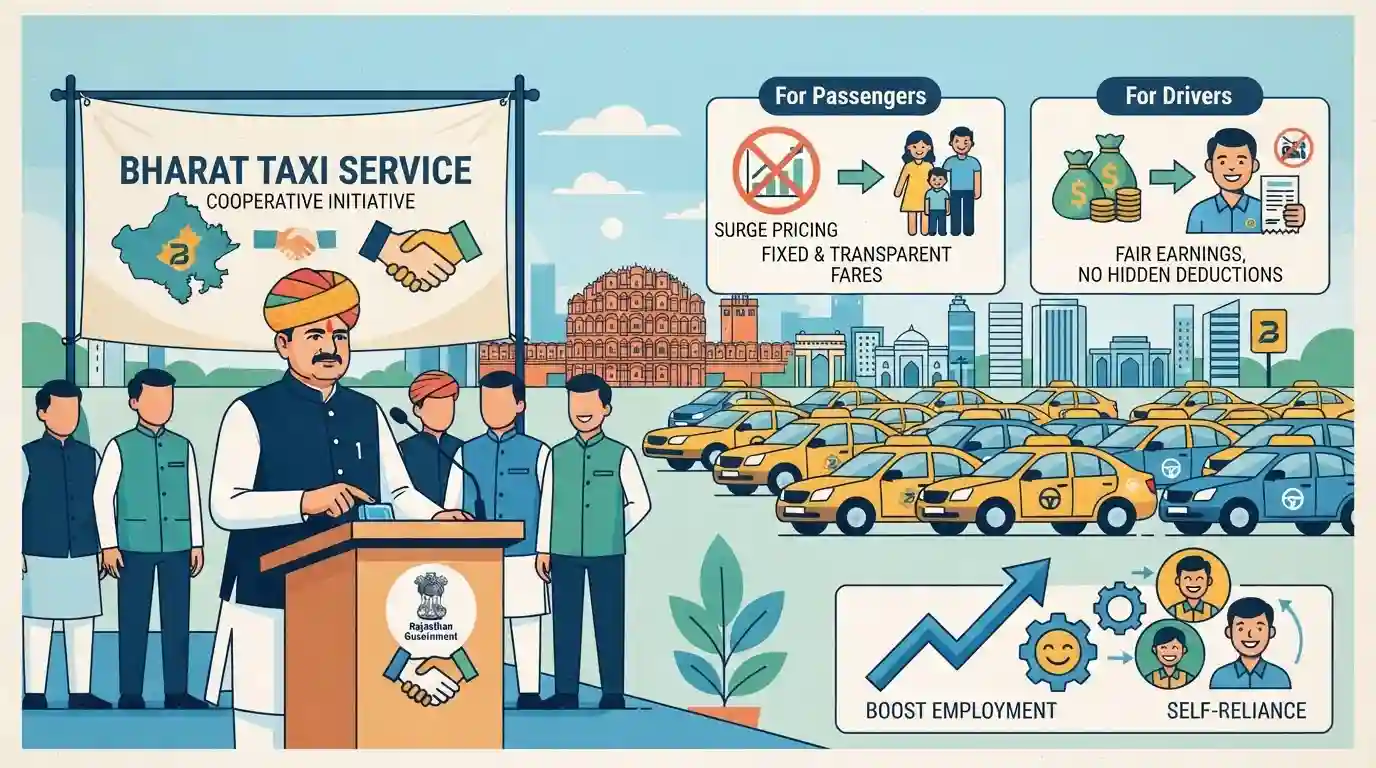
Rajasthan Chief Minister Bhajan Lal Sharma launched the 'Bharat Taxi Service' in Jaipur, introducing a cooperative model to the state's public transport sector. The service aims to eliminate surge pricing for passengers and ensure transparent, fair earnings for drivers by removing hidden deductions. Launched at the HCM Rajasthan State Institute of Public Administration, the initiative was supported by key cooperative ministers and is designed to boost employment and promote self-reliance in the transport sector.
Key Points
- Rajasthan Chief Minister Bhajan Lal Sharma launched the 'Bharat Taxi Service' in Jaipur.
- The service operates entirely on a cooperative model, ensuring fair earnings for drivers without hidden deductions and protecting commuters from surge pricing.
- The launch event was held at the HCM Rajasthan State Institute of Public Administration (HCM RIPA) and attended by Union and State Ministers of Cooperation.
- The initiative is viewed as a significant step toward self-reliance, transparent public transport, and employment generation in Rajasthan.
Important Terms
Bharat Taxi Service

A cooperative ride-hailing model launched in Rajasthan where drivers become shareholders. It aims to provide a secure transport alternative by eliminating surge pricing for passengers and ensuring transparent, deduction-free earnings for drivers.
UPSC context
GS Paper 2 & 3. Tests alternative gig-economy models, cooperative enterprise success, and labor welfare against monopolistic aggregators.
HCM Rajasthan State Institute of Public Administration (HCM RIPA)
The apex-level civil service training institute of the Rajasthan government, located in Jaipur. It conducts foundational and professional capacity-building programs for state civil servants and subordinate officers.
UPSC context
GS Paper 2 (Role of Civil Services). Relevant as a case study for state-level administrative training, capacity building, and governance reforms.
Platform Cooperativism
An economic model where digital platforms are collectively owned and governed by their workers or users. It empowers gig workers with voting rights, fair wages, and profit-sharing mechanisms.
UPSC context
GS Paper 3 (Employment/Economy). Tests knowledge of gig economy labor reforms, alternatives to platform capitalism, and inclusive economic growth.
Surge Pricing
A dynamic pricing strategy where service costs are temporarily increased during periods of high demand and low supply. Frequently used by private ride-hailing apps, it faces regulatory scrutiny over consumer exploitation.
UPSC context
GS Paper 3 (Economy). Important for understanding market dynamics, digital economy regulations, consumer protection, and algorithm manipulation.
Prelims Trap
The Multi-State Cooperative Societies Act is enacted by State Legislatures to govern cooperatives operating in more than one state.
Multi-state cooperatives fall under Entry 44 of the Union List (Parliamentary jurisdiction), unlike regular cooperatives which are a State Subject under Entry 32.
Static Concepts Connected
What is the constitutional and legislative framework governing Cooperatives in India?
- Seventh Schedule: Cooperative societies are a State Subject (Entry 32, List II), while Multi-State cooperatives fall under the Union List (Entry 44, List I).
- Constitutional Status: The 97th Amendment added Part IXB. The SC upheld it only for Multi-State Cooperatives, striking it down for state-level societies due to lack of ratification.
- Fundamental Right: Article 19(1)(c) was amended to protect the right to form cooperative societies as a fundamental right of all citizens.
Cross-Topic Patterns
Gig economy vs Cooperative federalism
State-led gig worker welfare acts (like Rajasthan’s 2023 Act) interact with Central labor codes, highlighting how states bridge regulatory gaps before central laws are fully implemented.
Platform cooperatives as anti-monopoly tools
Transitioning ride-hailing from venture-backed aggregators to multi-state cooperatives offers a democratic alternative to curb algorithmic exploitation and corporate pricing monopolies.

Mains 2026 may ask to critically analyze 'Platform Cooperatives' as a viable alternative to capital-backed gig aggregator monopolies.
Linked PYQs · 5
Linked PYQs · 5
- 2025RPSC_PRELIMSGS1
What has been formed in place of the Chief Minister Rajasthan Economic Reforms Advisory Council (CMRETAC)?
- 2024RPSC_PRELIMSGS1
Which of the following has been formed in place of Chief Minister's Rajasthan Economic Transformation Advisory Council (CMRETAC)?
- 2023RPSC_PRELIMSGS1
Which company was established by the Government of Rajasthan in the 21st century with the objective of developing information technology (IT) skills?
- 2024RPSC_PRELIMSGS1
Consider the following statements regarding 'Rajasthan Employment to 50 over 1 crore people (direct and indirect) by 2030': A. Provide employment to 50 over 1 crore people (direct and indirect) by 2030. B. To increase the contribution to state's GSDP 3% by 2030. C. 10% of the employment is to be achieved by 2046-47.
- 2025RPSC_PRELIMSGS1
The Ease of Doing Business ranking for states is issued by
