Jaipur Infrastructure Projects for Urban Development and Health
Source:jaipur-tribune ↗
Why It Matters
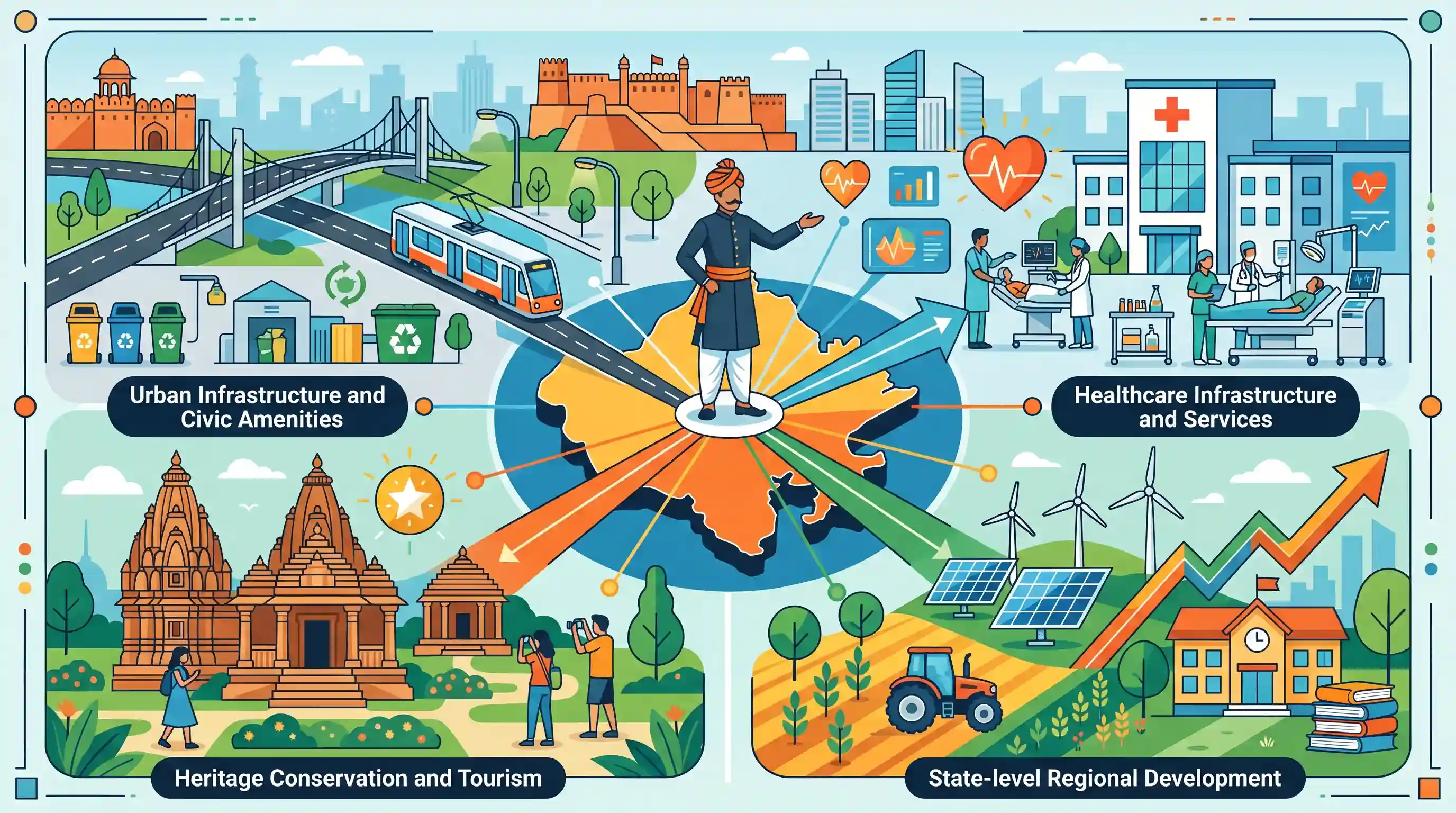
This article highlights the state's strategic policies for urban planning and growth, emphasizing citizen-centric infrastructure, public health, and cultural heritage conservation in major urban agglomerations.
Summary
Rajasthan Chief Minister Bhajan Lal Sharma announced a series of new development, healthcare, sanitation, and heritage conservation projects during a public event in Sanganer, Jaipur. These initiatives form part of a broader vision to enhance urban connectivity, improve civic infrastructure, expand medical services, and preserve local historical temples, thereby ensuring balanced urban growth and raising the quality of life for residents.
Key Points
- Chief Minister Bhajan Lal Sharma inaugurated and laid foundation stones for multiple development projects during a public event in Sanganer, Jaipur.
- The initiatives focus on four primary pillars: improving urban connectivity/transportation, expanding healthcare infrastructure, enhancing sanitation/civic services, and conserving cultural heritage.
- Infrastructure and connectivity upgrades aim to reduce traffic congestion and improve accessibility in key urban areas of Jaipur.
- Healthcare initiatives involve creating new medical facilities and expanding existing healthcare services to handle emergency support in expanding urban sectors.
- Heritage conservation efforts are specifically directed at the beautification and restoration of temples in the Sanganer region to promote local tourism and support community development.
Important Terms
Jaipur Development Authority

A statutory body established under the JDA Act, 1982, responsible for the planning, infrastructure development, and overall urban growth of the Jaipur metropolitan region in Rajasthan.
UPSC context
GS Paper III (Urbanization & Infrastructure); tests statutory bodies managing urban planning and growth.
Rajasthan Government
The sub-national governing authority of Rajasthan, comprising an executive led by the Chief Minister, a unicameral legislature, and a judiciary, responsible for state administration.
UPSC context
GS Paper II (State Executive & Legislature); tests administrative structures, federalism, and public policy formulation.
AMRUT Scheme
A centrally sponsored scheme launched in 2015 to improve urban infrastructure, focusing on water supply, sewage networks, septage management, stormwater drainage, and green spaces.
UPSC context
GS Paper II & III (Government Schemes, Urbanization); tests policies on urban rejuvenation and public utility delivery.
SVAMITVA Scheme
A Central Sector Scheme launched in 2020 by the Ministry of Panchayati Raj, using drone technology to map rural inhabited lands and issue legal property cards.
UPSC context
GS Paper II & III (Governance, Land Reforms); tests technological interventions in rural land registration.
Jaipur Metro Rail Corporation
A state-owned public sector company incorporated in 2010 to implement, operate, and manage the rapid transit metro rail network in the capital city of Rajasthan.
UPSC context
GS Paper III (Infrastructure); tests public transit planning, urban mass transit systems, and joint-venture governance models.
Prelims Trap
The Rajasthan Housing Board (RHB) was merged into RUDSICO as part of the state's urban administration consolidation.
RUDSICO consolidated RUIDP, RAVIL, and RUIFDCO. The Rajasthan Housing Board (RHB) remains a separate, independent public entity and was not part of this merger.
Static Concepts Connected
What are State-level equivalents of NITI Aayog and their role in cooperative federalism?
- Institutional shift: States are increasingly replacing traditional, allocation-focused State Planning Boards with strategic, policy-driven think tanks modeled on NITI Aayog.
- Strategic focus: These bodies (e.g., RITI in Rajasthan, MITRA in Maharashtra) focus on multi-sectoral strategies to achieve SDGs 2030 and long-term state vision documents.
- Federal alignment: They foster cooperative federalism by aligning state-level growth models directly with national macroeconomic targets and competitive benchmarks.
What is the HRIDAY paradigm of heritage-led urban development?
- Holistic planning: It shifts the focus from isolated monument conservation to systemic, heritage-sensitive civic infrastructure upgrading (roads, sanitation, waste management) in historical areas.
- Economic linkage: By revitalizing the civic amenities around heritage assets, it directly boosts tourism-led economic growth, enhancing the local community's livelihood security.
Cross-Topic Patterns
Urban corridors vs. Riverine ecosystems
Constructing major transit corridors (like Jaipur's Dravyavati River corridor) highlights the delicate environmental policy challenge of balancing urban decongestion with river channel and floodplain conservation.
Heritage restoration + Service GSVA
Targeted heritage beautification projects directly boost the 'Trade, Hotels & Restaurants' sub-sector, which acts as the primary driver within the state's dominant service sector economy.

State-level NITI-style think tanks (like RITI) and urban utility consolidation models are highly testable governance trends for 2026.
Linked PYQs · 2
Linked PYQs · 2
- 2023RPSC_PRELIMSGS1
Which of the following is not a part of the Rajasthan Urban Drinking Water, Sewage and Infrastructure Corporation Limited?
- 2018RPSC_PRELIMSGS1
Which of the following is NOT a unique selling proposition (USP) in Rajasthan's tourism sector?
