Kanpur Division PWD Infrastructure Projects and Road Network Review
Source:The Hindu ↗
Why It Matters
This update provides crucial facts on the administrative structure of Uttar Pradesh (districts of Kanpur division), the deployment of regional road infrastructure funding, and state-specific policy measures like Chief Minister Gram Sadak Yojana. UPPSC Prelims frequently tests candidates on district administration, regional schemes, and state infrastructure initiatives.
Summary
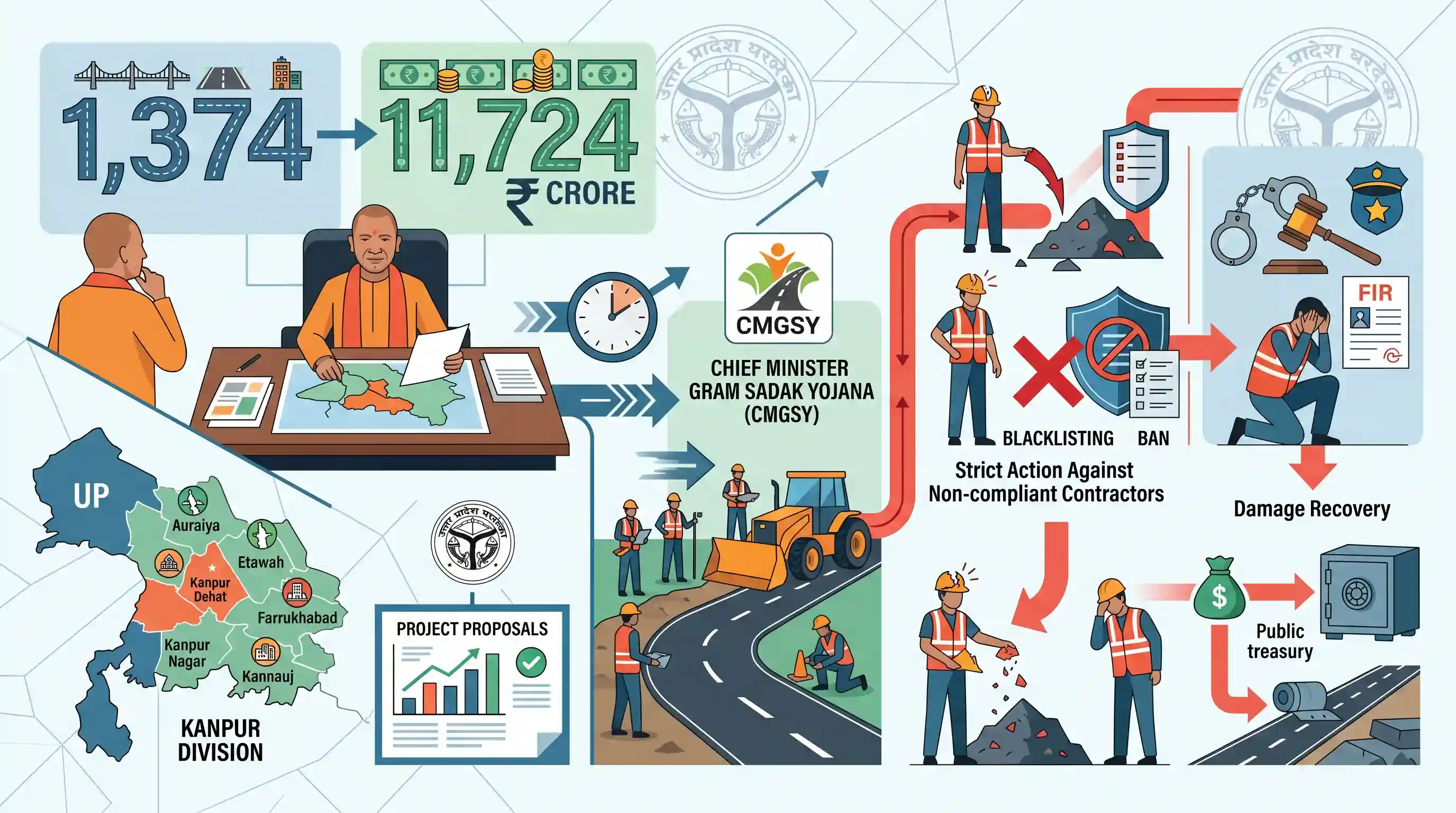
Chief Minister Yogi Adityanath reviewed 1,374 PWD infrastructure project proposals worth ₹11,724 crore for the Kanpur division, comprising six districts of Uttar Pradesh. The CM directed the swift implementation of schemes like Chief Minister Gram Sadak Yojana (CMGSY) and ordered strict legal action, including blacklisting and FIRs, against non-compliant contractors, alongside recovering damages for public roads from responsible parties.
Key Points
- Chief Minister Yogi Adityanath conducted a high-level review of Public Works Department (PWD) projects in the Kanpur division at HBTU Kanpur on June 18, 2026.
- The Kanpur division encompasses six districts: Kanpur Nagar, Kanpur Dehat, Kannauj, Etawah, Auraiya, and Farrukhabad.
- A total of 1,374 new infrastructure proposals worth ₹11,724 crore were submitted for the Kanpur division for the upcoming financial cycle.
- The district-wise funding breakdown includes Kanpur Nagar (₹5,523 crore), Kannauj (₹2,058 crore), Farrukhabad (₹2,016 crore), Kanpur Dehat (₹1,581 crore), Auraiya (₹439 crore), and Etawah (₹104 crore).
- In the previous financial year (2025-26), 2,301 projects worth ₹5,497 crore were approved in the division, with 1,242 completed and the rest in progress.
- The Chief Minister directed officials to legally recover compensation from individuals or institutions causing damage to PWD roads.
- Strict governance actions, including blacklisting and registering FIRs, were ordered against construction firms that delay or fail to initiate work after winning tenders.
- Emphasis was placed on accelerating works under the Chief Minister Gram Sadak Yojana (CMGSY), state highways, bridges, ROBs, RUBs, and road connectivity to major religious sites.
Important Terms
Chief Minister Gram Sadak Yojana (CMGSY)

A state-sponsored road development scheme in Uttar Pradesh designed to construct and upgrade all-weather rural roads, providing vital connectivity to habitations not covered under the central Pradhan Mantri Gram Sadak Yojana.
UPSC context
GS Paper II & III: Evaluates state welfare schemes and rural infrastructure development crucial for rural economy and connectivity.
Public Works Department (PWD)
A key government agency responsible for the design, construction, and maintenance of public infrastructure, including state highways, rural roads, bridges, and government buildings.
UPSC context
GS Paper II & III: Tests understanding of administrative governance, public resource management, and state infrastructure planning.
Harcourt Butler Technical University (HBTU)
Established in 1921 as an institute and upgraded to a university in 2016, this premier state technical university in Kanpur is one of India's oldest engineering and chemical research institutions.
UPSC context
GS Paper I & III: Tests knowledge of historic colonial-era educational institutions and modern engineering and technical education in India.
Prelims Trap
The Chief Minister Gram Sadak Yojana (CMGSY) is a Centrally Sponsored Scheme that has replaced the PMGSY in Uttar Pradesh.
CMGSY (or MMGSY) is a 100% state-funded scheme meant to complement, not replace or merge with, the PMGSY. It specifically targets smaller habitations that do not meet the minimum population threshold of PMGSY.
Static Concepts Connected
How does PMGSY differ from State-level Gram Sadak Schemes?
- Funding Pattern: PMGSY is a Centrally Sponsored Scheme (funded 60:40 between Center and States), whereas CMGSY/MMGSY is fully funded by the State Exchequer.
- Target Population: PMGSY targets habitations with populations of 500+ in plains (250+ in hill/tribal areas); state schemes target smaller habitations (e.g., 250+ in plains) missed by PMGSY.
- Nodal Agencies: PMGSY is monitored nationally by the National Rural Infrastructure Development Agency (NRIDA), whereas state schemes are managed by State PWDs or Rural Engineering departments.
What is the administrative division (Mandal) structure of Uttar Pradesh?
- Division Count: UP is divided into 18 administrative divisions, which act as key supervisory levels of governance between the state government and its 75 districts.
- Largest Divisions: Kanpur, Lucknow, and Meerut are the largest divisions in UP, each containing six districts under their jurisdiction.
- Administrative Head: Each division is headed by a Divisional Commissioner (senior IAS officer) who coordinates developmental, revenue, and law-and-order administration.
Cross-Topic Patterns
Rural Connectivity + Agricultural Supply Chains
Last-mile rural road infrastructure directly reduces post-harvest agricultural losses, linking remote farm-gates to e-NAM mandis and boosting non-farm rural employment opportunities.
Public Tenders + Contract Enforcement
Moving beyond mere blacklisting to active recovery of civil damages from negligent contractors highlights emerging strict liability principles in public infrastructure contract enforcement.

Multi-statement questions on rural infrastructure may test the target population thresholds of PMGSY versus State-funded road schemes.
Linked PYQs · 3
Linked PYQs · 3
- 2023UPPSC_PRELIMSGS1
Which of the following Scheme/Programme is not the Central Government Programme and it is Uttar Pradesh Government's Programme?
- 2025UPPSC_PRELIMSGS1
Which of the following districts of Uttar Pradesh shares its boundary with only one other district of Uttar Pradesh ? 1. Lalitpur 2. Saharanpur 3. Sonbhadra Select the correct answer from the code given below :
- 2021UPPSC_PRELIMSGS1
Which among the following districts of Uttar Pradesh is smallest in terms of area ?
