Kanpur Division Gram Sadak Yojana and PWD Infrastructure Plans
Source:The Hindu ↗
Why It Matters
This article highlights the decentralised infrastructure planning mechanism of Uttar Pradesh, showcasing how the state prioritises road connectivity through regional division reviews and rural road schemes like the Chief Minister Gram Sadak Yojana. It also illustrates state policy on contracting accountability and administrative divisions.
Summary
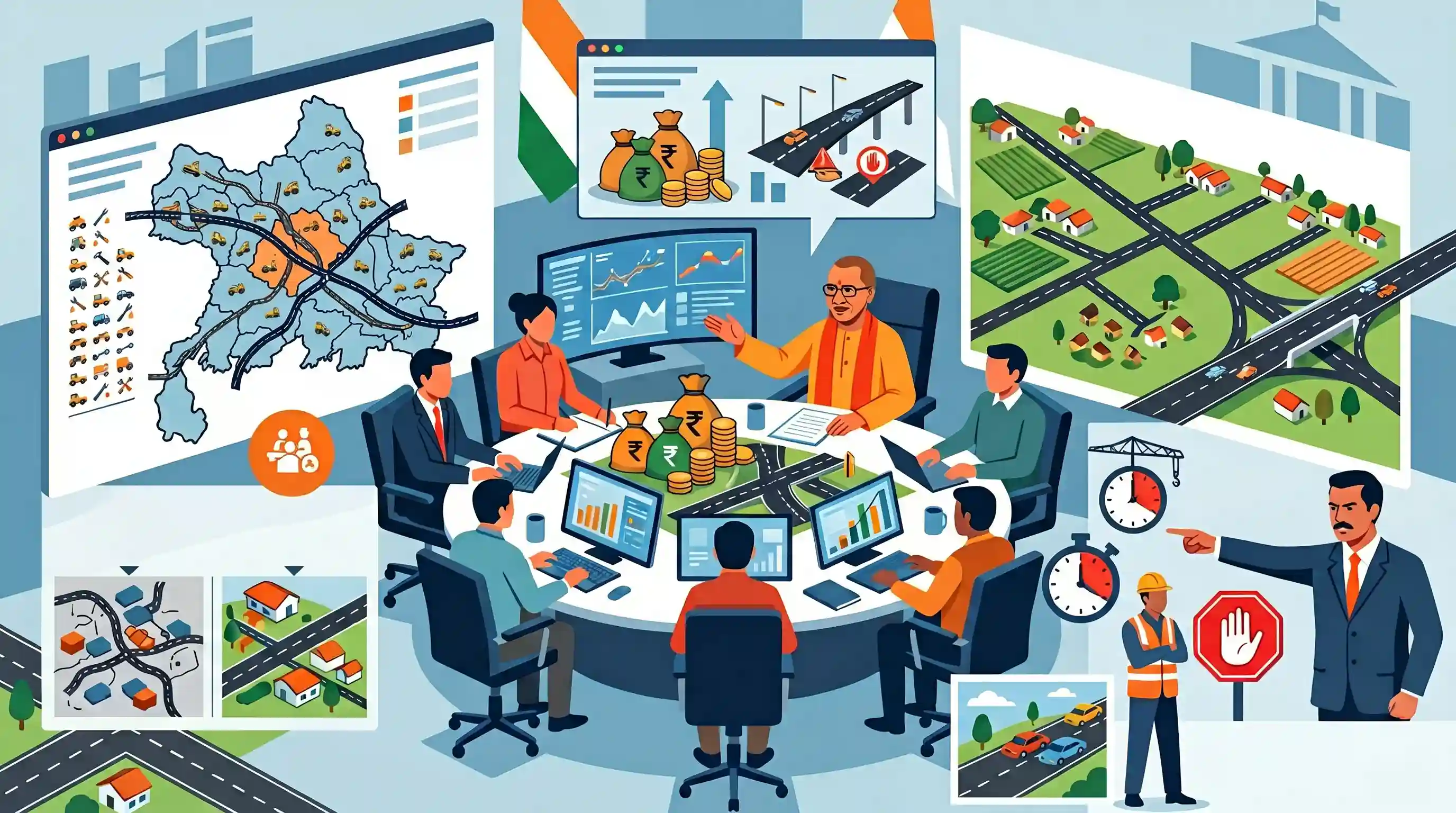
UP CM Yogi Adityanath chaired a Public Works Department (PWD) review meeting in Kanpur to approve the work plan for the FY 2026-27 for the Kanpur Division. Spanning six districts, the division submitted proposals for 1,374 infrastructure projects worth ₹11,724 crore. The CM emphasized key rural and urban road connectivity schemes, including the Chief Minister Gram Sadak Yojana, and directed strict administrative action against lagging contractors.
Key Points
- Chief Minister Yogi Adityanath reviewed the Public Works Department (PWD) projects and work plan for the financial year 2026-27 in the Kanpur Division of Uttar Pradesh.
- Kanpur Division comprises six districts: Kanpur Nagar, Kanpur Dehat, Kannauj, Etawah, Auraiya, and Farrukhabad.
- Proposals for 1,374 projects worth approximately ₹11,724 crore were submitted by public representatives of these six districts, with Kanpur Nagar seeking the highest share (344 projects worth ₹5,523 crore) and Etawah the lowest (54 projects worth ₹104 crore).
- The CM directed swift administrative action on the Chief Minister Gram Sadak Yojana, state highways, major/minor bridges, road over bridges (ROBs), road under bridges (RUBs), and connecting roads to religious sites.
- A total of 2,301 projects worth ₹5,497 crore had been approved in the previous financial year in Kanpur Division, of which 1,242 projects have been completed so far.
- In a bid to ensure accountability, the CM ordered strict actions, including blacklisting and filing FIRs, against contractors who failed to commence work post-tender allocation.
- Guidelines were given to recover financial compensation from individuals or institutions causing damage to PWD roads.
Important Terms
Chief Minister Gram Sadak Yojana (Mukhya Mantri Gram Sadak Yojana)

A state-level rural road connectivity scheme launched to construct all-weather roads connecting habitations and villages not covered under the central Pradhan Mantri Gram Sadak Yojana (PMGSY).
UPSC context
GS Paper II & III: Government schemes and infrastructure. Tests understanding of rural connectivity and state-led development initiatives.
Public Works Department (PWD), Uttar Pradesh
The premier state government agency in Uttar Pradesh responsible for the planning, design, construction, and maintenance of public infrastructure, including roads, bridges, and government buildings.
UPSC context
GS Paper III: Infrastructure. Tests knowledge of public administration, state-level project execution, and regional infrastructure planning.
Harcourt Butler Technical University (HBTU)
A premier state technical university in Kanpur, Uttar Pradesh (established 1921), focusing on engineering education, research, and supporting regional development and infrastructure quality monitoring.
UPSC context
GS Paper II: Issues relating to education and human resources. Tests understanding of higher technical institutions in regional development.
Prelims Trap
The Pradhan Mantri Gram Sadak Yojana (PMGSY) remains a 100% centrally-funded scheme since its inception.
Aspirants often confuse PMGSY's current 60:40 cost-sharing pattern (90:10 for NE/Himalayan states) with its original 100% central funding structure from the year 2000.
Static Concepts Connected
What is the governance and funding architecture of the Pradhan Mantri Gram Sadak Yojana (PMGSY)?
- Nodal ministry: Implemented by the Ministry of Rural Development, it was launched in 2000 to provide all-weather road connectivity to eligible unconnected habitations.
- Funding pattern: Shifted from 100% Central funding to a 60:40 sharing ratio (90:10 for NE and Himalayan states) in 2015-16.
- Phase-III mandate: Focuses on consolidating 1,25,000 km of roads connecting habitations to Gramin Agricultural Markets (GrAMs), schools, and hospitals.
What is the One District One Product (ODOP) initiative and its socio-economic objectives?
- Evolution & scale: Pioneered by Uttar Pradesh in 2018, it is now integrated nationally with DPIIT's 'Districts as Export Hubs' and MoFPI's PM-FME scheme.
- Core objectives: Aims to preserve indigenous crafts, boost local manufacturing, scale up local employment, and check distress rural-to-urban migration.
Cross-Topic Patterns
Rural roads + Agri-market logistics
PMGSY III's focus on linking habitations to GrAMs highlights the convergence of rural road infrastructure with post-harvest supply chain resilience and price realization for farmers.
Sub-national debt + Infrastructure funding
Fully state-funded mega expressways alongside shared CSS like PMGSY illustrate how states balance capital expenditure and sub-national debt within FRBM fiscal deficit targets.

PMGSY-III's focus on connecting GrAMs and its post-2015 60:40 funding pattern will likely be tested against absolute Central Sector schemes.
Linked PYQs · 3
Linked PYQs · 3
- 2023UPPSC_PRELIMSGS1
Which of the following Scheme/Programme is not the Central Government Programme and it is Uttar Pradesh Government's Programme?
- 2021UPPSC_PRELIMSGS1
Which among the following districts of Uttar Pradesh is smallest in terms of area ?
- 2021UPPSC_PRELIMSGS1
Which of the following Schemes in Uttar Pradesh were introduced in Budget of 2021-22? I. Atmanirbhar Krishak Samanvit Vikas Yojna II. Mukhya Mantri Saksham Suposhan Yojna III. Mukhya Mantri Pravasi Shramik Udyamita Vikas Yojna IV. Yuva Udyamita Vikas Abhiyan Select the correct answer from the codes given below.
