Ek Ped Maa Ke Naam plantation campaign launched in Uttar Pradesh
Source:thehindu ↗
Why It Matters
UP-specific initiatives on environmental protection, particularly the launch of India's first airshed-based clean air management project and massive plantation targets, are highly relevant for UPPSC Prelims. Questions about UP geography (forest cover) and environmental days are frequently asked.
Summary
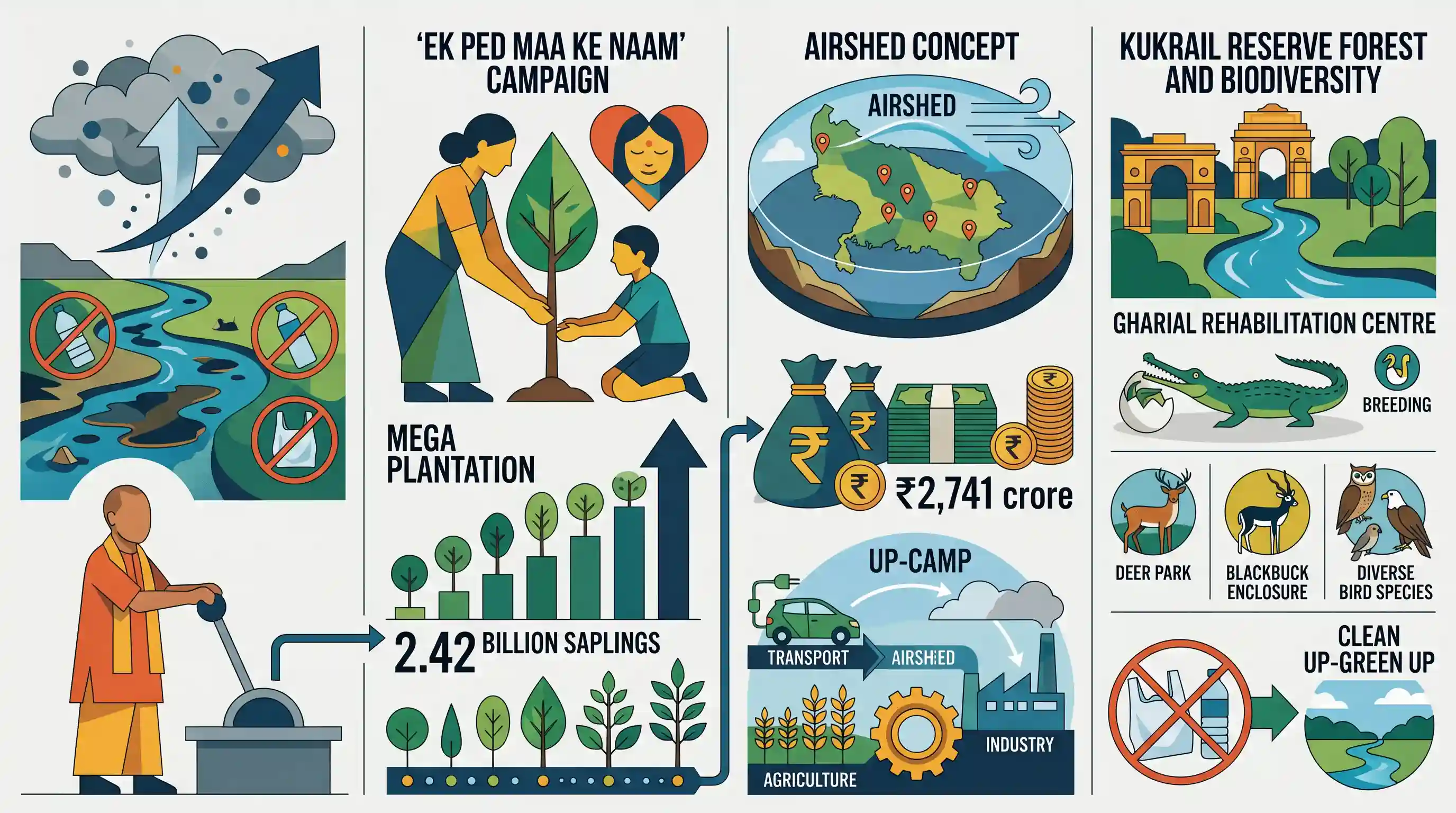
On World Environment Day (June 5, 2026), Uttar Pradesh Chief Minister Yogi Adityanath launched the 'Ek Ped Maa Ke Naam' mega plantation campaign at Kukrail, Lucknow. Alongside this, he launched India's first Airshed-based 'Uttar Pradesh Clean Air Management Project' (UP-CAMP) with an outlay of ₹2,741 crore. The initiative emphasizes massive afforestation (noting over 2.42 billion saplings planted in UP over 9 years) and calls for a single-use plastic-free state to combat human-made environmental challenges.
Key Points
- On World Environment Day (June 5, 2026), UP CM Yogi Adityanath launched the 'Ek Ped Maa Ke Naam' mega plantation campaign at Kukrail in Lucknow.
- Launched India's first Airshed-based 'Uttar Pradesh Clean Air Management Project' (UP-CAMP) with a budgeted cost of ₹2,741 crore to tackle air pollution beyond administrative limits.
- The 'Ek Ped Maa Ke Naam' campaign (inspired by PM Modi) encourages citizens to plant a tree in honor of their mother to protect the environment.
- UP has achieved a milestone of planting over 2.42 billion (242 crore) saplings over the last nine years.
- CM Adityanath appealed for a complete elimination of single-use plastics to protect water bodies, gardens, and forests from plastic pollution.
Important Terms
Ek Ped Maa Ke Naam Campaign

A nationwide mass tree-plantation campaign launched in 2024, combining environmental conservation with a personal tribute to mothers, aiming to increase green cover and restore degraded lands.
UPSC context
GS Paper III (Environment & Conservation). Tests understanding of community-driven afforestation models and India's climate action policies.
Uttar Pradesh Clean Air Management Project (UP-CAMP)
India's first state-level, airshed-based clean air program supported by the World Bank, utilizing a multi-sectoral strategy to systematically reduce PM2.5 levels across Uttar Pradesh.
UPSC context
GS Paper III (Environmental Pollution). Tests knowledge of regional-level air quality management and structural reforms in transboundary pollution control.
Airshed-based Air Quality Management
An environmental governance approach that manages air quality within a geographical area sharing a common air mass, transcending political boundaries to address regional and transboundary pollution.
UPSC context
GS Paper III (Environmental Degradation). Tests understanding of transboundary air pollution dynamics and limitations of city-centric clean-air programs.
Kukrail Reserve Forest
An urban subtropical dry deciduous forest in Lucknow, Uttar Pradesh, serving as a critical city green lung and housing India's highly successful captive-breeding Gharial Rehabilitation Centre.
UPSC context
GS Paper III (Biodiversity & Conservation). Tests knowledge of urban forestry, ex-situ wildlife conservation, and endangered species protection strategies.
Prelims Trap
The Airshed approach (UP-CAMP) manages air quality strictly within local municipal and state administrative boundaries to ensure localized accountability.
An airshed is defined by meteorological and geographic factors where pollutants mix, deliberately ignoring administrative boundaries. Trans-boundary coordination is the core USP of UP-CAMP.
Static Concepts Connected
What is the Airshed Approach to Air Quality Management?
- Definition: An airshed is a geographic area where meteorological and topographical factors cause air pollutants to disperse uniformly.
- NCAP shift: Traditional NCAP focuses on city-specific plans, whereas airshed management tackles cross-border regional transport of PM2.5.
- Regional coordination: It shifts governance from urban municipal limits to regional cooperative mechanisms sharing identical wind patterns.
What is the conservation status and distribution of the Gharial?
- Status: Listed as Critically Endangered on the IUCN Red List and protected under Schedule I of India's Wildlife (Protection) Act, 1972.
- Habitat: The primary wild population resides in the Chambal River, with captive-bred individuals from Kukrail (Lucknow) restocked to restore habitats.
- Key features: Highly adapted to deep, fast-flowing rivers; mature males possess a distinct snout bulb (ghara) used for acoustic communication.
Cross-Topic Patterns
World Bank funding + State environmental diplomacy
UP-CAMP’s external funding highlights how multilateral institutions increasingly bypass traditional central-only programs to directly shape state-specific ecological governance models.
Ramsar classification + Central Asian Flyway conservation
Surha Tal becoming India’s 100th Ramsar site underscores the intersection of international treaties, domestic wetland rules, and protecting critical migratory bird corridors.

UP-CAMP's airshed model and India's 100th Ramsar site (Surha Tal) will likely feature in 2026 questions on environmental governance.
Linked PYQs · 4
Linked PYQs · 4
- 2021UPPSC_PRELIMSGS1
Which of the following is indicator of air pollution ?
- 2025UPPSC_PRELIMSGS1
As per the India State of Forest Report 2023, which of the following districts in Uttar Pradesh had forest over more than 20% of their total area? 1. Bahraich 2. Chandaili 3. Shravasti Select the correct answer from the code given below:
- 2025UPPSC_PRELIMSGS1
Which of the following pairs is/are NOT correctly matched? (Day) (Date) 1. International - 16 September Ozone Day 2. World Environment - 5 June Day 3. World Wildlife Day - 22 March Select the correct answer from the code given below:
- 2017UPPSC_PRELIMSGS1
Which one of the following is not correctly matched?
