Har Ghar Tiranga Campaign Preparations in Uttar Pradesh
Source:theprint ↗
Why It Matters
The article connects state-driven patriotic campaigns to core polity and history topics, including the fundamental duty to respect the National Flag/Anthem (Article 51A), the historical significance of the National Song (Vande Mataram), and modern history regarding the Partition of India.
Summary
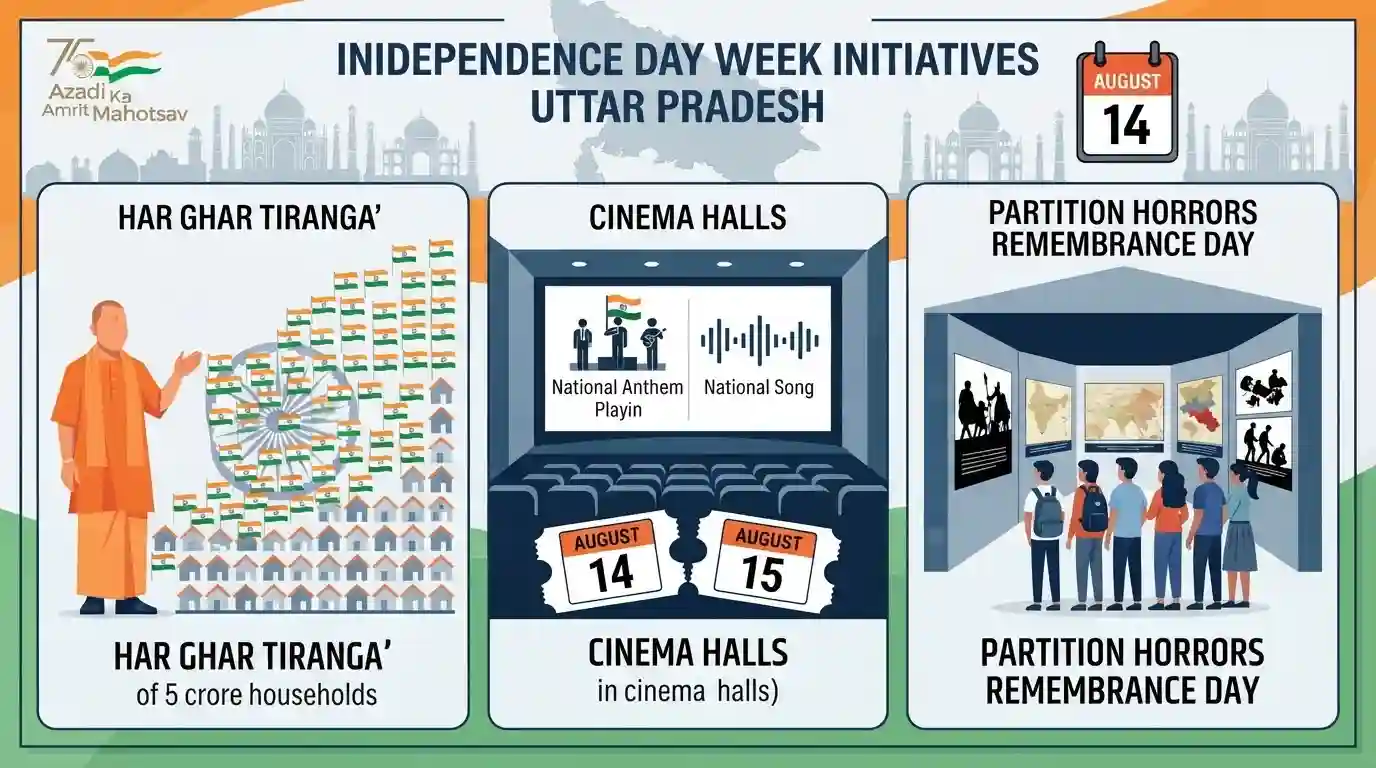
Uttar Pradesh Chief Minister Yogi Adityanath has launched preparations for the 'Har Ghar Tiranga' campaign under the 'Azadi Ka Amrit Mahotsav', aiming to unfurl the national flag at 5 crore households in the state. As part of the Independence Day week, the UP government has mandated the screening of the national song and national anthem in all cinema halls on August 14 and 15. Furthermore, exhibitions will be organized on August 14 to mark 'Partition Horrors Remembrance Day', educating the youth about the sacrifices and tragedies associated with India's partition.
Key Points
- Uttar Pradesh CM Yogi Adityanath urged the public to participate in the 'Har Ghar Tiranga' campaign by hoisting the national flag at 5 crore houses in the state.
- The campaign is being run under the broader 'Azadi Ka Amrit Mahotsav' initiative.
- Screening of the national song (Vande Mataram) and national anthem (Jana Gana Mana) has been made mandatory in all cinema halls in UP on August 14 and 15.
- The state will observe 'Partition Horrors Remembrance Day' on August 14 with dedicated exhibitions at all district headquarters to educate the younger generation about the tragedy of the Partition.
- The state will also honor families of freedom fighters and hold various patriotic competitions.
Important Terms
Har Ghar Tiranga

A nationwide campaign under Azadi Ka Amrit Mahotsav that encourages citizens to hoist the national flag at their homes, transforming our institutional relationship with the Tiranga into a deeply personal connection and fostering patriotism.
UPSC context
Relevant for GS Paper II (Polity/Governance), testing understanding of government-initiated citizen engagement and national identity campaigns.
Azadi Ka Amrit Mahotsav
A Government of India initiative celebrating and commemorating 75 years of independence, highlighting the nation's rich history, diverse culture, and milestone achievements through citizen-centric public events (Jan-Bhagidari).
UPSC context
Important for GS Paper I (Modern Indian History) and GS Paper II (Governance), focusing on post-independence history and public administration.
Flag Code of India, 2002
A comprehensive set of guidelines and laws governing the display, hoisting, and respectful usage of the Indian National Flag by the public, private organizations, and government institutions, amended to allow day-and-night display.
UPSC context
Essential for GS Paper II (Polity/Constitution), testing knowledge of national symbols, Article 51A (Fundamental Duties), and legal guidelines.
Partition Horrors Remembrance Day
Observed annually on August 14, this national memorial day commemorates the victims and massive displacements of the 1947 partition of India, promoting social harmony, empathy, and peaceful coexistence among all communities.
UPSC context
Relevant for GS Paper I (Modern Indian History), testing knowledge of the human impact and historic legacy of the 1947 partition.
Government of Uttar Pradesh
The subnational state governing authority of India's most populous state, established by the Constitution, consisting of a Governor as constitutional head, a Chief Minister-led Cabinet, and a bicameral legislature.
UPSC context
Relevant for GS Paper II (State Legislature and Executive), evaluating regional administration, federal relations, and local policy implementation.
Prelims Trap
"Article 51A(a) mandates respect for the National Anthem, National Flag, and the National Song."
Article 51A(a) explicitly mandates respect for the National Flag and the National Anthem. The National Song (Vande Mataram) is NOT explicitly mentioned in the Fundamental Duties.
Static Concepts Connected
What were the recent major amendments to the Flag Code of India, 2002?
- Polyester flags: Allowed the use of machine-made and polyester national flags, removing the strict restriction that only hand-spun/hand-woven Khadi could be used.
- Day and night: Permitted the National Flag to be flown day and night at private homes, amending the earlier rule restricting it from sunrise to sunset.
What is the Supreme Court's stance on playing the National Anthem in cinemas?
- Optional playing: In the 2018 Shyam Narayan Chouksey vs Union of India judgment, the Supreme Court ruled that playing the National Anthem prior to film screenings is optional, not mandatory.
- Storyline exception: The Court clarified that the audience does not need to stand up if the anthem is played as part of the film's storyline or newsreel.
Cross-Topic Patterns
State Directives vs Judicial Precedent
UP mandating the Anthem in cinemas contrasts with the SC's 2018 ruling making it optional, highlighting the tension between state executive orders and judicial precedents regarding Fundamental Duties.
Modern commemoration of Partition
Commemorating 'Partition Horrors Remembrance Day' links modern political directives directly to the Mountbatten Plan (June 3 Plan), making the 1947 timeline a high-yield area for history questions.

Expect a multi-statement Prelims question mixing Article 51A(a), the 2021 Flag Code amendments, and the exact status of the National Song.
Linked PYQs · 4
Linked PYQs · 4
- 2005UPPSC_PRELIMSGS1
Vande Mataram became the theme song of the Indian National Movement during
- 2022UPPSC_PRELIMSGS1
Which of the following is NOT a fundamental duty ?
- 2013UPPSC_PRELIMSGS1
The Mountbatten Plan became the basis for
- 2014UPPSC_PRELIMSGS1
The Indian Independence Bill received the Royal Assent on
