Cloud Seeding: Technological Limits in Curbing Delhi Smog
Source:The Hindu ↗
Why It Matters
Assesses the viability of technological interventions like cloud seeding for mitigating chronic urban air pollution, illustrating both the scientific mechanisms (using silver iodide/sodium chloride) and the practical limitations (dependence on atmospheric humidity).
Summary
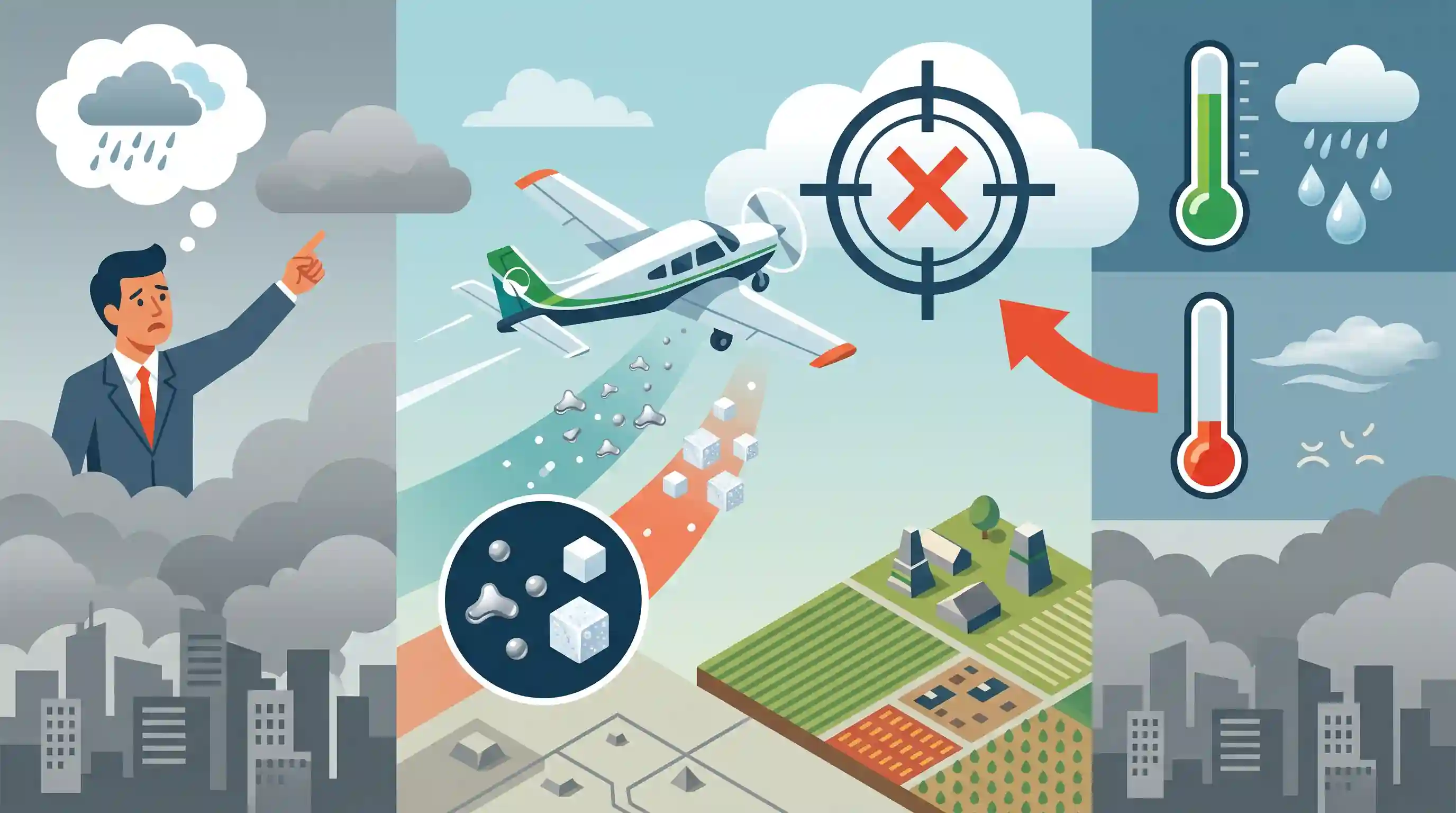
Delhi Chief Minister Rekha Gupta emphasized that cloud seeding is an essential measure for combating the city's severe winter air pollution. A recent artificial rain trial conducted over Burari by the Delhi government and IIT-Kanpur was unsuccessful due to insufficient atmospheric moisture (less than 20% compared to the required 50%). The experiment involved dispersing silver iodide and sodium chloride from a Cessna aircraft in an attempt to induce precipitation and wash out suspended particulate matter.
Key Points
- Delhi authorities are exploring cloud seeding as a technological intervention to combat severe winter air pollution and smog.
- A recent trial conducted jointly by the Delhi government and IIT-Kanpur over Burari involved dispersing silver iodide and sodium chloride flares from an aircraft.
- The experiment was unsuccessful because atmospheric moisture was less than 20%, falling short of the 50% minimum required for cloud seeding to induce precipitation.
- Artificial rain aims to wash down suspended particulate matter and pollutants, providing temporary relief from poor air quality.
- The trial highlights the weather-dependent limitations of using geoengineering and weather modification technologies for pollution control.
Important Terms
Cloud Seeding

A weather modification technique that disperses substances like silver iodide or salt into clouds to stimulate condensation and induce artificial precipitation.
UPSC context
GS Paper 3 (S&T/Environment); relevant for disaster management, drought mitigation, and innovative air pollution control strategies.
Particulate Matter (PM)
Microscopic solid or liquid particles suspended in the air (e.g., PM2.5, PM10) that can penetrate the respiratory system and cause severe health issues.
UPSC context
GS Paper 3 (Environment); central to understanding the Air Quality Index (AQI) and National Clean Air Programme (NCAP).
Silver Iodide
An inorganic compound used as a nucleating agent in glaciogenic cloud seeding due to its crystal structure being similar to natural ice.
UPSC context
GS Paper 3 (Science & Tech); tests technical knowledge of chemical agents used in weather modification and artificial rain.
IIT-Kanpur
A premier Indian technical university that provides scientific research and operational expertise for environmental technology demonstrations, including cloud seeding trials.
UPSC context
GS Paper 3 (S&T); represents the role of indigenous academic institutions in providing technological solutions for public policy challenges.
Relative Humidity
The amount of water vapor in the air relative to the maximum it can hold at that temperature, expressed as a percentage.
UPSC context
GS Paper 1 (Geography); vital for understanding cloud formation, precipitation thresholds, and the feasibility of weather modification.
Sodium Chloride (NaCl)
A hygroscopic salt used in warm-cloud seeding to attract water droplets and promote their growth into raindrops through collision-coalescence.
UPSC context
GS Paper 3 (Science & Tech); distinguishes between different types of artificial rain induction based on cloud temperature and agent properties.
Prelims Trap
"Cloud seeding can generate artificial clouds and induce precipitation even in completely dry, clear-sky winter conditions."
Cloud seeding cannot create clouds from thin air. It strictly requires pre-existing cloud cover and adequate atmospheric moisture (at least 50%) to accelerate precipitation.
Static Concepts Connected
What are the two primary methods and chemicals used in cloud seeding?
- Glaciogenic seeding: Injecting Silver Iodide or Dry Ice (solid CO2) into cold clouds to form ice crystals that grow and fall as snow or rain.
- Hygroscopic seeding: Dispersing salts like Sodium Chloride into warm clouds to act as cloud condensation nuclei, accelerating water droplet coalescence.
- Moisture prerequisite: Cloud seeding fundamentally relies on pre-existing atmospheric moisture (typically >50%) and cannot work in extremely dry conditions.
How does artificial rain reduce air pollution?
- Wet Deposition: Raindrops physically wash down suspended particulate matter (PM2.5, PM10) from the lower atmosphere, a process known as wet deposition.
- Temporary mitigation: It is merely a temporary, emergency measure that provides brief relief without addressing the root emission sources.
Cross-Topic Patterns
Cloud Seeding vs. GRAP Measures
While GRAP (Graded Response Action Plan) focuses on emission control at the source, cloud seeding acts as an end-of-pipe, emergency mitigation tool that is highly weather-dependent.
Geoengineering & Soil Toxicity
Prolonged use of silver iodide for localized weather modification raises ecological concerns regarding heavy metal accumulation in local soils and water bodies.
Geophysical Politics of Rainfall
Artificially modifying weather in one region may alter precipitation patterns in a neighboring state, raising legal and ethical questions over shared atmospheric resources.

Expect a Prelims question testing the specific chemicals used (Silver Iodide) and the prerequisite moisture conditions for cloud seeding.
Linked PYQs · 3
Linked PYQs · 3
- 2025PrelimsGS1
Artificial way of causing rainfall to reduce air pollution makes use of
- 2020MainsGS3
What are the key features of the National Clean Air Programme (NCAP) initiated by the Government of India?
- 2019PrelimsGS1
In the context of which of the following do some scientists suggest the use of cirrus cloud thinning technique and the injection of sulphate aerosol into stratosphere?
