Delhi Air Pollution: Evaluating Cloud Seeding as Emergency Tool
Source:The Hindu ↗
Why It Matters
Cloud seeding and weather modification are important S&T concepts directly tested in UPSC Prelims (e.g., 2025 question on silver iodide). Furthermore, mitigating severe urban air pollution is a persistent GS3 Mains theme, showcasing the transition from traditional policy measures (like NCAP) to emergency technological interventions.
Summary
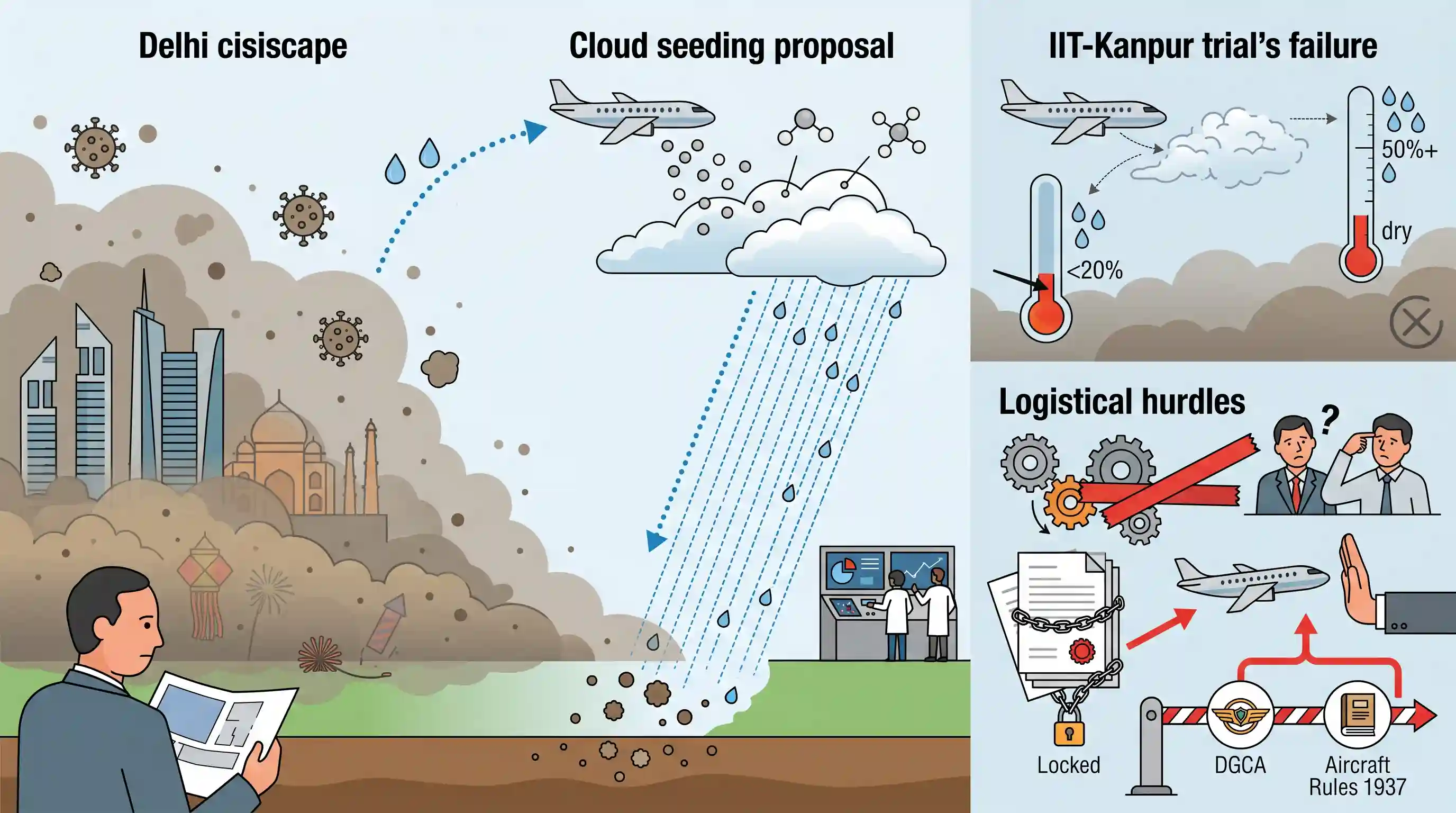
The Delhi government is exploring cloud seeding to induce artificial rain as an emergency mitigation strategy against severe post-Diwali winter smog. The technology, which disperses compounds like silver iodide and sodium chloride into clouds to trigger precipitation, aims to wash atmospheric particulate matter out of the air. However, recent trials conducted by IIT-Kanpur failed to produce rain due to insufficient atmospheric moisture (below 20%, compared to the required 50%). The initiative also faces regulatory hurdles, requiring extensive clearances from bodies like the DGCA under the Aircraft Rules, 1937, highlighting the complex logistical and meteorological constraints of using weather modification for pollution control.
Key Points
- The Delhi government plans to deploy cloud seeding (artificial rain) as an emergency measure to wash out post-Diwali smog and particulate matter.
- Cloud seeding involves dispersing agents like silver iodide and sodium chloride to act as ice or condensation nuclei, triggering precipitation.
- The technology requires specific meteorological conditions, particularly adequate cloud cover and a minimum atmospheric moisture level of 50%, which was not met during a recent trial by IIT-Kanpur (<20% moisture).
- Execution requires rigorous regulatory approvals, including clearances from the DGCA for modified aircraft under the Aircraft Rules, 1937.
Important Terms
Cloud Seeding

A weather modification technique that disperses substances like silver iodide or sodium chloride into clouds to stimulate condensation or ice crystal formation, thereby inducing artificial rain.
UPSC context
GS-III (Science & Technology/Environment). Relevant for innovative pollution mitigation strategies and disaster management (drought) applications.
Silver Iodide
An inorganic chemical compound used in cloud seeding as a glaciogenic agent; its ice-like crystalline structure facilitates the freezing of supercooled water droplets to trigger precipitation.
UPSC context
GS-III (S&T). Frequently tested in Prelims regarding chemical agents used in artificial rain and environmental technology.
Particulate Matter (PM)
Microscopic solids or liquid droplets (e.g., PM2.5, PM10) suspended in the atmosphere. They are major air pollutants that cause severe respiratory and cardiovascular health issues.
UPSC context
GS-III (Environment). Fundamental for understanding air quality indices (AQI) and urban pollution challenges in India.
Directorate General of Civil Aviation (DGCA)
The statutory regulatory body under the Ministry of Civil Aviation responsible for safety oversight, aircraft registration, and licensing of aviation personnel in India.
UPSC context
GS-II (Regulatory Bodies). Crucial for questions on governance, aviation safety, and the legal clearances required for specialized aerial operations.
Aircraft Rules, 1937
A comprehensive set of regulations framed under the Aircraft Act, 1934, governing the manufacture, possession, operation, and safety standards of all civil aircraft within Indian airspace.
UPSC context
GS-II (Governance/Legal Framework). Relevant for understanding the regulatory hurdles and procedures involved in deploying emergency technology like cloud seeding.
Prelims Trap
Cloud seeding can induce artificial rain to wash out pollution even in clear skies during dry winter smog.
Cloud seeding cannot create rain from clear skies; it strictly requires pre-existing moisture-laden clouds and a minimum atmospheric relative humidity of >50%.
Static Concepts Connected
How does cloud seeding work and what chemicals are used?
- Mechanism: Alters cloud microphysics by introducing artificial condensation or ice nuclei to trigger precipitation.
- Cold clouds: Uses Silver Iodide (AgI) or dry ice (solid CO2) to create ice crystals in sub-freezing clouds.
- Warm clouds: Uses hygroscopic salts like Sodium Chloride (NaCl) to gather moisture into larger, heavier droplets in warm clouds.
How does weather modification differ from solar geoengineering?
- Weather Modification: Localized, short-term changes affecting cloud microphysics, such as cloud seeding to induce rain or suppress hail.
- Solar Geoengineering: Macro-scale planetary cooling techniques, such as stratospheric sulphate aerosol injection or cirrus cloud thinning.
Cross-Topic Patterns
Tech-fixes vs. Structural AQM
Cloud seeding acts as an emergency "wet deposition" tool, contrasting with the CAQM's structural Graded Response Action Plan (GRAP) which mandates long-term emission source-control.
Silver Iodide & Environmental Toxicity
UPSC frequently tests chemical applications. Silver iodide's accumulation and potential ecological impact when washed into soil and water bodies directly links to environmental degradation themes.

A comparative multi-statement question on cloud seeding chemicals (AgI vs NaCl) and their specific humidity requirements is highly probable.
Linked PYQs · 4
Linked PYQs · 4
- 2025PrelimsGS1
Artificial way of causing rainfall to reduce air pollution makes use of
- 2020MainsGS3
What are the key features of the National Clean Air Programme (NCAP) initiated by the Government of India?
- 2019PrelimsGS1
In the context of which of the following do some scientists suggest the use of cirrus cloud thinning technique and the injection of sulphate aerosol into stratosphere?
- 2021MainsGS3
Describe the key points of the revised Global Air Quality Guidelines (AQGs) recently released by the World Health Organisation (WHO). How are these different from its last update in 2005? What changes in India's National Clean Air Programme are required to achieve these revised standards?
