Cloud seeding mechanism and winter air pollution in Delhi
Source:Indian Express ↗
Why It Matters
Delhi's annual winter air quality crisis is a persistent governance and public health challenge. For UPSC candidates, understanding the scientific mechanisms of technological interventions like cloud seeding, alongside the complex meteorological and anthropogenic drivers of smog, is crucial for evaluating environmental policies and short-term versus long-term mitigation strategies.
Summary
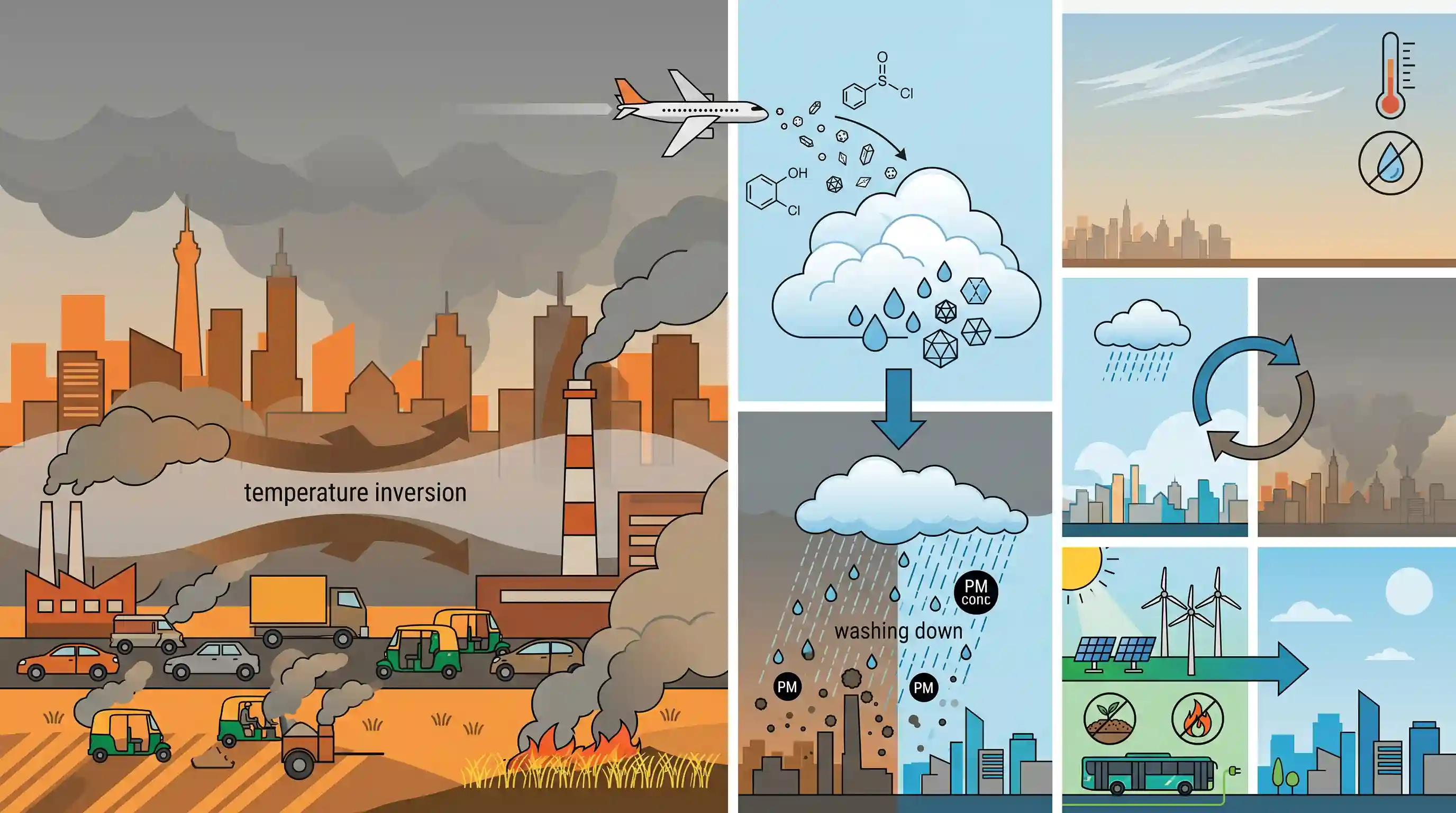
The article explores the viability and limitations of cloud seeding as an emergency intervention to mitigate severe winter air pollution in Delhi. It explains the scientific mechanism of artificial rain, which involves dispersing salts like silver iodide into clouds to induce precipitation and wash down atmospheric pollutants. However, the text highlights that this technique requires specific meteorological conditions, such as adequate cloud cover and moisture, which are frequently lacking during Delhi's winter smog peaks. It also details the geographical and anthropogenic factors driving the city's seasonal pollution—including temperature inversions, slow wind speeds, stubble burning, and vehicular emissions—emphasizing that cloud seeding offers only temporary relief and cannot replace sustainable, source-level pollution control measures.
Key Points
- Cloud seeding is a weather modification technique that uses agents like silver iodide and potassium iodide as ice nuclei to induce precipitation artificially.
- In the context of severe air pollution, artificial rain is proposed as a mechanism to wash down suspended particulate matter (PM2.5 and PM10) and clear the smog.
- The success of cloud seeding relies heavily on specific meteorological preconditions, primarily the presence of moisture-rich clouds, which are often absent during the dry winter months in Delhi.
- Delhi's winter pollution is exacerbated by temperature inversions that trap cold air and pollutants near the surface, combined with low wind speeds that prevent dispersion.
- Anthropogenic factors including stubble burning in neighboring states, vehicular emissions, construction dust, and industrial pollution remain the root causes of the crisis.
- Experts view artificial rain as a temporary, emergency measure that cannot substitute for long-term, source-level emission reductions and comprehensive air quality management.
Important Terms
Commission for Air Quality Management (CAQM)

A statutory body established in 2021 to coordinate and oversee air quality management in the National Capital Region (NCR) and adjoining states, replacing previous ad-hoc committees.
UPSC context
GS Paper 2 (Statutory Bodies) and Paper 3 (Environment); focuses on centralized environmental governance and regulatory powers.
Graded Response Action Plan (GRAP)
An emergency framework for Delhi-NCR that mandates specific stage-wise actions (restrictions on construction, vehicles, etc.) based on Air Quality Index (AQI) levels to prevent environmental worsening.
UPSC context
GS Paper 3 (Environmental Pollution); important for understanding reactive urban crisis management and pollution control protocols.
National Clean Air Programme (NCAP)
A 2019 national-level strategy aiming for a 20-40% reduction in particulate matter concentrations by 2026 across 131 identified 'non-attainment' cities.
UPSC context
GS Paper 3 (Government Policies/Environment); tests knowledge of long-term national pollution targets and city-specific action plans.
Cloud Seeding
A weather modification technique that disperses substances like silver iodide into clouds to stimulate precipitation, used as an experimental emergency measure to clear smog.
UPSC context
GS Paper 3 (Science & Tech); explores technological interventions in meteorology and their practical limitations in environmental mitigation.
Temperature Inversion
An atmospheric phenomenon where a layer of warm air traps cooler air near the ground, preventing the vertical dispersion of pollutants and worsening smog.
UPSC context
GS Paper 1 (Geography) and GS Paper 3 (Environment); explains the physical causes behind seasonal air quality spikes in northern India.
Prelims Trap
"Cloud seeding creates artificial clouds in clear skies to generate rain for washing down urban air pollution."
Cloud seeding cannot generate clouds from scratch. It strictly requires pre-existing moisture-laden clouds with sufficient vertical air motion to induce precipitation.
Static Concepts Connected
How does temperature inversion aggravate urban winter air pollution?
- Normal lapse rate: Normally, temperature decreases with altitude, allowing warm, polluted surface air to rise and disperse vertically into the atmosphere.
- The Inversion lid: During winter, a layer of warm air settles above cooler surface air, preventing upward vertical mixing.
- Pollutant trapping: This meteorological "lid" traps emissions from vehicles and stubble burning near the ground, creating dense smog.
What are the primary chemical agents used in cloud seeding?
- Silver/Potassium Iodide: Act as ice-nucleating particles in cold clouds, providing a crystalline structure for water vapor to freeze around.
- Dry Ice: Solid CO2 rapidly cools the surrounding cloud air, instantly triggering the formation of ice crystals.
- Hygroscopic salts: Calcium chloride or sodium chloride are dispersed into warm clouds to attract water vapor, forming heavy droplets.
Cross-Topic Patterns
Weather Modification vs Downwind Rights
Cloud seeding for pollution or drought mitigation raises unaddressed ethical and legal questions regarding moisture deprivation or "stealing rain" from neighboring or downwind regions.
Secondary Particulate Matter Formation
Trapped gases (NOx, SOx) under inversion layers undergo chemical reactions, forming secondary PM2.5. This makes source-level emission control (like BS-VI) far more critical than end-of-pipe fixes.

Expect a multi-statement question linking cloud seeding chemicals (AgI), its limitation in clear skies, and winter temperature inversions.
Linked PYQs · 3
Linked PYQs · 3
- 2025PrelimsGS1
Artificial way of causing rainfall to reduce air pollution makes use of
- 2022MainsGS3
Discuss in detail the photochemical smog emphasizing its formation, effects and mitigation. Explain the 1999 Gothenburg Protocol.
- 2020MainsGS3
What are the key features of the National Clean Air Programme (NCAP) initiated by the Government of India?
