Winter Meteorology Limits Cloud Seeding Success for Air Pollution
Source:Indian Express ↗
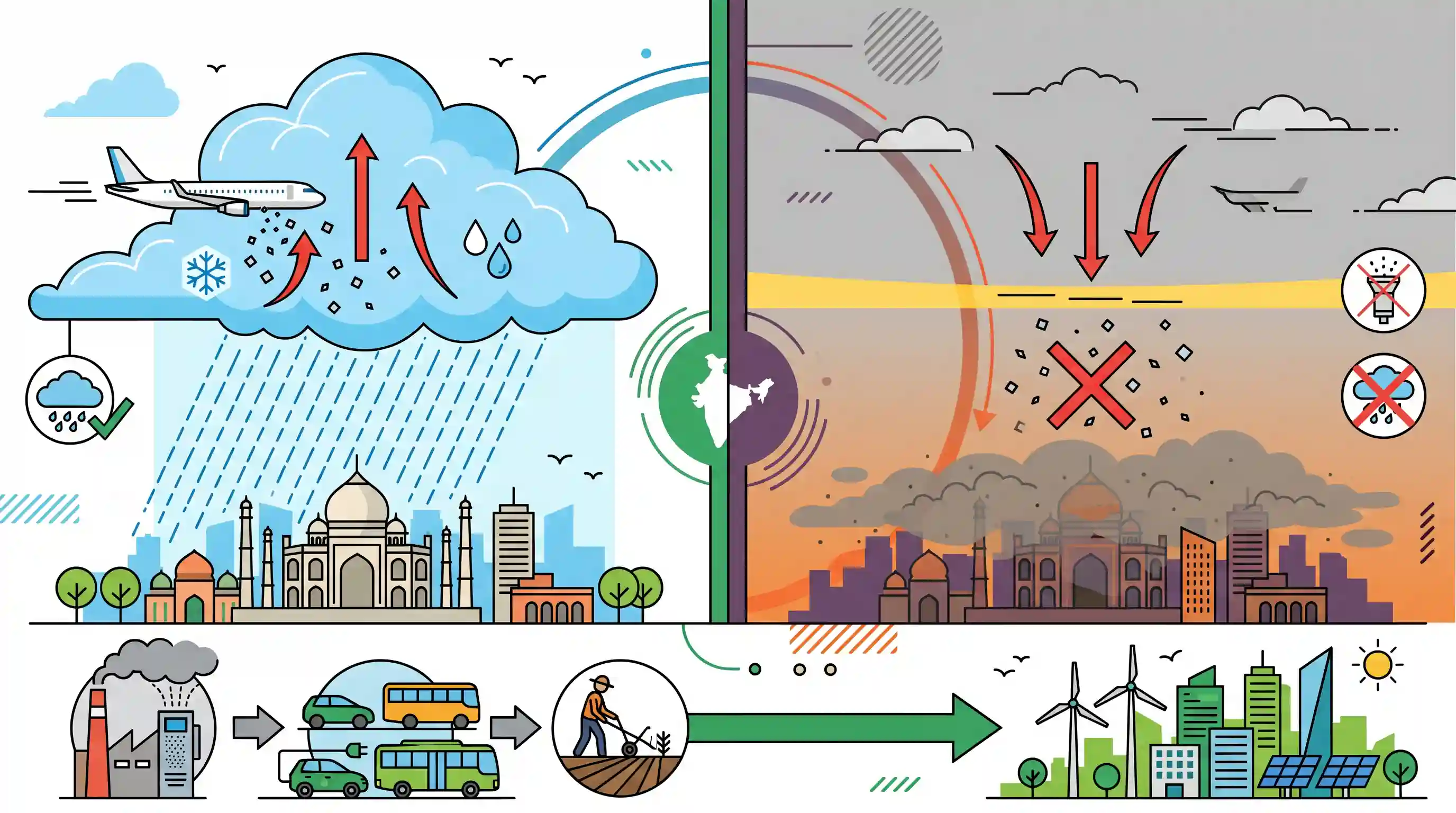
Why It Matters
It bridges Science & Technology (cloud seeding mechanisms) with Geography (North Indian winter weather systems, Western Disturbances) and Environment (air pollution). Aspirants need to understand why technological fixes cannot substitute for structural environmental governance, a recurring theme in UPSC Mains.
Summary
The article explains why cloud seeding, frequently proposed as a technological fix for Delhi's severe winter air pollution, has a very low probability of success. The process of inducing artificial rain requires specific meteorological conditions, particularly pre-existing clouds with sufficient supercooled moisture and vertical updrafts to disperse seeding agents like silver iodide. However, winter in Northwest India is dominated by anticyclonic conditions, subsidence of air, temperature inversions, and clear skies. While Western Disturbances occasionally bring clouds, they rarely possess the required moisture or updrafts for effective seeding. Consequently, artificial rain cannot replace sustained, source-level emission controls to address the region's air quality crisis.
Key Points
- Cloud seeding involves dispersing agents like silver iodide or potassium iodide into clouds to act as ice nuclei, encouraging water droplets to freeze, grow, and fall as precipitation.
- Successful artificial rain requires pre-existing clouds with adequate supercooled liquid water and strong vertical updrafts to mix the seeding agents.
- During winter, Northwest India experiences anticyclonic conditions causing air subsidence, high atmospheric stability, and clear skies, which are highly unfavorable for cloud formation.
- Even when Western Disturbances bring winter clouds, they often lack the vertical depth or sufficient moisture content necessary for effective cloud seeding.
- Relying on artificial rain to combat Delhi's severe winter smog is scientifically unfeasible; long-term mitigation requires controlling emissions at their source.
Important Terms
Cloud Seeding

A weather modification technique that disperses substances like silver iodide or salt into clouds to stimulate precipitation. It requires existing moisture-rich clouds and vertical updrafts.
UPSC context
GS III (Science & Tech/Environment). Tests understanding of technological fixes for pollution and their meteorological limitations.
Graded Response Action Plan (GRAP)
An emergency framework for Delhi-NCR that triggers specific stage-wise restrictions (on construction, vehicles, and industries) based on the severity of the Air Quality Index (AQI).
UPSC context
GS III (Environment/Governance). Tests knowledge of statutory pollution control mechanisms and urban air quality management.
National Clean Air Programme (NCAP)
A national-level strategy launched in 2019 targeting a 20–40% reduction in particulate matter (PM2.5 and PM10) concentrations across 131 non-attainment cities by 2024-2026.
UPSC context
GS III (Environment). Tests awareness of long-term national policy targets and strategies for tackling particulate pollution.
Western Disturbances
Extra-tropical storms originating in the Mediterranean region that bring essential winter rain and snow to Northwest India, crucial for Rabi crops.
UPSC context
GS I (Geography). Tests knowledge of seasonal precipitation patterns, Indian climatology, and their impact on agriculture.
Temperature Inversion
A meteorological condition where warm air settles above colder air near the ground, trapping pollutants and preventing vertical mixing, often causing severe smog.
UPSC context
GS I (Geography) & GS III (Environment). Tests understanding of atmospheric stability and its direct impact on pollution.
India Meteorological Department (IMD)
The nodal agency under the Ministry of Earth Sciences responsible for meteorological observations, weather forecasting, and issuing warnings for severe weather events.
UPSC context
GS I/III (Geography/Science). Tests awareness of key scientific bodies providing critical data for agriculture and disaster management.
Prelims Trap
"Cloud seeding involves dispersing chemical agents to create artificial clouds and induce rain during clear-sky conditions."
Cloud seeding cannot create clouds from clear skies. It strictly requires pre-existing clouds with adequate supercooled moisture and vertical updrafts to induce precipitation.
Static Concepts Connected
What are the scientific mechanisms and chemicals used in cloud seeding?
- Ice Nucleation: Glaciogenic seeding uses Silver Iodide or Dry Ice, which act as artificial ice condensation nuclei in supercooled clouds to trigger freezing and precipitation.
- Condensation: Hygroscopic seeding uses salts like Potassium Iodide or Sodium Chloride to attract moisture and accelerate water droplet coalescence in warmer clouds.
- Prerequisites: The process strictly requires pre-existing moisture-rich clouds and vertical updrafts to mix the agents; it is impossible in stable, clear skies.
How do winter meteorological conditions exacerbate air pollution in Northwest India?
- Subsiding Air: Winter is characterized by anticyclonic conditions over NW India, causing air to subside (sink) rather than rise, leading to high atmospheric stability.
- Temperature Inversion: Normally, temperature decreases with altitude. During winter, a layer of warm air sits above cold surface air, a phenomenon called temperature inversion.
- Trapping Pollutants: This stable inversion layer acts as a 'lid', preventing the vertical dispersion of particulate matter (PM2.5) and trapping pollutants close to the ground.
Cross-Topic Patterns
Techno-fixes vs Source Reduction
Like smog towers, cloud seeding highlights the limitations of treating pollution symptoms (technological fixes) rather than addressing root causes like vehicular emissions or stubble burning—a recurring GS3 Mains theme.
Western Disturbances & Winter Climatology
Western Disturbances bring the only viable winter clouds to NW India. Their changing frequency and intensity impact both Rabi crop yields (GS1/GS3) and winter smog dispersion capabilities.

A 2026 Prelims question will likely combine the chemical agents of cloud seeding (Silver Iodide) with its strict meteorological prerequisites (pre-existing clouds, updrafts).
Linked PYQs · 5
Linked PYQs · 5
- 2025PrelimsGS1
Artificial way of causing rainfall to reduce air pollution makes use of
- 2015PrelimsGS1
Consider the following statements: 1. The winds which blow between 30° N and 60° S latitudes through-out the year are known as westerlies. 2. The moist air masses that cause winter rains in North-Western region of India are part of westerlies. Which of the statements given above is/are correct?
- 2022PrelimsGS1
In the context of WHO Air Quality Guidelines, consider the following statements: 1. The 24-hour mean of PM2.5 should not exceed 15 µg/m³ and annual mean of PM2.5 should not exceed 5 µg/m³. 2. In a year, the highest levels of ozone pollution occur during the periods of inclement weather. 3. PM10 can penetrate the lung barrier and enter the bloodstream. 4. Excessive ozone in the air can trigger asthma. Which of the statements given above are correct?
- 2015MainsGS1
Mumbai, Delhi and Kolkata are the three mega cities of the country but the air pollution is much more serious problem in Delhi as compared to the other two. Why is this so?
- 2020MainsGS3
What are the key features of the National Clean Air Programme (NCAP) initiated by the Government of India?
