Cervical Cancer Burden in India and Prevention Strategies
Source:Indian Express ↗
આ શા માટે મહત્વનું છે
Highlights the intersection of health policy, social equity, and science & technology in addressing a major public health crisis. It provides critical data points and policy suggestions (like the National Essential Diagnostics List) for GS2 answers on health infrastructure and gender disparities, as well as GS3 answers on the application of medical technology and vaccines.
સારાંશ
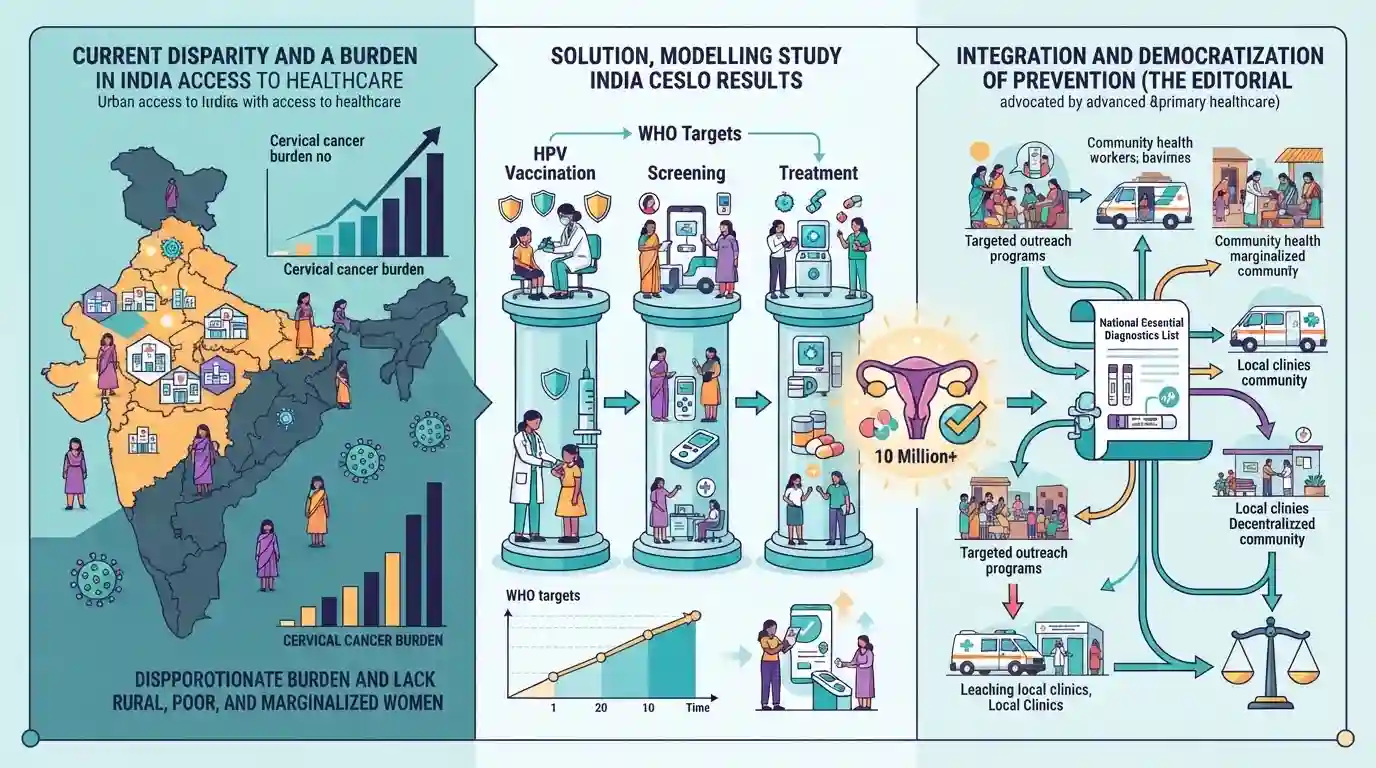
A recent modelling study in The Lancet indicates that India could prevent over 10 million cervical cancer cases in the next century by fulfilling WHO targets for HPV vaccination, screening, and treatment. Despite being highly preventable, cervical cancer places a disproportionately heavy burden on India. Access to preventive healthcare like the HPV vaccine and regular screening remains skewed against rural, poor, and socially marginalized women, creating stark regional disparities. The editorial advocates for targeted outreach, overcoming socio-cultural barriers, and integrating HPV nucleic acid testing into the National Essential Diagnostics List to democratize disease prevention and achieve health equity.
મુખ્ય મુદ્દા
- India faces a massive cervical cancer burden, with over 1.2 lakh new cases and approximately 80,000 deaths annually.
- A study in The Lancet estimates that India could prevent over 10 million cases in the next century by meeting WHO targets: 90% vaccination by age 15, 70% screening by age 30, and 90% treatment coverage.
- National screening rates are extremely low at around 2%, with sharp regional disparities (e.g., over 10% in Tamil Nadu compared to 0.2% in Assam and West Bengal).
- Access to the HPV vaccine and early screening remains inequitable, disproportionately affecting rural, poorer, and socially marginalized women due to awareness and infrastructure gaps.
- The editorial recommends integrating HPV nucleic acid testing into the National Essential Diagnostics List and scaling up targeted outreach to close the equity gap in the new national vaccination drive.
મહત્વપૂર્ણ શબ્દો
National Essential Diagnostics List (NEDL)

A comprehensive registry formulated by the Indian Council of Medical Research (ICMR) that outlines critical, affordable diagnostic tests required across all tiers of India's public healthcare facilities.
UPSC context
GS Paper II (Social Justice/Health): Tests knowledge of health governance, diagnostic infrastructure, and measures to reduce out-of-pocket expenditure.
Universal Immunization Programme (UIP)
One of the world's largest public health campaigns, launched by India in 1985 to provide free, essential vaccines against 12 preventable diseases to children and pregnant women.
UPSC context
GS Paper II (Health/Governance): Analyzes public health delivery, immunization milestones, and initiatives like Mission Indradhanush.
HPV Vaccination Programme
A nationwide, state-sponsored immunization initiative launched in 2026 targeting adolescent girls to provide free Human Papillomavirus vaccines for preventing cervical cancer.
UPSC context
GS Paper II (Women & Child Development): Evaluates gender-responsive healthcare, cervical cancer prevention, and public vaccine infrastructure.
World Health Organization (WHO)
A specialized agency of the United Nations established in 1948, mandated to direct and coordinate international public health, establish global healthcare standards, and combat epidemics.
UPSC context
GS Paper II (International Relations): Tests understanding of multilateral health agencies, global governance, and disease elimination strategies.
Cervical Cancer
A highly preventable cancer of the cervix primarily caused by persistent high-risk Human Papillomavirus (HPV) infection, standing as the second most common cancer among Indian women.
UPSC context
GS Paper III (Science and Technology): Focuses on public health challenges, non-communicable disease control, and medical/indigenous vaccine breakthroughs.
પ્રિલિમ્સ ટ્રેપ
Cervavac is a therapeutic vaccine used to cure active cervical cancer and clear pre-existing HPV infections in adult women.
Cervavac is a prophylactic (preventive) vaccine. It triggers neutralizing antibodies to prevent infection before exposure (best for girls aged 9-14) but cannot cure active infections or established cancer.
સંલગ્ન સ્થિર ખ્યાલો
What is the National Essential Diagnostics List (NEDL)?
- First globally: Launched by India in 2019, compiled by ICMR, making India the first country to define a standardized baseline of essential diagnostic tests.
- Core Objective: Aims to standardize diagnostic services, improve clinical outcomes, and drastically reduce out-of-pocket health expenditure (OOPE) at primary/secondary levels.
- Complementary role: Acts as a companion framework to the National List of Essential Medicines (NLEM) to harmonize free public testing and treatment protocols.
What is a Quadrivalent Vaccine and how does it work against HPV?
- Four-strain coverage: Targets four distinct strains of a pathogen; for HPV, it targets high-risk oncogenic strains 16/18 (cancer-causing) and strains 6/11 (causing warts).
- VLP Technology: Uses non-infectious recombinant Virus-Like Particles (VLPs) to mimic the viral capsid, stimulating strong antibody production without introducing live viral DNA.
- Prophylactic nature: Acts preventatively by blocking viral entry into host cells, meaning it must be administered prior to exposure to be effective.
આંતર-વિષય પેટર્ન
Federal health disparities
Varying cervical screening rates (10% in Tamil Nadu vs 0.2% in Assam) highlight the uneven execution of national health policies across different state administrations.
Socio-economic cost of care
High cervical cancer mortality correlates with lack of early screening, pushing vulnerable rural households into catastrophic health expenditures and generational poverty.

Expect questions linking HPV biological transmission, Cervavac's quadrivalent nature, and the WHO 90-70-90 elimination strategy by 2030.
સંલગ્ન PYQ · 3
સંલગ્ન PYQ · 3
- 2022MainsGS3
What is the basic principle behind vaccine development ? How do vaccines work? What approaches were adopted by the Indian vaccine manufacturers to produce COVID-19 vaccines ?
- 2020MainsGS2
In order to enhance the prospects of social development, sound and adequate health care policies are needed particularly in the fields of geriatric and maternal health care. Discuss.
- 2020PrelimsGS1
What is the importance of using Pneumococcal Conjugate Vaccines in India? 1. These vaccines are effective against pneumonia as well as meningitis and sepsis. 2. Dependence on antibiotics that are not effective against drug-resistant bacteria can be reduced. 3. These vaccines have no side effects and cause no allergic reactions. Select the correct answer using the code given below:
