Addressing Disparities and Prevention Gaps in Cervical Cancer Care
Source:Indian Express ↗
Why It Matters
Addresses critical shortcomings in India's preventive healthcare infrastructure and highlights the social determinants of health outcomes. It is highly relevant for analyzing grassroots healthcare delivery, immunisation strategies, and social justice issues within the GS2 syllabus.
Summary
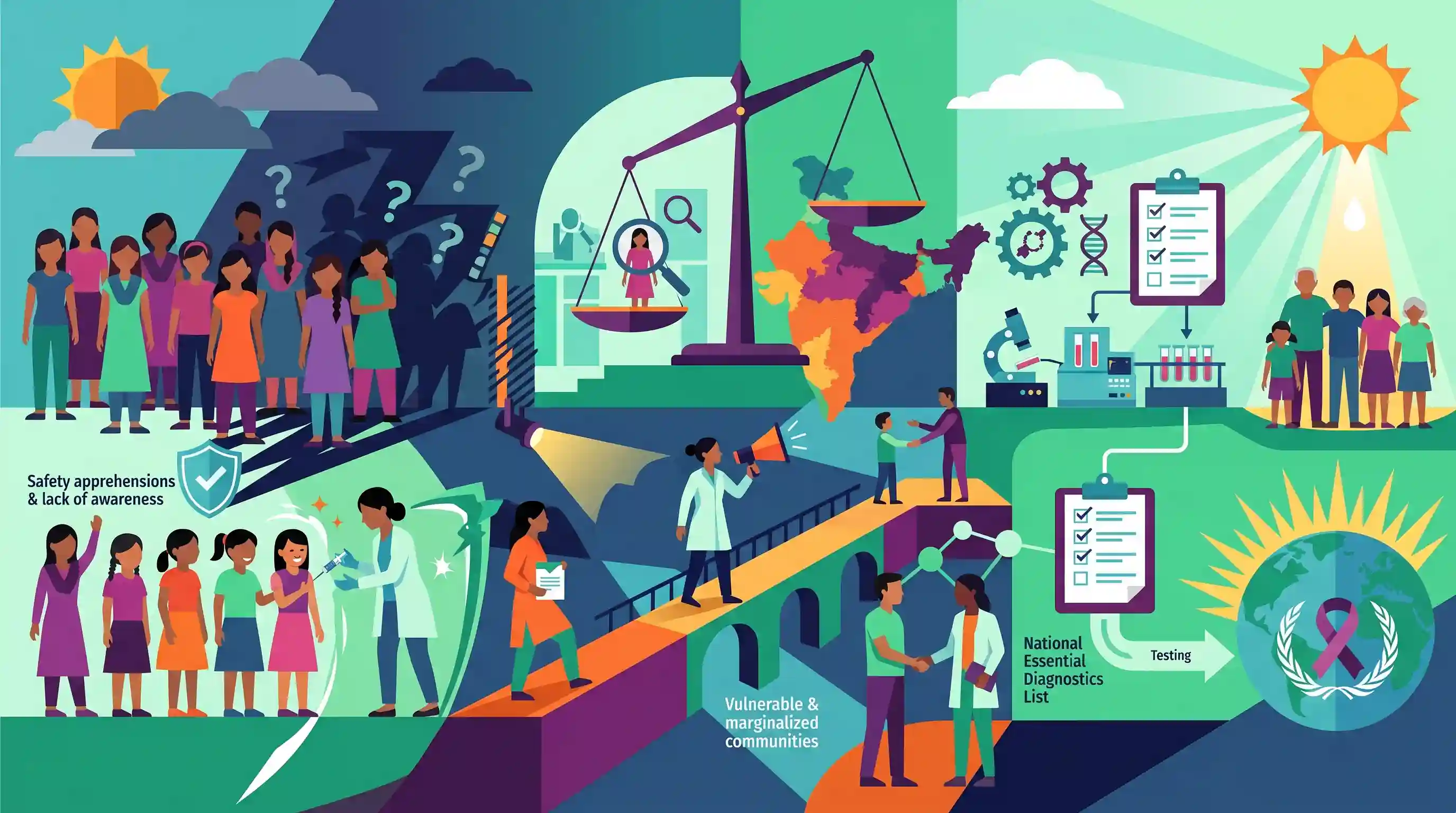
An editorial emphasizing the urgent need to address India's severe cervical cancer burden by focusing on proactive prevention and healthcare equity. Although India launched an HPV vaccination program for adolescent girls in early 2026, uptake remains uneven due to safety apprehensions and lack of awareness. Furthermore, cervical cancer screening rates are abysmally low and marred by sharp regional disparities, disproportionately affecting vulnerable and marginalized communities. The article advocates for targeted outreach and the inclusion of HPV nucleic acid testing in the National Essential Diagnostics List to narrow these disparities and align with WHO elimination targets.
Key Points
- India bears nearly a quarter of the global cervical cancer burden, with 1.2 lakh new cases and 80,000 deaths annually.
- A Lancet study indicates that achieving WHO targets (90% vaccination by age 15, 70% screening at age 30+, and 90% treatment) could prevent over 10 million cases in India over the next century.
- Despite the launch of an HPV vaccination program for adolescent girls in February 2026, participation remains uneven due to persisting safety concerns and information gaps.
- Cervical cancer screening rates in India are extremely low (around 2% of eligible women), with stark regional disparities, such as Tamil Nadu exceeding 10% while Assam and West Bengal stand at 0.2%.
- The disease disproportionately impacts vulnerable communities, including rural, poorer households, and marginalized populations.
- Experts recommend integrating HPV nucleic acid testing into the National Essential Diagnostics List to boost early detection and bridge healthcare inequities.
Important Terms
National Essential Diagnostics List (NEDL)

A list compiled by ICMR (first in 2019) specifying essential diagnostic tests available at various healthcare tiers to improve patient outcomes and reduce out-of-pocket expenses.
UPSC context
GS Paper 2: Governance/Health; tests knowledge of healthcare infrastructure and ICMR's role in diagnostics.
Universal Immunization Programme (UIP)
One of the world's largest public health programs providing free vaccines against life-threatening diseases. In 2026, India launched a nationwide HPV campaign for adolescent girls for inclusion here.
UPSC context
GS Paper 2: Social Justice/Health; tests understanding of national health missions and preventive care.
WHO 90-70-90 Targets
The World Health Organization's 2030 goals to eliminate cervical cancer: 90% girls vaccinated by age 15, 70% women screened twice, and 90% of those identified treated.
UPSC context
GS Paper 2: International Relations/Health; tests awareness of global health standards and India's alignment with international targets.
The Lancet
A highly influential peer-reviewed medical journal. Its commission reports often provide roadmaps for India's healthcare reforms, such as Universal Health Coverage targets for 2047.
UPSC context
GS Paper 2/3: Health/S&T; used as an authoritative source for data in Mains answers.
HPV Nucleic Acid Testing
A molecular screening method that detects the DNA or RNA of high-risk HPV types. It is considered more accurate than traditional Pap smears for cervical cancer detection.
UPSC context
GS Paper 3: Science and Technology; tests technical knowledge of diagnostic advancements and cancer prevention.
Human Papillomavirus (HPV)
A viral infection that is the primary cause of cervical cancer. Preventive vaccines like Gardasil-4 and India's indigenous Cervavac target high-risk strains (16 and 18).
UPSC context
GS Paper 3: S&T/Biology; tests basic understanding of viral diseases and domestic vaccine development.
Prelims Trap
"CERVAVAC provides lifelong immunity against all variants of the Human Papillomavirus (HPV)."
CERVAVAC is a quadrivalent vaccine. It targets only the four most high-risk strains (6, 11, 16, and 18) responsible for most cervical cancers, not all HPV variants.
Static Concepts Connected
What is the National Essential Diagnostics List (NEDL)?
- Genesis: Formulated by ICMR in 2019, making India the first country globally to release a dedicated list of essential diagnostic tests.
- Objective: It complements the National List of Essential Medicines (NLEM) to ensure baseline availability of diagnostic testing across public health facilities.
- Tiered Structure: The list is mapped hierarchically, recommending specific tests for village level, primary health centres, and district hospitals.
What is the WHO 90-70-90 elimination strategy for cervical cancer?
- Vaccination: 90% of all girls fully vaccinated against HPV by the age of 15.
- Screening: 70% of women screened using a high-performance test by age 35, and again by age 45.
- Treatment: 90% of women identified with precancer treated, and 90% of women with invasive cancer managed.
Cross-Topic Patterns
Indigenous Biotech + Universal Immunisation
The rollout of CERVAVAC mimics the past integration of the indigenous Rotavirus vaccine into Mission Indradhanush, bridging GS3 (Biotech indigenization) with GS2 (Health interventions).
Health Disparities & Fiscal Federalism
The stark screening divide (Tamil Nadu vs. Assam) highlights systemic capacity gaps in Eastern states, complicating Finance Commission 'health performance' parameters and GS2 federalism debates.

Expect a multi-statement Prelims question pairing CERVAVAC's quadrivalent mechanism (S&T) with the WHO's 90-70-90 cervical cancer targets.
Linked PYQs · 3
Linked PYQs · 3
- 2024MainsGS2
In a crucial domain like the public healthcare system the Indian State should play a vital role to contain the adverse impact of marketisation of the system. Suggest some measures through which the State can enhance the reach of public healthcare at the grassroots level.
- 2021MainsGS2
“Besides being a moral imperative of a Welfare State, primary health structure is a necessary precondition for sustainable development.” Analyze.
- 2019PrelimsGS1
Which one of the following statements is not correct?
