Climate study projects persistent drying of Cauvery river basin
Source:The Hindu ↗
Why It Matters
This study provides concrete scientific data on how climate change disparately impacts regional hydrology in India. It is highly relevant for UPSC questions dealing with geographical aspects of water stress, the viability of river interlinking as a mitigation strategy, and the ecological/climate basis of inter-state water conflicts.
Summary
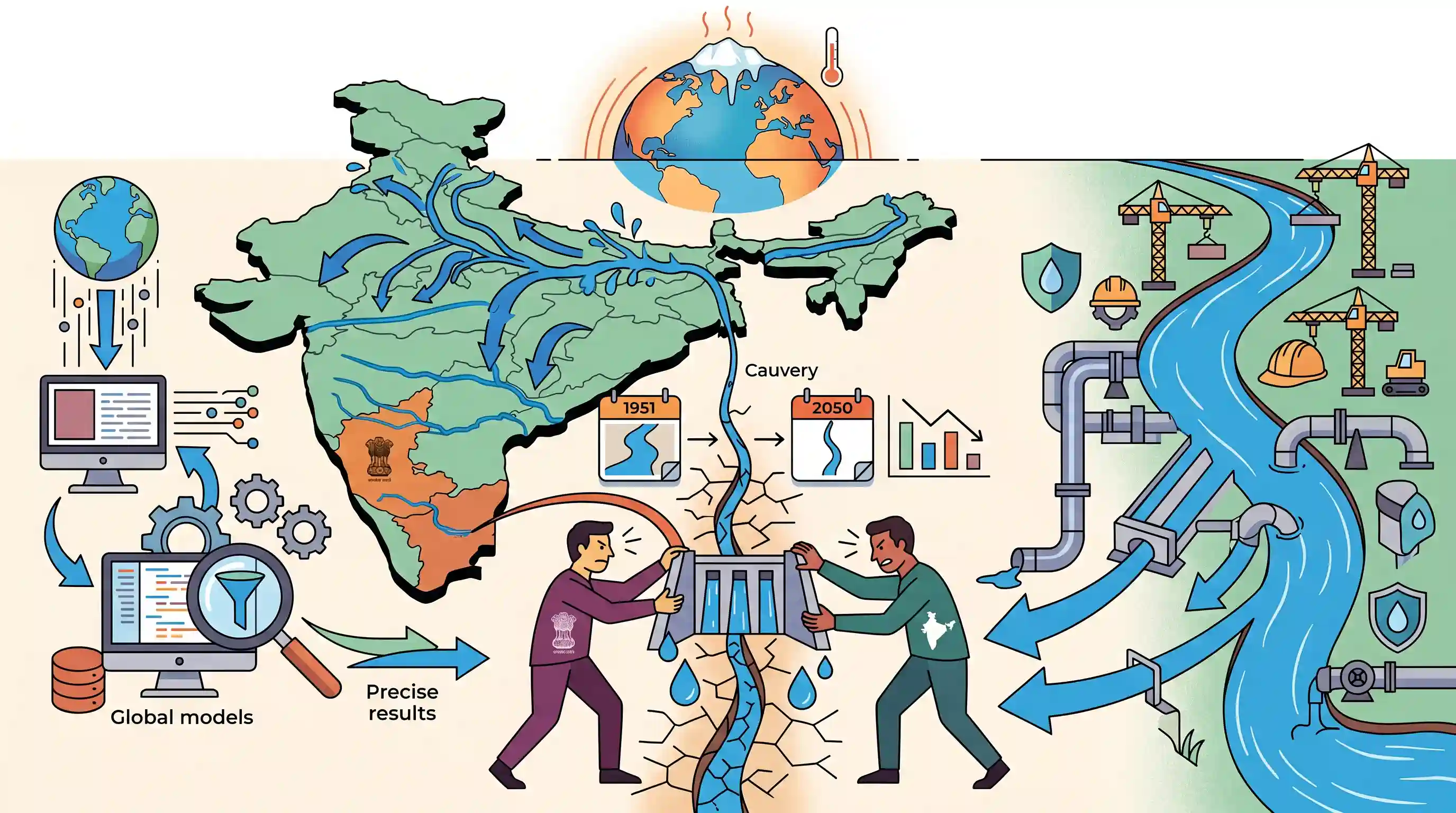
A recent study by IIT Gandhinagar researchers warns that the Cauvery river basin will continue to experience a near-term water decline of around 3.5% until 2050, even as global warming is projected to cause other Indian rivers to swell. Using a novel 'constrained modelling' approach to correct biases in global climate models, researchers found that the Cauvery's streamflow has already declined by 28% since 1951. This persistent drying trend threatens to intensify the long-standing water sharing disputes between Karnataka and Tamil Nadu. The study's findings underscore the growing regional disparity in water availability due to climate change and highlight the potential necessity of interventions such as the Godavari-Cauvery river interlinking project to ensure water security.
Key Points
- A climate study predicts the Cauvery river basin will face a near-term water decline of approximately 3.5% between 2026 and 2050, contrasting with other Indian rivers expected to swell due to global warming.
- Researchers used a 'constrained modelling' approach to calibrate raw global climate models (CMIP6) with actual observations, revealing that only 8 out of 22 models accurately captured Indian monsoon seasonality.
- Historically, the Cauvery basin has already experienced a significant 28% decline in streamflow between 1951 and 2012.
- The projected shrinking of the Cauvery River could severely exacerbate existing inter-state water sharing conflicts between Karnataka and Tamil Nadu.
- The findings strengthen the argument for mega-infrastructure solutions, such as the proposed Godavari-Cauvery river interlinking project, to address regional water stress and imbalances.
Important Terms
Godavari-Cauvery Link Project

Proposed peninsular river-linking project to divert ~247 TMC of surplus Godavari water to the Krishna, Pennar, and Cauvery basins via dams and canals.
UPSC context
GS Paper 3: Infrastructure and Water Management; tests understanding of inter-basin water transfer and drought mitigation.
IIT Gandhinagar Study
A 2026 climate study by researchers here used 'constrained modelling' to predict a 3.5% decline in Cauvery's flow by 2050.
UPSC context
GS Paper 1: Geography (Climate Change); tests knowledge of regional disparities in water availability due to global warming.
Cauvery Water Disputes Tribunal (CWDT)
Established in 1990, it issued a 2007 award (modified in 2018) to resolve water-sharing between Karnataka, Tamil Nadu, Kerala, and Puducherry.
UPSC context
GS Paper 2: Governance/Inter-state Relations; tests understanding of statutory mechanisms for resolving riparian conflicts.
Supreme Court (Cauvery Verdict)
The apex court's 2018 ruling declared Cauvery a 'national asset' and mandated the creation of the Cauvery Water Management Authority (CWMA).
UPSC context
GS Paper 2: Judiciary/Federalism; tests knowledge of the Court's role in enforcing water equity and modifying tribunal awards.
Constrained Modelling
Statistical approach used to correct biases in global climate models by aligning projections with historical observations for higher accuracy.
UPSC context
GS Paper 3: Science and Tech/Environment; tests awareness of advanced methodologies in climate change impact assessment.
CMIP6 Models
The latest generation of global climate models used by scientists to project future environmental changes and water availability.
UPSC context
GS Paper 3: Environment; tests familiarity with international scientific standards for climate change projections.
Inter-state Water Disputes Act, 1956
Legislation under Article 262 that empowers the Union to establish tribunals for adjudicating disputes over inter-state river waters.
UPSC context
GS Paper 2: Polity/Federal Structure; tests knowledge of constitutional provisions for managing shared natural resources.
Prelims Trap
"Due to climate change, all major peninsular rivers in India will face a severe decline in streamflow by 2050."
The IIT study explicitly notes a contrast: while most other Indian rivers are expected to swell due to global warming, Cauvery uniquely faces a persistent decline.
Static Concepts Connected
What is the geographical profile of the Cauvery river basin?
- Origin: Rises at Talakaveri in the Brahmagiri range of the Western Ghats (Karnataka).
- Basin States: Spreads across the states of Tamil Nadu, Karnataka, Kerala, and the Union Territory of Puducherry.
- Key Tributaries: Left bank: Harangi, Hemavati, Shimsha, Arkavathy. Right bank: Lakshmantirtha, Kabini, Suvarnavathi, Bhavani, Noyyal, Amaravati.
How are inter-state river water disputes governed under the Constitution?
- Article 262: Empowers Parliament to provide for the adjudication of any dispute with respect to inter-state rivers or river valleys.
- Legislation: Parliament enacted the Inter-State River Water Disputes Act, 1956, which allows the Centre to set up ad-hoc tribunals.
- Judicial Review: While the Supreme Court's original jurisdiction is excluded under Art 262, it can still hear appeals via Special Leave Petitions (Article 136).
Cross-Topic Patterns
Climate Change & Cooperative Federalism
Resource scarcity driven by climate models directly strains constitutional federalism, shifting water disputes from historical allocation issues to managing projected future deficits.
Peninsular River Interlinking
The drying Cauvery strengthens the economic case for the Godavari-Cauvery link under the National Perspective Plan, reigniting debates on ecological costs vs. water security.

Geography of the Cauvery basin combined with the constitutional mechanics of water dispute tribunals is highly probable for 2026 Prelims.
Linked PYQs · 4
Linked PYQs · 4
- 2011MainsGS1
Discuss the impact of climate change on water resources in India.
- 2019MainsGS1
What is water stress? How and why does it differ regionally in India?
- 2015MainsGS1
India is well endowed with fresh water resources. Critically examine why it still suffers from water scarcity.
- 2020MainsGS1
The interlinking of rivers can provide viable solutions to the multi-dimensional inter-related problems of droughts, floods and interrupted navigation. Critically examine.
