Climate Risk Index Findings on Extreme Weather Vulnerability
Source:Indian Express ↗
Why It Matters
The Climate Risk Index is critical for Prelims (factual questions about reports/indices and ranking bodies) and Mains GS3 (providing empirical data to substantiate answers on climate-induced disasters, economic impacts, and the need for robust adaptation and disaster management strategies in India).
Summary
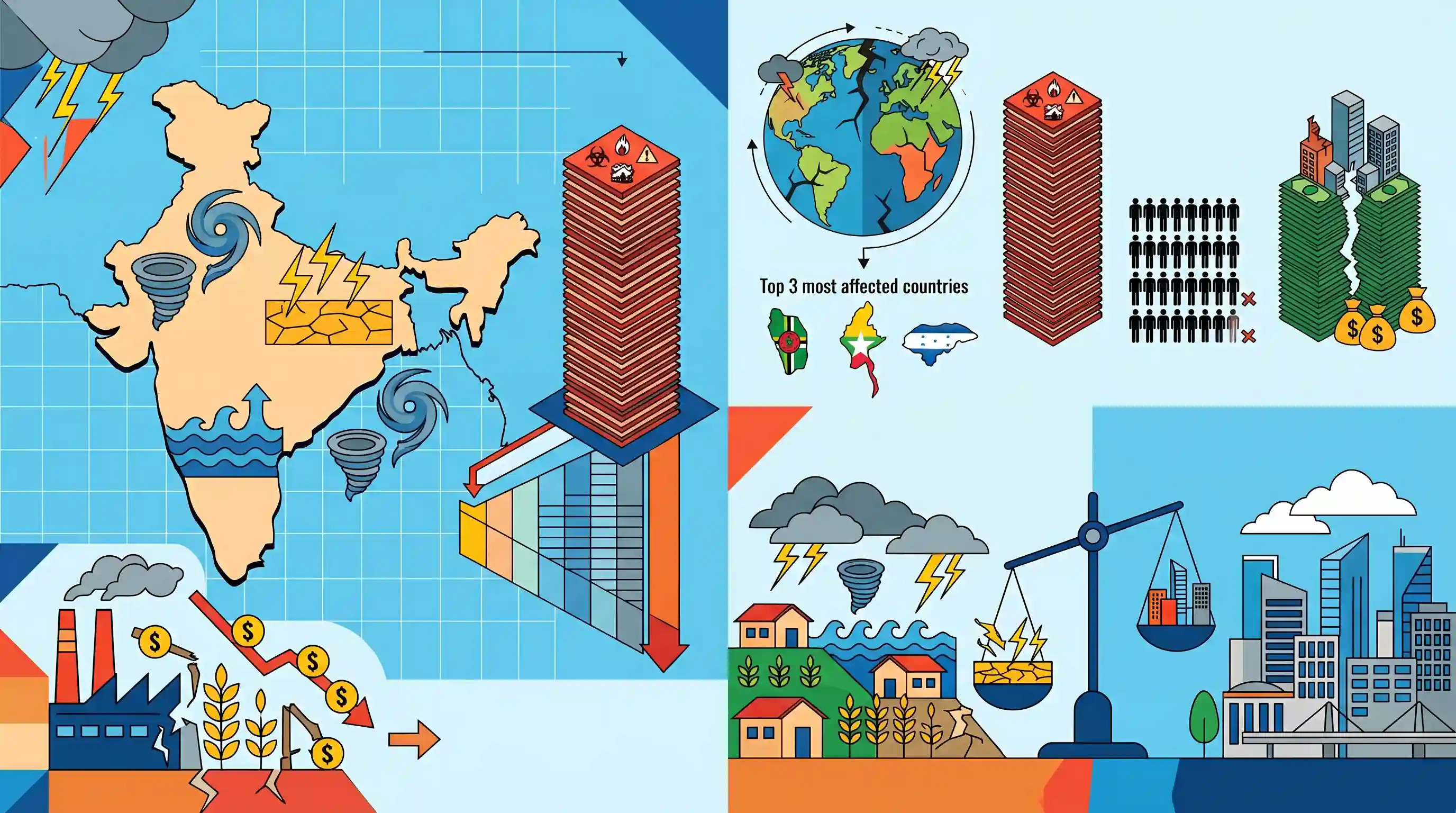
The Germanwatch Climate Risk Index 2026 identifies India as the 9th most vulnerable country to climate-related extreme weather events between 1995 and 2024. Over this period, India faced 430 major disasters—including devastating cyclones, droughts, and floods—costing the economy $170 billion. While India's annual vulnerability rank improved to 15 in 2024, the report underscores the disproportionate burden borne by developing nations. Globally, 9,700 climate disasters claimed 832,000 lives and caused $4.5 trillion in losses, with Dominica, Myanmar, and Honduras identified as the top three most affected countries.
Key Points
- Germanwatch released the Climate Risk Index 2026, analyzing the impact of extreme weather events from 1995 to 2024.
- India is ranked the 9th most affected country globally over the 30-year period, having endured 430 climate-related disasters resulting in $170 billion in economic losses.
- In the annual ranking for 2024 alone, India improved to the 15th position (up from 10th in 2023).
- Globally, over 9,700 extreme weather events caused 832,000 deaths and $4.5 trillion in economic damage during 1995-2024, with developing nations like Dominica, Myanmar, and Honduras being the worst hit.
- The report highlights major Indian disasters, including Cyclones Hudhud and Amphan, the Odisha cyclone, extreme droughts, and the Uttarakhand floods, underscoring the severe socio-economic impact of climate change.
Important Terms
Climate Risk Index (CRI)

An annual report ranking countries based on the human and economic impacts (fatalities and financial losses) of weather-related disasters like floods and storms.
UPSC context
Relevant for GS Paper III (Environment and Disaster Management); assesses India’s vulnerability and climate policy effectiveness.
Germanwatch
A Bonn-based non-governmental organization and environmental think-tank that advocates for global equity, sustainability, and climate justice through research and policy indices.
UPSC context
Tests knowledge of international environmental agencies and non-state actors in Prelims and GS Paper II/III.
Extreme Weather Events (EWEs)
Unusual or severe weather phenomena, such as cyclones, heatwaves, and droughts, which have increased in frequency and intensity due to anthropogenic climate change.
UPSC context
Core topic for GS Paper I (Geography) and GS Paper III (Disaster Management/Environment).
Loss and Damage (L&D)
The physical, human, and economic impacts of climate change that occur when adaptation limits are reached and mitigation efforts are insufficient.
UPSC context
A critical pillar of UNFCCC negotiations; relevant for GS Paper II (International Relations) and GS Paper III.
Global South
Refers to developing and least-developed nations that face disproportionate climate risks despite contributing the least to historical global greenhouse gas emissions.
UPSC context
Central to debates on climate justice, equity, and international environmental governance (GS Paper II and III).
Climate Adaptation
Adjusting processes, practices, and structures to moderate potential damages or benefit from opportunities associated with climate change impacts.
UPSC context
Key strategy in India’s National Action Plan on Climate Change (NAPCC); tested in GS Paper III.
Disaster Management
The systematic process of using administrative decisions and operational skills to implement policies and coping capacities to lessen the impact of hazards.
UPSC context
Directly listed in the GS Paper III syllabus; focuses on India’s resilience to recurring climate disasters.
Prelims Trap
The Global Climate Risk Index is an official UN report published annually by the United Nations Environment Programme (UNEP).
A classic UPSC trap. The Global Climate Risk Index is published by Germanwatch, an independent non-profit environmental and development organisation, not a UN agency.
Static Concepts Connected
What is the framework for Loss and Damage (L&D) under the UNFCCC?
- Warsaw Mechanism: Established at COP19 (Warsaw) to address climate-induced loss and damage in highly vulnerable developing countries.
- L&D Fund: Operationalised at COP28 (Dubai) with the World Bank as interim host, designed to financially compensate the hardest-hit developing nations for irreversible climate impacts.
How are disaster management funds structured in India?
- Response Funds: Constituted under the Disaster Management Act, 2005, the NDRF and SDRF are primarily meant for immediate relief response rather than long-term mitigation.
- Funding Ratio: The Centre contributes 75% to the SDRF for general category states and 90% for special category (hilly and North-Eastern) states.
- Mitigation Funds: The 15th Finance Commission recommended a dedicated window for mitigation funds (NDMF/SDMF) to balance post-disaster response with pre-disaster preparedness.
Cross-Topic Patterns
Climate Disasters & Fiscal Deficit
Frequent disasters force states to divert capital expenditure to immediate relief, triggering a cycle of borrowing that inflates the fiscal deficit and harms sovereign credit ratings.
Climate-Induced Displacement
Recurring floods and droughts in highly vulnerable zones (e.g., Odisha, Uttarakhand) accelerate rural distress migration, straining urban infrastructure and creating new poverty traps.

Expect a multi-statement Prelims question mixing Germanwatch's CRI methodology with the newly operationalised COP28 Loss and Damage Fund.
Linked PYQs · 4
Linked PYQs · 4
- 2024MainsGS3
Flooding in urban areas is an emerging climate-induced disaster. Discuss the causes of this disaster. Mention the features of two such major floods in the last two decades in India. Describe the policies and frameworks in India that aim at tackling such floods.
- 2019MainsGS3
Vulnerability is an essential element for defining disaster impacts and its threat to people. How and in what ways can vulnerability to disasters be characterized? Discuss different types of vulnerability with reference to disasters.
- 2023MainsGS1
Discuss the consequences of climate change on the food security in tropical countries.
- 2022PrelimsGS1
"Climate Action Tracker" which monitors the emission reduction pledges of different countries is a :
