Climate Resilient Water Infrastructure Initiative in Karnataka
Source:The Hindu ↗
Why It Matters
Provides an excellent case study for Mains GS3 on how global platforms like the CDRI are operationalized at the local level to combat climate-induced disasters and groundwater depletion. It demonstrates the integration of climate risk modeling into urban water infrastructure planning, a crucial theme for sustainable development.
Summary
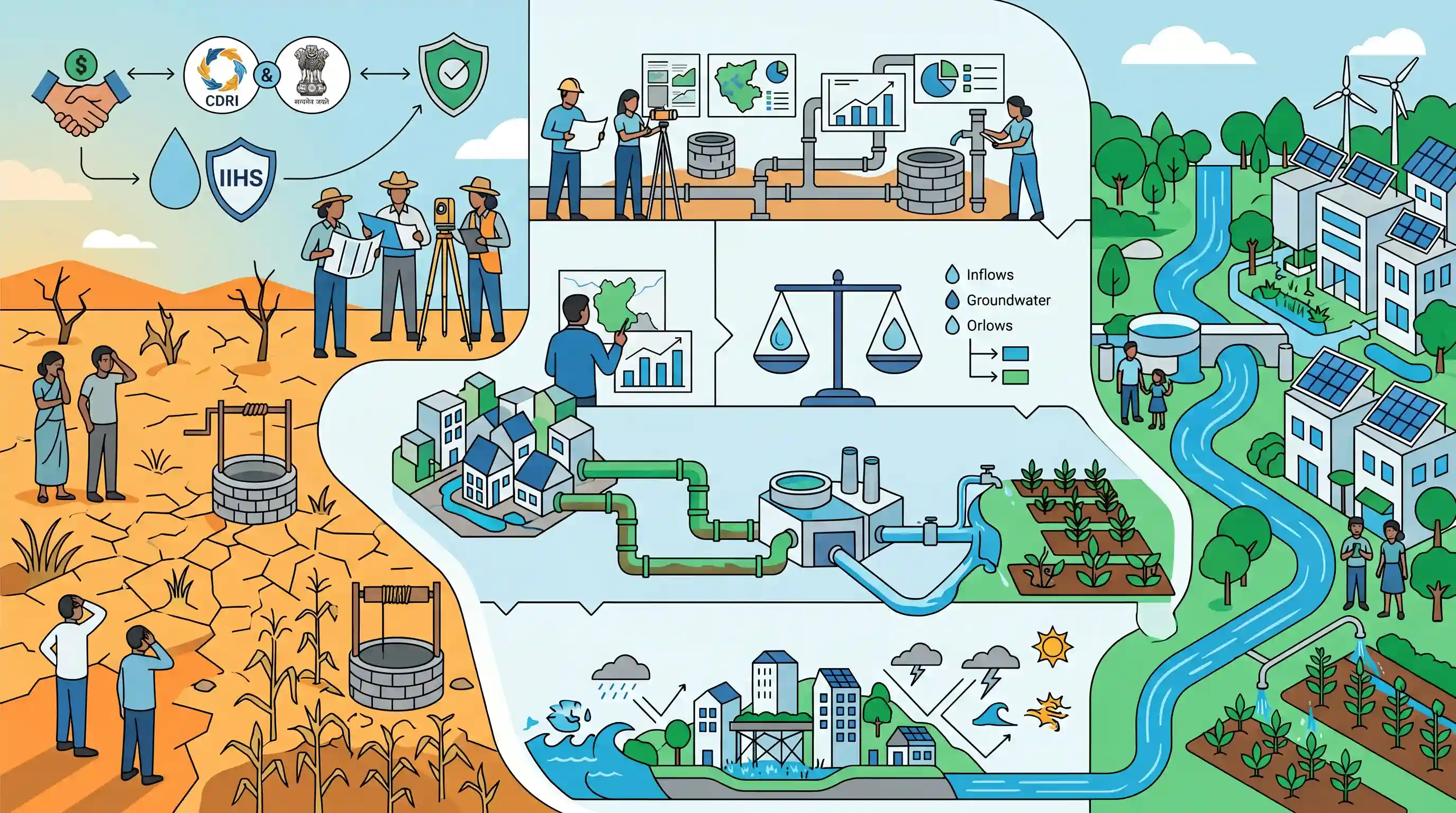
A climate-resilient water initiative has been launched in Karnataka's drought-prone Chickballapur district to address acute water stress and groundwater depletion. Funded by the Coalition for Disaster Resilient Infrastructure (CDRI) under its Urban Infrastructure Resilience Programme (UIRP), the two-year project is co-implemented by the Indian Institute for Human Settlements (IIHS) and the district administration. Covering six small towns, the initiative aims to assess water and wastewater systems, develop water balance studies, and formulate technical guidelines to safely reuse wastewater and integrate disaster and climate risks into local infrastructure planning.
Key Points
- A new project titled 'Building Small Town Water Resilience' has been launched in Karnataka's Chickballapur district, running from April 2026 to March 2028.
- The initiative is funded by the Coalition for Disaster Resilient Infrastructure (CDRI) under its global Urban Infrastructure Resilience Programme (UIRP).
- Implemented jointly by the Indian Institute for Human Settlements (IIHS) and the district administration.
- The project focuses on six drought-prone towns facing severe water stress, climate variability, and rapid groundwater depletion.
- Key objectives include conducting water balance studies, long-term scenario modelling, and creating guidelines for safe, efficient wastewater reuse and climate-resilient water infrastructure.
Important Terms
Coalition for Disaster Resilient Infrastructure (CDRI)

A global partnership of governments and organizations launched by India in 2019 to promote infrastructure resilience against climate and disaster risks.
UPSC context
GS Paper 3: Disaster Management; India's global leadership in climate action and disaster preparedness.
Urban Infrastructure Resilience Programme (UIRP)
A CDRI flagship initiative supporting cities to integrate disaster and climate risk into urban infrastructure planning, operations, and financing.
UPSC context
GS Paper 3: Infrastructure and Urbanization; tests knowledge of specific global-to-local resilience frameworks.
Disaster Resilient Infrastructure (DRI)
Systems designed and maintained to withstand, absorb, and recover from disaster impacts while ensuring the continuity of essential services.
UPSC context
GS Paper 3: Disaster Management; fundamental concept in the Sendai Framework and sustainable development.
Indian Institute for Human Settlements (IIHS)
An Indian institution dedicated to equitable and sustainable urban transformation through research, capacity building, and policy advisory.
UPSC context
GS Paper 1 & 3: Urbanization and Sustainable Development; relevant for institutional partnerships in urban governance.
Water Balance Study
A scientific assessment of water inflows and outflows within a specific area to manage resources and address groundwater depletion.
UPSC context
GS Paper 3: Water Resources; technical tool for sustainable water management and drought mitigation.
Sendai Framework for Disaster Risk Reduction
A 15-year international agreement (2015-2030) aiming to reduce global disaster risk and losses to lives, livelihoods, and infrastructure.
UPSC context
GS Paper 3: Disaster Management; the primary global roadmap for disaster risk reduction targets.
Prelims Trap
The Urban Infrastructure Resilience Programme (UIRP) is a flagship scheme of the Ministry of Housing and Urban Affairs (MoHUA).
UIRP is a global programme under the Coalition for Disaster Resilient Infrastructure (CDRI), not a domestic Indian urban scheme.
Static Concepts Connected
What is the Coalition for Disaster Resilient Infrastructure (CDRI)?
- Origin: Launched by the Indian Prime Minister at the 2019 UN Climate Action Summit in New York.
- Nature: A global partnership of national governments, UN agencies, programs, multilateral development banks, and the private sector.
- Objective: Promotes resilience of infrastructure systems to climate and disaster risks, prioritizing sustainable development.
How is an 'Over-exploited' groundwater unit defined in India?
- Extraction rate: The stage of groundwater extraction is greater than 100% of the annual extractable recharge.
- Water decline: There is a significant long-term decline in both pre-monsoon and post-monsoon groundwater levels.
- Assessing body: Categorized periodically by the Central Ground Water Board (CGWB) in coordination with state agencies.
Cross-Topic Patterns
CDRI's pivot to Small-Town Urbanization
CDRI's focus is expanding from national-scale mega-infrastructure to localized tier-2/3 urban vulnerability, directly complementing the water-resilience objectives of domestic missions like AMRUT 2.0.
Hard-Rock Aquifers + Climate Stress
Karnataka's Deccan hard-rock terrain severely limits rapid groundwater recharge compared to the northern alluvial plains, making technical interventions like wastewater reuse mandatory for climate adaptation.

Expect a multi-statement question combining CDRI's specific global programmes (like UIRP) with India's groundwater extraction criteria.
Linked PYQs · 4
Linked PYQs · 4
- 2024MainsGS3
What is disaster resilience? How is it determined? Describe various elements of a resilience framework. Also mention the global targets of Sendai Framework for Disaster Risk Reduction (2015–2030).
- 2024MainsGS3
The world is facing an acute shortage of clean and safe freshwater. What are the alternative technologies which can solve this crisis? Briefly discuss any three such technologies citing their key merits and demerits.
- 2025MainsGS3
Examine the factors responsible for depleting groundwater in India. What are the steps taken by the government to mitigate such depletion of groundwater?
- 2024MainsGS3
Flooding in urban areas is an emerging climate-induced disaster. Discuss the causes of this disaster. Mention the features of two such major floods in the last two decades in India. Describe the policies and frameworks in India that aim at tackling such floods.
