Climate models underestimation of urban heat island effect in India
Source:The Hindu ↗
Why It Matters
The Urban Heat Island (UHI) effect is a critical geography and environment topic for UPSC. This article provides vital, quantifiable data (ESMs underestimate warming by 45%) and contemporary examples (Patiala) to substantiate answers on the impacts of urbanization, climate change adaptation, and the limitations of current climate modeling.
Summary
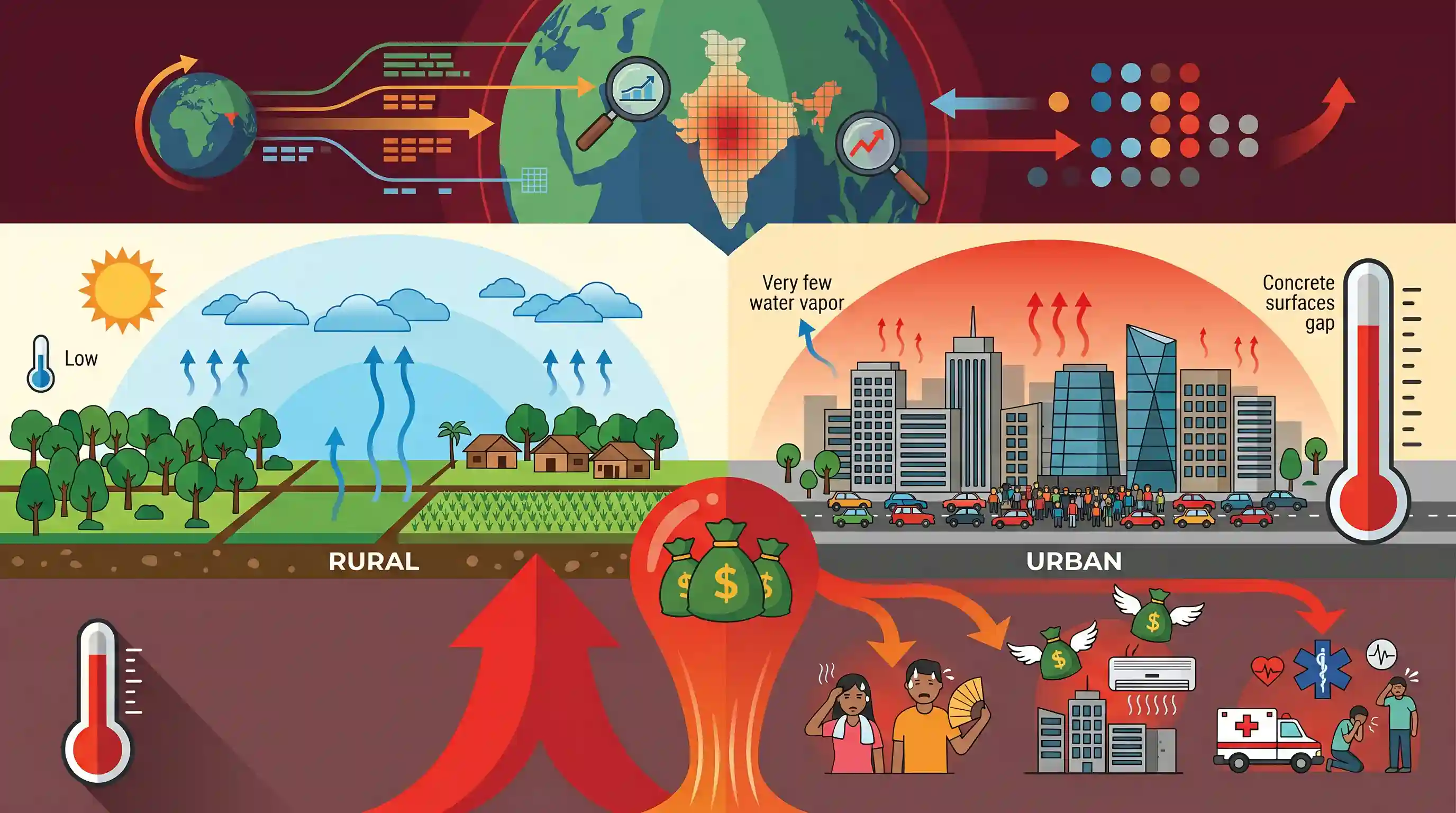
A recent study has found that standard climate models, specifically Earth System Models (ESMs), severely underestimate the accelerated warming occurring in Indian cities compared to their rural surroundings. Because global models lack fine-scale resolution, they obscure the localized Urban Heat Island (UHI) effect. The primary driver of this rural-urban temperature gap is evapotranspiration: rural vegetation efficiently cools the environment by releasing moisture, whereas heavily paved urban centers cannot. Consequently, under a 2°C global warming scenario, Indian cities will face a disproportionately higher surge in temperatures, amplifying the risk of extreme heat stress, increased cooling costs, and public health crises.
Key Points
- A new study reveals that Earth System Models (ESMs) significantly underestimate the rate of warming in Indian cities compared to surrounding rural areas, missing the disparity by an average of 45%.
- Under a 2°C global warming scenario, cities could experience much steeper temperature rises due to the Urban Heat Island (UHI) effect. For instance, Patiala in Punjab is projected to see temperatures rise at nearly double the rate of its rural counterparts.
- The underestimation occurs because current global climate models operate at a coarse resolution that fails to capture localized land surface differences, effectively blending cities into their rural surroundings.
- The dominant factor distinguishing urban from rural temperatures is 'evapotranspirative cooling' — rural areas benefit from vegetation that releases moisture, whereas cities are dominated by impervious surfaces and engineered drainage that prevent this cooling.
- This discrepancy suggests that urban populations will face significantly higher risks of severe heat stress, heat strokes, and water scarcity than previously anticipated by broad climate models.
Important Terms
Urban Heat Island (UHI)

A phenomenon where urban areas experience significantly higher temperatures than surrounding rural regions due to heat-trapping surfaces (concrete, asphalt), dense infrastructure, and limited vegetation.
UPSC context
GS Paper 1 (Geography: Urbanization) and Paper 3 (Environment). Tests understanding of urban environmental challenges and heat-related public health risks.
Evapotranspiration
The combined process of water evaporating from surfaces and being released by plants via transpiration. It acts as a natural cooling mechanism often absent in paved urban centers.
UPSC context
GS Paper 1 (Physical Geography: Water Cycle). Relevant for water resource management and explaining rural-urban temperature variations.
Earth System Model (ESM)
Advanced numerical climate models that integrate atmospheric, oceanic, land, and biological processes. They provide the scientific basis for long-term global and regional climate projections.
UPSC context
GS Paper 3 (Science & Technology/Environment). Tests knowledge of climate modeling tools and their application in policy planning.
Intergovernmental Panel on Climate Change (IPCC)
The UN scientific body established in 1988 (by WMO and UNEP) to assess climate change. Its reports guide global climate negotiations and international treaties like the Paris Agreement.
UPSC context
GS Paper 3 (International Organizations/Environment). Crucial for questions on global climate governance and the scientific consensus on warming.
Microclimate
Localized atmospheric conditions (temperature, humidity, wind) in a specific small-scale area, such as a city square or park, that differ from the surrounding regional climate.
UPSC context
GS Paper 1 (Geography) and Paper 3 (Disaster Management). Important for urban planning and mitigating localized heatwave impacts.
Prelims Trap
"The Urban Heat Island effect is primarily driven by localized greenhouse gas emissions from urban transport."
While anthropogenic heat contributes, the dominant driver of the rural-urban temperature gap is the loss of evapotranspirative cooling due to concrete replacing vegetation.
Static Concepts Connected
How do Albedo and Evapotranspiration dictate urban microclimates?
- Low Albedo: Concrete and asphalt reflect less sunlight, absorbing and trapping more solar radiation compared to natural landscapes.
- Lost Evapotranspiration: A lack of urban vegetation means no moisture is released to absorb latent heat, removing a crucial natural cooling mechanism.
- High Thermal Mass: Urban infrastructure stores solar energy during the day and releases it slowly, preventing temperatures from dropping at night.
What are Earth System Models (ESMs) in climate science?
- Coarse Grid Resolution: ESMs divide the planet into 3D grids (often 100-250 km wide), which makes them too coarse to detect city-scale microclimates.
- Coupled Systems: They mathematically integrate interactions between the atmosphere, oceans, land surface, and biosphere to predict broad, long-term global climate trends.
Cross-Topic Patterns
Impervious surfaces: heat and floods
The concrete infrastructure driving the Urban Heat Island effect by blocking evapotranspiration also prevents groundwater percolation, acting as the root cause of frequent urban flooding.
UHI and the cooling penalty
Escalating urban heat directly impacts informal outdoor workers and increases cooling costs, linking microclimate phenomena to labor productivity drops and 'cooling poverty' in Indian cities.

Expect a 2026 Prelims geography question pairing UHI mechanisms (albedo, evapotranspiration) with urban flooding as dual consequences.
Linked PYQs · 3
Linked PYQs · 3
- 2013MainsGS1
Bring out the causes for the formation of heat islands in the urban habitat of the world.
- 2022MainsGS3
Discuss global warming and mention its effects on the global climate. Explain the control measures to bring down the level of greenhouse gases which cause global warming, in the light of the Kyoto Protocol, 1997.
- 2024MainsGS3
Flooding in urban areas is an emerging climate-induced disaster. Discuss the causes of this disaster. Mention the features of two such major floods in the last two decades in India. Describe the policies and frameworks in India that aim at tackling such floods.
