Climate Disruption Impacts on Children Education
Source:Indian Express ↗
Why It Matters
This intersection of environmental issues and education provides a crucial data point for mains answers discussing the socio-economic impacts of climate change, emphasizing the vulnerability of human capital and the need for climate-resilient social infrastructure.
Summary
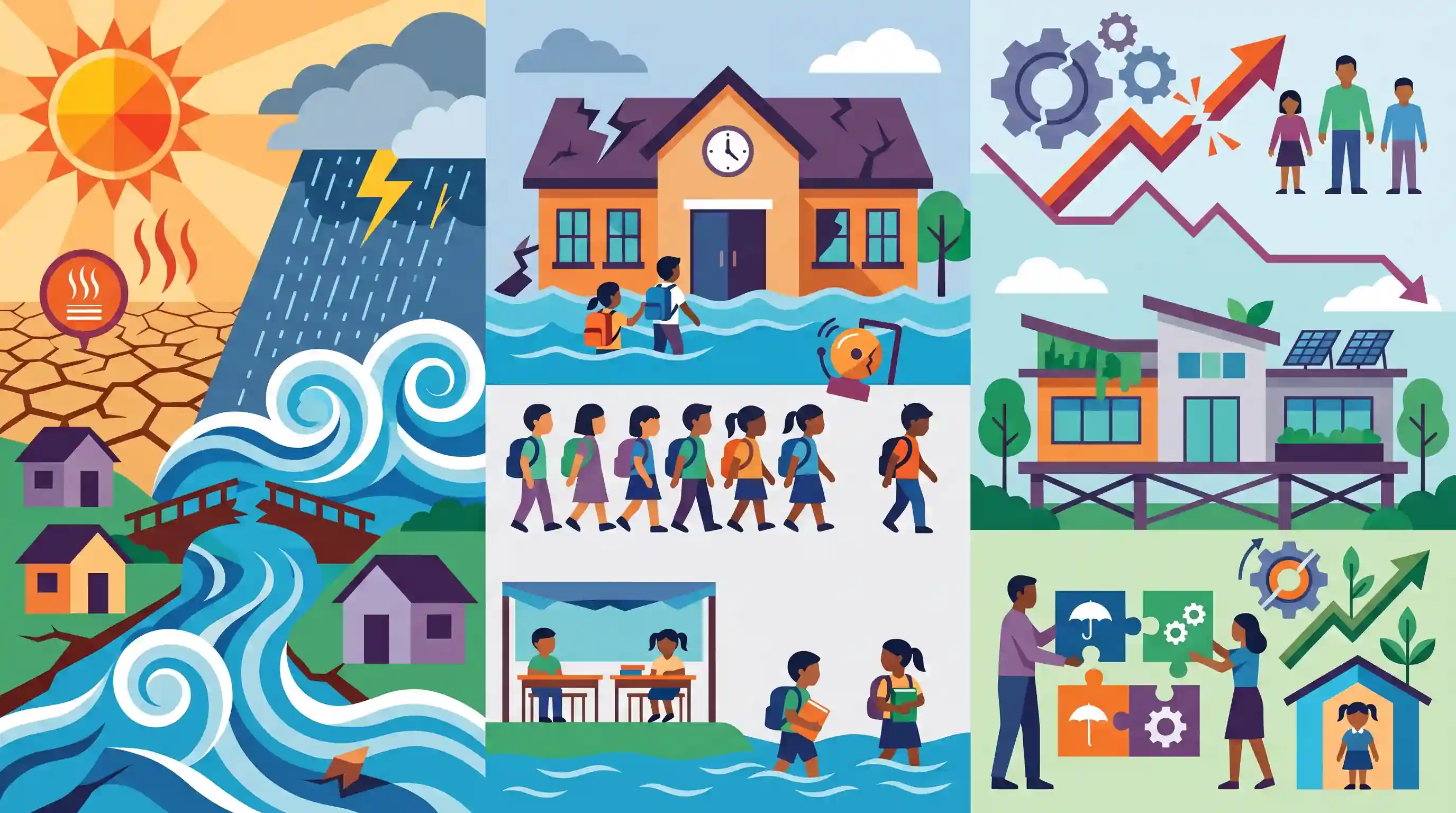
UNICEF India Representative Cynthia McCaffrey highlighted that climate change has a profound, cascading impact on human capital, revealing that 1 in 7 children were forced out of school globally due to climate-related disruptions in 2024. The phenomenon indicates that extreme weather events (such as floods and heatwaves) are increasingly impeding basic social services like education. It brings to the forefront the urgent need for climate-resilient infrastructure and the integration of child welfare into disaster mitigation and climate adaptation strategies, showing that climate change directly exacerbates socio-economic vulnerabilities.
Key Points
- In 2024, approximately 1 in 7 children experienced disruptions in schooling due to climate change-induced factors.
- UNICEF India Representative Cynthia McCaffrey highlighted this statistic, emphasizing the severe secondary impacts of extreme weather on education and human development.
- The finding underscores the necessity of building climate-resilient educational infrastructure and accounting for child welfare in climate adaptation policies.
- Climate change is no longer just an environmental issue but a direct threat to social sector outcomes, exacerbating vulnerabilities among children.
Important Terms
UNICEF

The United Nations Children's Fund is a global agency mandated to provide humanitarian and developmental aid to children worldwide, advocating for their rights and welfare.
UPSC context
GS Paper II: International Institutions; GS Paper II: Welfare schemes for vulnerable sections of the population (children).
Human Capital
The economic value of a population's skills, knowledge, and health, considered a critical driver of productivity, economic growth, and the realization of a demographic dividend.
UPSC context
GS Paper III: Indian Economy and issues relating to planning, mobilization of resources, and growth; GS Paper II: Social Justice.
Climate-resilient Infrastructure
Infrastructure systems planned and built to withstand, adapt to, and recover quickly from climate-related shocks like floods and heatwaves, ensuring the continuity of essential services.
UPSC context
GS Paper III: Infrastructure and Disaster Management; GS Paper III: Environment & Ecology (Adaptation).
Climate Adaptation
The process of adjusting ecological, social, or economic systems in response to actual or expected climatic stimuli and their effects to minimize harm or exploit beneficial opportunities.
UPSC context
GS Paper III: Conservation, environmental pollution and degradation, environmental impact assessment; GS Paper III: Disaster Management.
Disaster Mitigation
Proactive measures taken to reduce the severity or adverse impacts of disasters, focusing on long-term risk reduction rather than just immediate emergency response.
UPSC context
GS Paper III: Disaster and disaster management; GS Paper II: Social Justice (vulnerability reduction).
Prelims Trap
"UNESCO recently reported that 1 in 7 children were out of school globally due to climate change."
Aspirants naturally associate global education data with UNESCO, overlooking UNICEF’s expanding role in tracking climate-induced vulnerabilities in children.
Static Concepts Connected
What is the Coalition for Disaster Resilient Infrastructure (CDRI)?
- Origin: Initiated by India at the 2019 UN Climate Action Summit to promote disaster-resilient infrastructure.
- Social Infrastructure: It explicitly covers both economic and social infrastructure, emphasizing the need for climate-resilient schools and hospitals.
- Structure: It functions as a multi-stakeholder global partnership of national governments, UN agencies, and private sectors.
Does the RTE Act 2009 mandate climate-resilient schools?
- All-weather requirement: The Act mandates an 'all-weather building' with at least one classroom per teacher.
- WASH facilities: It requires safe drinking water and separate functioning toilets for boys and girls.
- Policy Gap: While 'all-weather' is required, explicit statutory mandates for modern climate resilience (e.g., specific heat or flood defenses) are currently absent.
Cross-Topic Patterns
Climate disruption of PM POSHAN
School closures due to heatwaves or floods directly disrupt schemes like PM POSHAN, compounding child malnutrition and linking GS-3 Environment to GS-2 Social Justice.
Climate migration and child labor
Climate-induced distress migration forces families to relocate, pulling children out of school and pushing them into informal labor, a recurring theme in GS-1 Society.

Expect a 2026 GS-2 or GS-3 Mains question explicitly linking climate change impacts to human capital formation and child welfare.
Linked PYQs · 2
Linked PYQs · 2
- 2017MainsGS3
'Climate change' is a global problem. How India will be affected by climate change? How Himalayan and coastal states of India will be affected by climate change?
- 2022MainsGS2
The Right of Children to Free and Compulsory Education Act, 2009 remains inadequate in promoting incentive-based system for children's education without generating awareness about the importance of schooling. Analyse.
