Climate Change Performance Index Ranking and India Mitigation Metrics
Source:Indian Express ↗
কেন এটি গুরুত্বপূর্ণ
Understanding global indices like the CCPI is crucial for evaluating India's climate commitments, trajectory towards renewable energy targets, and positioning in international climate negotiations.
সারসংক্ষেপ
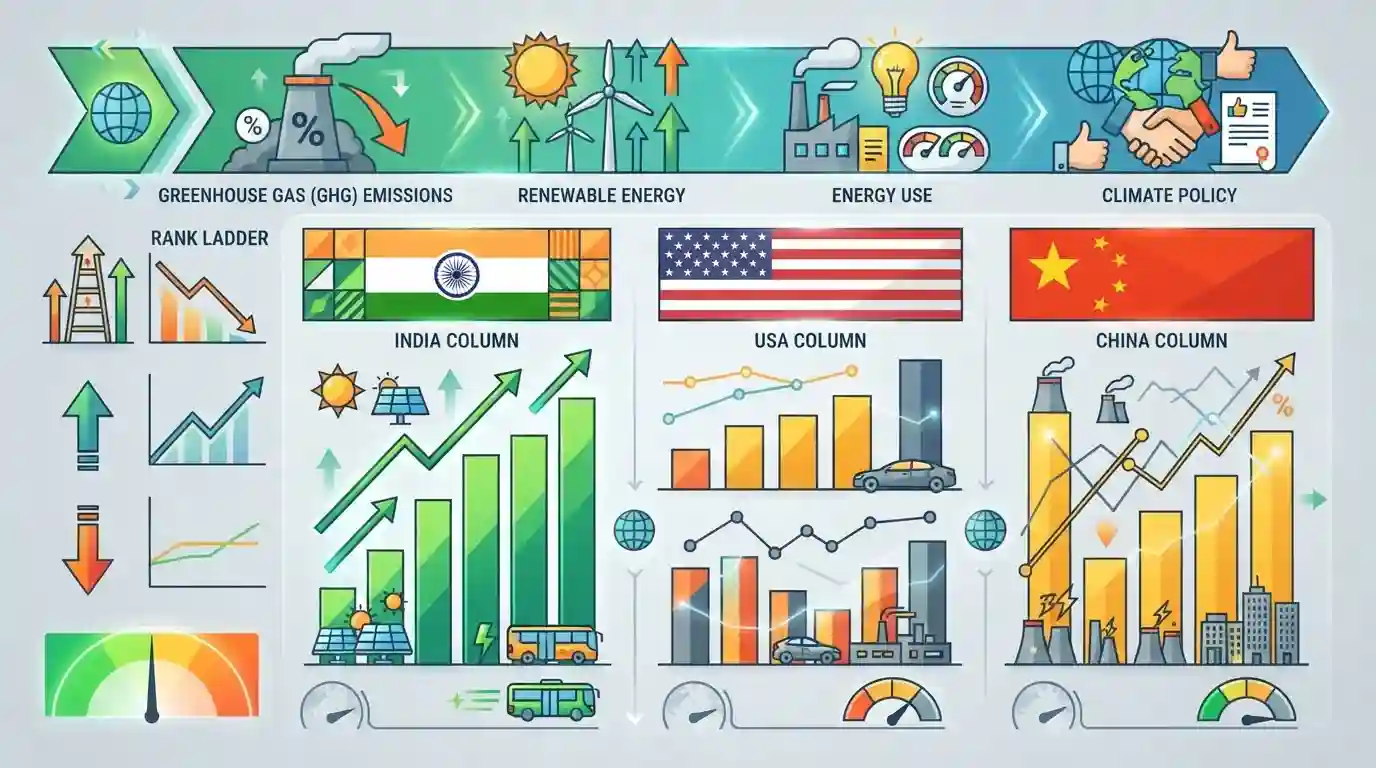
An analysis of the Climate Change Performance Index (CCPI), detailing India's ranking and performance metrics in comparison to global powerhouses like the US and China across major climate mitigation pillars.
মূল বিষয়
- The Climate Change Performance Index (CCPI) evaluates and compares the climate protection performance of 63 countries and the European Union, which together account for over 90% of global greenhouse gas emissions.
- The index evaluates countries across four key categories: GHG Emissions, Renewable Energy, Energy Use, and Climate Policy.
- India's performance in the CCPI highlights its progress and standing relative to major global emitters like the US and China.
গুরুত্বপূর্ণ শব্দ
Climate Change Performance Index (CCPI)

An annual independent monitoring tool co-published by Germanwatch, NewClimate Institute, and Climate Action Network that evaluates countries' climate change mitigation performance across greenhouse gas emissions, renewable energy, energy use, and climate policy.
UPSC context
GS Paper III (Environment & Ecology). Useful for evaluating global climate indices, India's relative ranking, and international commitments.
Nationally Determined Contributions (NDCs)
The national climate action plans under the Paris Agreement detailing each country's targets for reducing greenhouse gas emissions and building resilience to climate change.
UPSC context
GS Paper III (Environment and Conservation). Essential for questions regarding India's climate pledges, net-zero commitments, and international obligations.
Paris Agreement
A landmark legally binding international treaty adopted at COP21 in 2015 to limit global warming to well below 2°C, preferably 1.5°C, relative to pre-industrial levels.
UPSC context
GS Paper III (Environment & Ecology). Frequently tested for global climate architecture, UNFCCC mechanisms, and carbon emission goals.
Germanwatch
An independent German civil society and environmental organization that advocates for global equity, climate protection, and sustainable resource management, and co-publishes the CCPI.
UPSC context
GS Paper III (Environment). Often cited in prelims and mains when referencing international think-tanks and climate performance indices.
NewClimate Institute
A non-profit research organization established in Germany that focuses on climate policy and science, tracking global emissions and evaluating national climate action roadmaps.
UPSC context
GS Paper III (Environment & Climate Change). Useful for analytical reports and evaluating climate policy effectiveness.
Climate Action Network (CAN)
A global network of over 1,900 civil society organizations in more than 130 countries working together to promote government action on climate change.
UPSC context
GS Paper III (Environment). Highlights the role of non-governmental coalitions in global climate governance and reporting indices.
প্রিলিমস ফাঁদ
India's high rank means it achieved a 'very high' overall score in the CCPI index.
Aspirants often assume a top-ranked country receives a 'very high' overall rating in the CCPI, missing that the top three ranks are left permanently vacant because no nation meets the 1.5°C/2°C trajectory.
সংযুক্ত স্থির ধারণা
What are the core categories and publishing organizations of the Climate Change Performance Index (CCPI)?
- Publishing Bodies: Published jointly by Germanwatch, NewClimate Institute, and Climate Action Network (CAN) since 2005.
- Coverage Scope: Evaluates 63 countries plus the EU, accounting for over 90% of global greenhouse gas emissions.
- Core Categories: Four categories: GHG Emissions (40%), Renewable Energy (20%), Energy Use (20%), and Climate Policy (20%).
- Vacant Top Ranks: The top three ranks remain unoccupied because no country's aggregate performance aligns with the Paris Agreement 1.5°C threshold.
আন্তঃবিষয় প্যাটার্ন
Climate Indices vs. Fiscal Deficit & Subsidies
The CCPI's heavy weight on renewable energy and energy use directly connects international climate indexes to domestic fiscal management and subsidy rationalisation.
NDCs, Carbon Markets & Climate Finance
India's NDC commitments evaluated in global indexes overlap directly with Article 6 carbon markets and international climate finance debates.

CCPI criteria weights + unoccupied top ranks (no country at 'very high') make a high-probability multi-statement prelims question.
সংযুক্ত PYQ · 2
সংযুক্ত PYQ · 2
- 2022MainsGS3
Do you think India will meet 50 percent of its energy needs from renewable energy by 2030 ? Justify your answer. How will the shift of subsidies from fossil fuels to renewables help achieve the above objective ? Explain.
- 2025MainsGS3
Write a review on India's climate commitments under the Paris Agreement (2015) and mention how these have been further strengthened in COP26 (2021). In this direction, how has the first Nationally Determined Contribution intended by India been updated in 2022?
