Climate change attribution study on Mediterranean region wildfires
Source:The Hindu ↗
Why It Matters
Provides a scientific attribution of extreme weather events (wildfires) to human-induced climate change, which is highly relevant for GS-3 (Environment and Disaster Management) and GS-1 (Geography - Climatology/Local Winds).
Summary
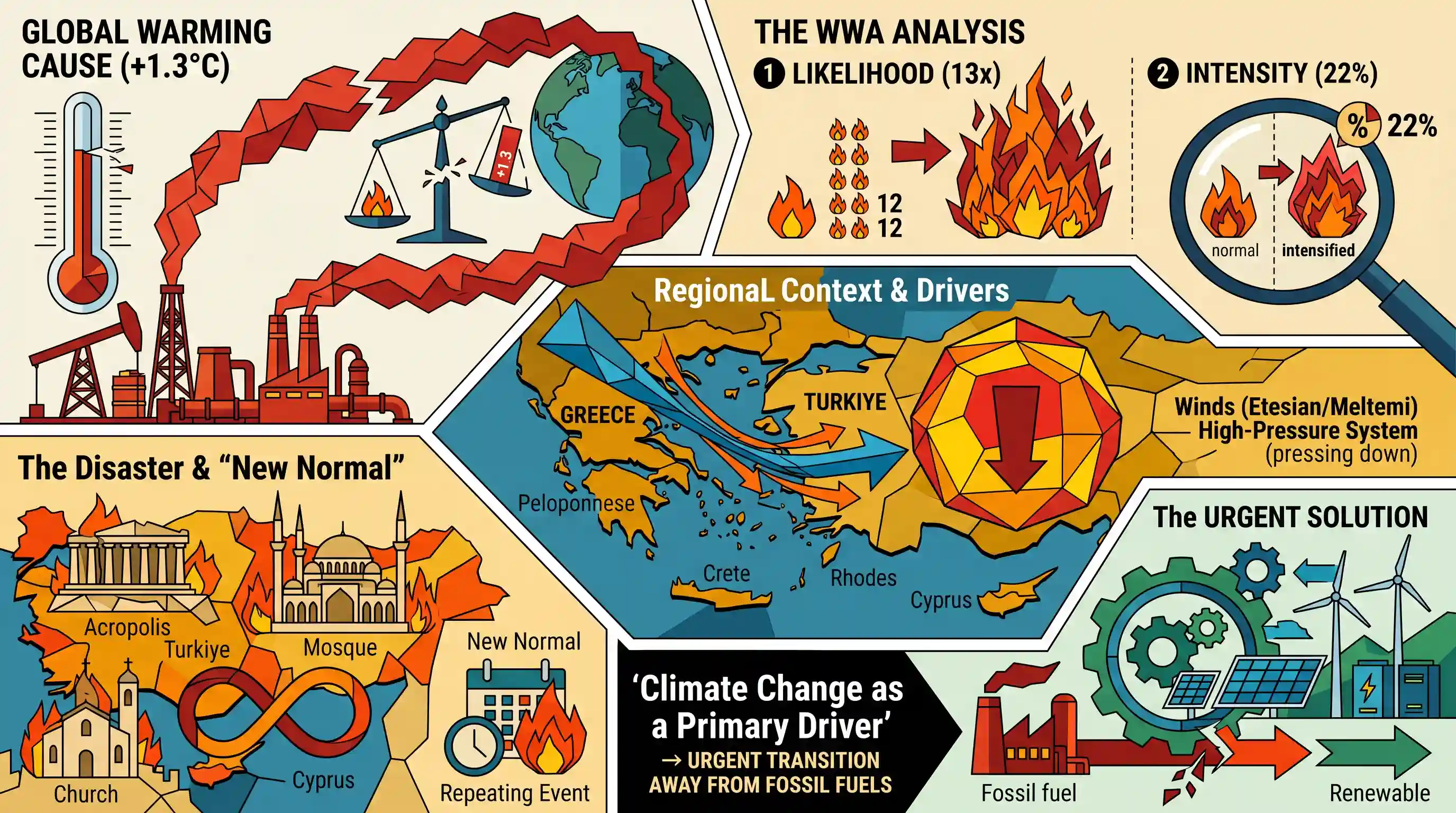
A study by World Weather Attribution (WWA) reveals that human-induced climate change significantly intensified deadly wildfires in Turkiye, Greece, and Cyprus. With a global temperature rise of 1.3°C, the hot, dry conditions driving these fires are 13 times more likely, making the fires 22% more intense. The spread was worsened by extreme "Etesian" winds and regional high-pressure systems. The findings emphasize that such catastrophic fire-weather events are becoming a "new normal" in the highly vulnerable Mediterranean region, underscoring the urgent need to transition away from fossil fuels to prevent further escalation.
Key Points
- Human-induced climate change significantly intensified the deadly wildfires in Turkiye, Greece, and Cyprus, according to a World Weather Attribution (WWA) study.
- Current global warming of 1.3°C has made the hot and dry weather conditions conducive to such wildfires 13 times more likely to occur.
- The study found that climate change made the intense fires 22% more severe in the Mediterranean region.
- The fires were exacerbated by high-pressure systems and extreme northerly winds known as Etesian winds.
- Experts warn that these extreme fire-weather events are becoming the 'new normal' and emphasize the urgent need to transition away from fossil fuels.
Important Terms
Attribution Science

A scientific field that quantifies the link between human-induced climate change and specific extreme weather events, helping determine if global warming made an event more likely or intense.
UPSC context
GS Paper 3 (Environment/S&T); essential for discussing 'Loss and Damage' liability and climate justice in international negotiations.
World Weather Attribution (WWA)
An international collaboration of scientists who use peer-reviewed methods to provide rapid, real-time analysis of the role of climate change in extreme weather events globally.
UPSC context
GS Paper 3 (Environment); relevant as a key scientific source for reports on climate-induced disasters and global warming impacts.
Etesian Winds
Strong, dry seasonal north winds of the Aegean Sea and Eastern Mediterranean that blow from mid-May to mid-September, often exacerbating wildfire spread in the region.
UPSC context
GS Paper 1 (World Geography); tests knowledge of regional wind systems and their influence on local climate and environmental hazards.
Fire Weather
A combination of meteorological factors—typically high temperature, low humidity, and strong winds—that increases the risk of wildfire ignition, spread, and intensity.
UPSC context
GS Paper 3 (Disaster Management); critical for understanding the drivers of forest fires and planning mitigation strategies.
Mediterranean Climate Hotspot
A region identified by the IPCC as highly vulnerable, warming 20% faster than the global average and facing extreme risks from drought, heatwaves, and biodiversity loss.
UPSC context
GS Paper 1 (Geography) & GS Paper 3 (Environment); important for discussing regional vulnerability and the geographical impacts of climate change.
Prelims Trap
Etesian winds are warm, moisture-laden southerly winds that bring summer rainfall to the Mediterranean region.
Etesian (Meltemi) winds are actually strong, dry, northerly winds blowing during summer over the Aegean Sea, which dry out vegetation and exacerbate wildfires.
Static Concepts Connected
What are the defining geographical characteristics of the Mediterranean climate region?
- Rainfall pattern: Receives precipitation primarily in winter from onshore Westerlies, while summers remain hot and completely dry.
- High-pressure systems: Summer aridity is driven by the poleward shift of subtropical high-pressure belts, which causes continuous air subsidence.
- Sclerophyllous vegetation: Features evergreen drought-resistant vegetation with thick barks, deep roots, and waxy leaves to minimize transpiration.
Which major local winds directly influence the climate and weather of the Mediterranean region?
- Sirocco: A hot, dry, dust-laden southerly wind blowing from the Sahara Desert across the Mediterranean to southern Europe.
- Mistral: A cold, dry, strong northerly wind that funnels down the Rhone valley in France into the Gulf of Lion.
- Etesian (Meltemi): Dry, strong northerly winds blowing over the Aegean Sea in summer, notorious for spreading regional wildfires rapidly.
Cross-Topic Patterns
Disaster diplomacy & territorial disputes
Shared environmental threats like wildfires in the Aegean often clash with the complex Greece-Turkiye EEZ disputes, testing regional disaster diplomacy and resource sharing during crises.
Climate attribution science & policy
World Weather Attribution (WWA) data bridges physical geography and climate policy, shifting 'Act of God' disasters to quantifiable, human-induced events requiring strict mitigation targets at COP summits.

Expect a 2026 Prelims pair-matching question linking specific local winds (Etesian, Mistral, Sirocco) to their exact Mediterranean regions.
Linked PYQs · 3
Linked PYQs · 3
- 2022MainsGS3
Discuss global warming and mention its effects on the global climate. Explain the control measures to bring down the level of greenhouse gases which cause global warming, in the light of the Kyoto Protocol, 1997.
- 2024MainsGS3
Flooding in urban areas is an emerging climate-induced disaster. Discuss the causes of this disaster. Mention the features of two such major floods in the last two decades in India. Describe the policies and frameworks in India that aim at tackling such floods.
- 2014PrelimsGS1
The seasonal reversal of winds is the typical characteristic of
