Rising carbon emissions reduce nutritional value of staple crops
Source:The Hindu ↗
Why It Matters
This topic masterfully links environmental science (carbon fertilization) with agriculture (crop yields) and public health (hidden hunger). It provides a critical nuance to food security debates—shifting the focus from 'caloric quantity' to 'nutritional quality' under a changing climate. Highly relevant for both Prelims and Mains GS2/GS3.
Summary
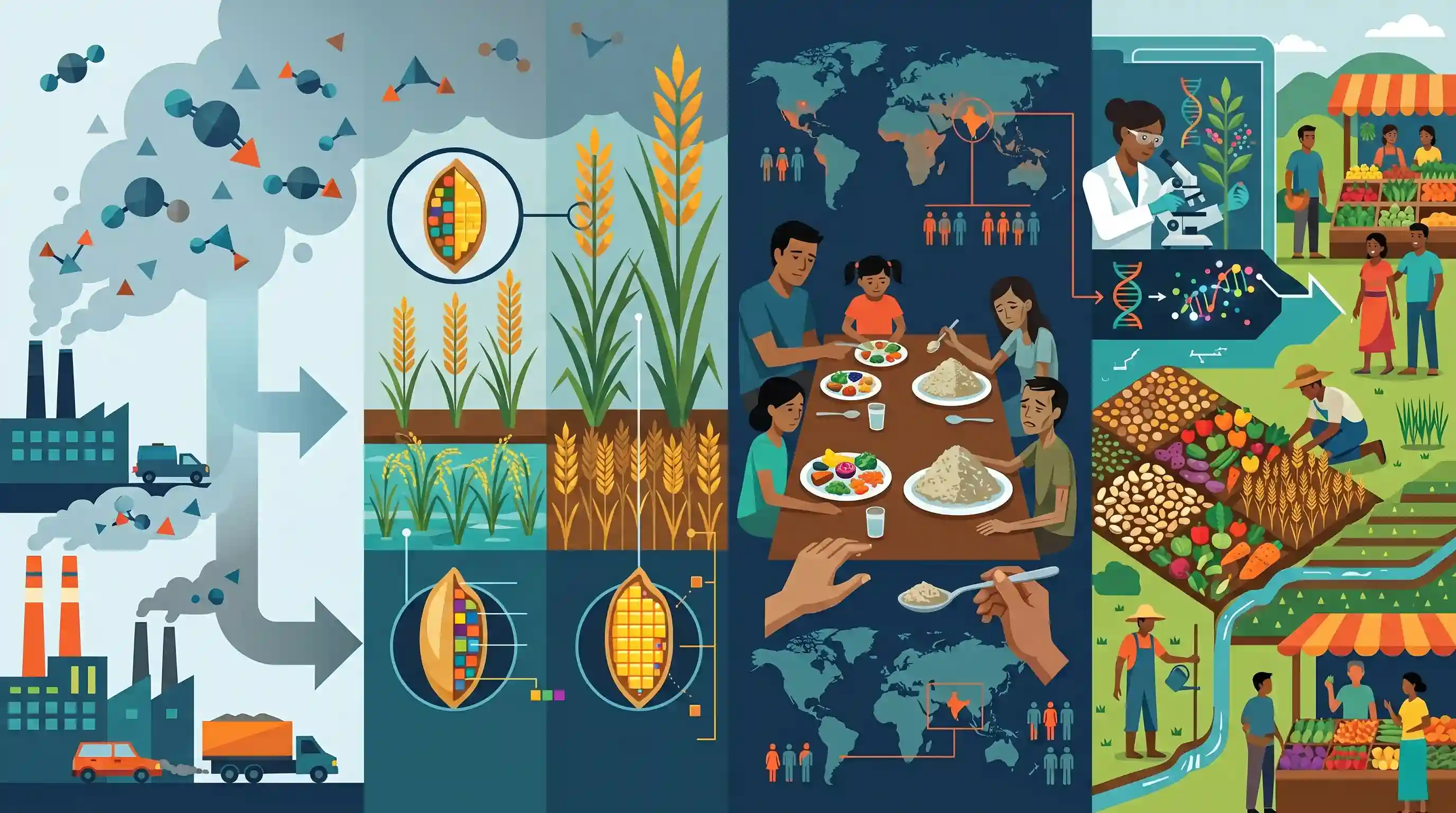
Rising atmospheric CO2 levels are triggering a 'carbon dilution effect' in staple crops, increasing their carbohydrate content while significantly depleting essential nutrients like protein, zinc, and iron. Although carbon fertilization temporarily boosts plant biomass, this qualitative decline in crop nutrition threatens to exacerbate 'hidden hunger' and malnutrition worldwide. For countries like India, this underscores the urgent need to integrate biofortification, crop diversification, and climate-resilient agricultural practices to safeguard both food and nutritional security.
Key Points
- Elevated atmospheric CO2 causes a 'carbon dilution effect,' where plants synthesize more carbohydrates but absorb fewer essential minerals like zinc, iron, and calcium.
- While 'carbon fertilization' may initially boost plant biomass and overall crop yield, it significantly reduces the protein and micronutrient density in staple crops such as wheat, rice, and soybeans.
- This decline in plant nutritional quality threatens to exacerbate 'hidden hunger' (micronutrient deficiency) globally, disproportionately affecting vulnerable populations in developing nations who rely heavily on plant-based diets.
- Addressing this dual challenge of climate change and malnutrition requires urgent adaptation strategies, including the development of biofortified crop varieties, enhanced soil nutrient management, and dietary diversification.
Important Terms
POSHAN Abhiyaan

India's flagship program launched in 2018 to improve nutritional outcomes for children, pregnant women, and lactating mothers by targeting stunting, undernutrition, anemia, and low birth weight.
UPSC context
GS Paper II (Social Justice/Health). Crucial for discussing India's policy response to malnutrition and achieving SDG 2 (Zero Hunger).
National Food Security Act (NFSA), 2013
A 2013 law providing subsidized food grains to 67% of India's population. It transforms the 'right to food' into a legal entitlement, ensuring access to adequate quantity and quality food.
UPSC context
GS Paper II (Governance) and GS Paper III (Public Distribution System). Relevant for analyzing food accessibility and rights-based frameworks.
Biofortification
The process of increasing the density of essential vitamins and minerals in a crop through plant breeding, agronomic practices, or biotechnology during the plant's growth stage.
UPSC context
GS Paper III (Agriculture/Science). A key strategy for addressing nutrient depletion in staple crops caused by climate change.
Hidden Hunger
A form of undernutrition where individuals consume sufficient calories but lack essential micronutrients (vitamins and minerals), leading to severe long-term health, cognitive, and developmental issues.
UPSC context
GS Paper II/III. Highlights the shift from simple food security (quantity) to nutritional security (quality) in policy debates.
Indian Council of Agricultural Research (ICAR)
The apex Indian body for coordinating agricultural research and education. It leads initiatives like NICRA to develop climate-resilient crop varieties and sustainable farming practices.
UPSC context
GS Paper III (Agriculture). Vital for evaluating technological and R&D interventions for climate-resilient and nutrient-dense food systems.
IPCC (Intergovernmental Panel on Climate Change)
The UN body for assessing climate science. Its reports provide the scientific foundation for understanding how rising CO2 levels impact global agricultural productivity and crop nutritional quality.
UPSC context
GS Paper III (Environment). The primary source for global scientific evidence and risk assessments regarding climate-induced nutritional threats.
Food and Agriculture Organization (FAO)
A specialized UN agency that leads international efforts to defeat hunger and improve nutrition. It provides global standards, data, and policy support for resilient agrifood systems.
UPSC context
GS Paper II (International Relations). Essential for discussing global benchmarks, reports, and international cooperation in food security.
Prelims Trap
Carbon fertilization uniformly benefits food security by increasing both the yield and the nutritional density of staple crops.
Carbon fertilization boosts biomass/carbohydrates but triggers a "carbon dilution effect," significantly reducing essential nutrients like protein, zinc, and iron, thus worsening nutritional security.
Static Concepts Connected
How does biofortification fundamentally differ from standard food fortification?
- Biofortification: Enhances nutritional value directly during plant growth via selective breeding or agronomic practices (e.g., CR Dhan 310 rice).
- Food Fortification: Adds nutrients manually during the manufacturing or processing stage after the crop is harvested (e.g., iodized salt, fortified wheat flour).
What characterizes 'Hidden Hunger' in the context of global health?
- Micronutrient Deficiency: A chronic lack of essential vitamins and minerals (iron, zinc, vitamin A) required for optimal health and development.
- Caloric Sufficiency: Occurs even when daily caloric or energy intake is adequate, making it 'hidden' compared to visible clinical starvation or undernourishment.
Cross-Topic Patterns
Mainstreaming Millets for Climate Resilience
The carbon dilution in C3 plants (wheat/rice) makes C4 plants like millets crucial. They are inherently climate-resilient and nutrient-dense, linking agricultural adaptation directly to POSHAN Abhiyaan.
NFSA and the Shift to Nutritional Security
The PDS historically favors calorie-dense rice and wheat. This CO2-induced nutrient drop demands a policy shift in the National Food Security Act from mere calorie provision to holistic nutritional security.

Carbon fertilization's dual impact (yield vs nutrition) is ripe for a 2026 Prelims statement-based question linking ecology & agriculture.
Linked PYQs · 4
Linked PYQs · 4
- 2018PrelimsGS1
Which of the following statements best describes "carbon fertilization"?
- 2024MainsGS2
Poverty and malnutrition create a vicious cycle, adversely affecting human capital formation. What steps can be taken to break the cycle ?
- 2019MainsGS2
There is a growing divergence in the relationship between poverty and hunger in India. The shrinking of social expenditure by the government is forcing the poor to spend more on non-food essential items squeezing their food-budget. - Elucidate.
- 2017MainsGS3
What are the major reasons for declining rice and wheat yield in the cropping system? How crop diversification is helpful to stabilise the yield of the crops in the system?
