India Climate Action Progress and NDC Implementation Narrative
Source:Indian Express ↗
Why It Matters
The article provides essential talking points and data for UPSC Mains answers regarding India's climate change mitigation strategies, its progress on Paris Agreement targets (NDCs), and its geopolitical stance on climate finance and CBDR.
Summary
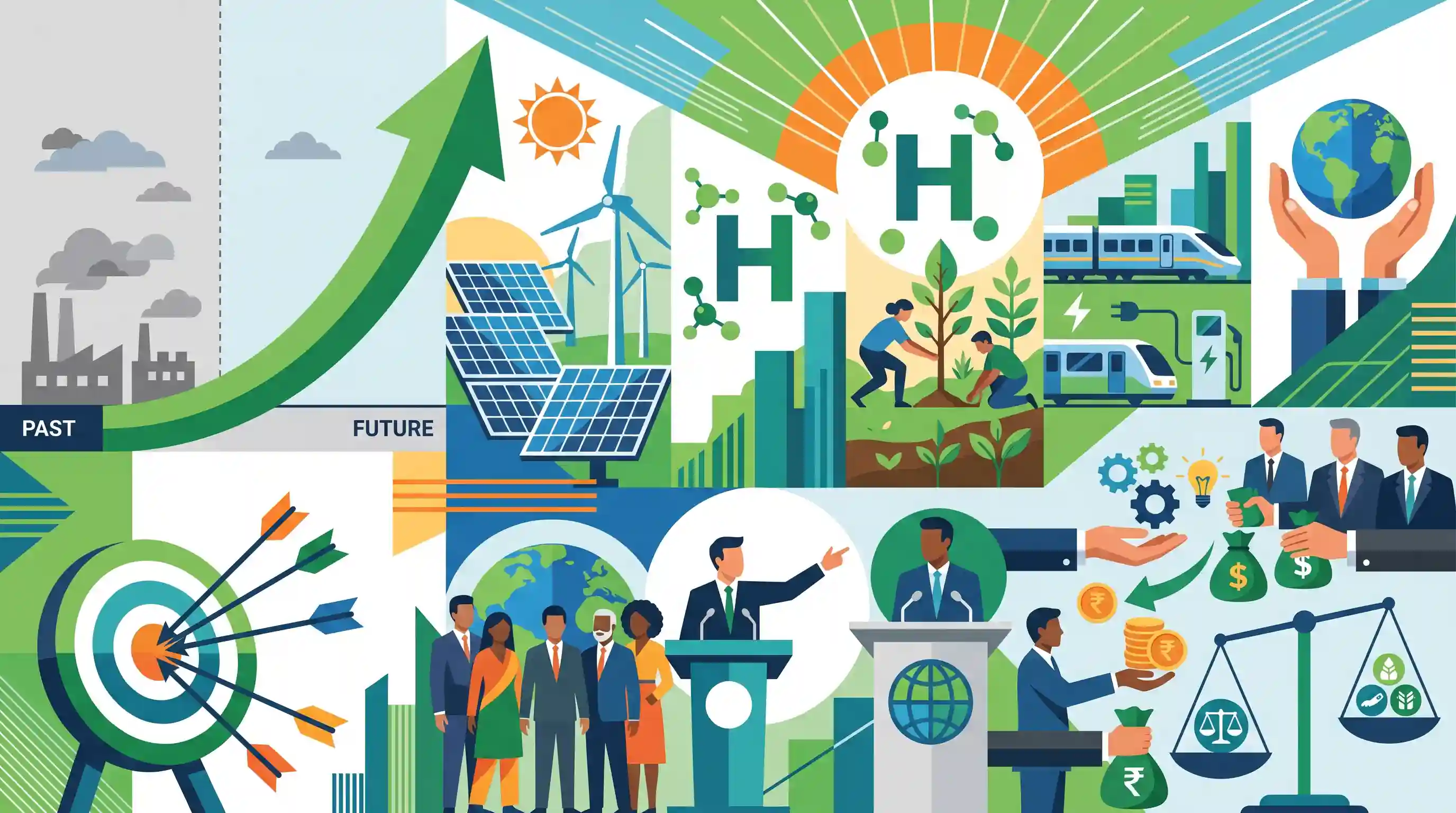
The article asserts that India presents a strong and positive narrative regarding climate action. Despite its low historical contribution to global greenhouse gas emissions, India is proactively pursuing ambitious mitigation strategies. It highlights India's success in overachieving its early Nationally Determined Contribution (NDC) targets and its commitment to 'Panchamrit', including significant renewable energy deployment and the National Green Hydrogen Mission. Furthermore, the piece emphasizes India's leadership role in advocating for global equity, demanding that developed countries honor their climate finance and technology transfer commitments under the framework of Common But Differentiated Responsibilities (CBDR).
Key Points
- India has achieved several of its initial Nationally Determined Contribution (NDC) targets ahead of schedule, notably in reducing the emission intensity of its GDP.
- Despite having historically low per capita emissions, India is demonstrating strong global leadership in climate action through its 'Panchamrit' commitments, including aggressive renewable energy capacity targets.
- The shift towards renewable energy is being accelerated by domestic initiatives like the National Green Hydrogen Mission and the promotion of a sustainable lifestyle through Mission LiFE.
- The article reiterates the principle of Common But Differentiated Responsibilities (CBDR), stressing that developed nations must fulfill their obligations to provide climate finance and technology transfer.
- India's strategy serves as a model for the Global South, proving that rapid economic growth can be decoupled from massive carbon emissions.
Important Terms
Paris Agreement

A legally binding 2015 international treaty aiming to limit global warming to well-below 2°C (preferably 1.5°C) through global cooperation on mitigation and finance.
UPSC context
GS Paper 3 (Environment). Tests knowledge of global climate governance and India's role in international diplomacy.
Nationally Determined Contributions (NDCs)
Self-defined, non-binding climate action plans submitted by countries under the Paris Agreement, outlining targets to reduce greenhouse gas emissions and enhance resilience.
UPSC context
GS Paper 3 (Environment). Vital for tracking India's specific commitments and progress toward international climate goals.
Mission LiFE
An India-led global mass movement promoting "mindful utilization" over "mindless consumption." It focuses on individual behavioral change to drive sustainable environmental conservation.
UPSC context
GS Paper 3 (Environment). Tests understanding of community-led sustainable development and India's unique climate narrative.
Panchamrit
India’s five-point climate roadmap announced at COP26, including targets for 500GW non-fossil capacity, 50% renewable energy share by 2030, and net-zero by 2070.
UPSC context
GS Paper 3 (Environment/Energy). Key for explaining India’s specific strategy for energy transition and decarbonization.
National Green Hydrogen Mission
A flagship initiative aiming to make India a global hub for green hydrogen production, targeting 5 million metric tonnes annually by 2030.
UPSC context
GS Paper 3 (Economy/Energy). Tests knowledge of India's green industrial policy and technological self-reliance.
International Solar Alliance (ISA)
An India-France led intergovernmental organization headquartered in Gurugram, aimed at accelerating solar energy deployment and ensuring energy access globally.
UPSC context
GS Paper 2/3 (IR/Energy). Highlights India’s leadership in multilateral institutions and South-South cooperation.
UNFCCC
The primary 1992 international environmental treaty designed to stabilize greenhouse gas concentrations, serving as the parent framework for the Paris Agreement.
UPSC context
GS Paper 3 (Environment). Foundational framework for understanding global climate negotiations and environmental protocols.
Prelims Trap
"Under its updated NDCs, India has committed to reducing its absolute greenhouse gas emissions by 45% by 2030."
India's NDC pledges to reduce the emission intensity of its GDP, not absolute emissions. Absolute emissions will continue to grow as the developing economy expands.
Static Concepts Connected
What is the CBDR-RC principle under the UNFCCC framework?
- Origin: Formalized at the 1992 Earth Summit in Rio de Janeiro, establishing the foundation of global climate justice.
- Core Meaning: Acknowledges that while all states must protect the environment, developed nations bear greater historical responsibility for accumulated greenhouse gases.
- Operational Obligation: Legally obligates developed countries to provide adequate climate finance and technology transfer to developing nations.
How does Green Hydrogen differ from other color-coded hydrogen generation?
- Green Hydrogen: Produced via electrolysis of water using renewable energy, resulting in a zero-carbon footprint.
- Grey Hydrogen: Produced from natural gas via steam methane reforming (SMR) with no carbon capture, releasing CO2.
- Blue Hydrogen: Produced via SMR but paired with Carbon Capture and Storage (CCS) to trap the emitted carbon.
Cross-Topic Patterns
Mission LiFE + SDG 12 linkages
Mission LiFE connects directly to SDG 12 (Responsible Consumption and Production), shifting the climate narrative from macro-industrial shifts to individual behavioral change and demand-side management.
Green Hydrogen + Trade Barriers (CBAM)
India's Green Hydrogen Mission is not just about domestic energy; it is a strategic counter to the EU's Carbon Border Adjustment Mechanism (CBAM), shielding heavy export industries from future carbon taxes.
Climate Finance + Sovereign Debt crisis
The insistence on CBDR and climate finance links to the Global South's rising sovereign debt crisis, as developing nations are increasingly forced to borrow heavily for essential climate mitigation.

Expect a 2026 multi-statement question contrasting India's updated legal NDCs against its Panchamrit pledges and exact Mission LiFE goals.
Linked PYQs · 4
Linked PYQs · 4
- 2025MainsGS3
Write a review on India's climate commitments under the Paris Agreement (2015) and mention how these have been further strengthened in COP26 (2021). In this direction, how has the first Nationally Determined Contribution intended by India been updated in 2022?
- 2022MainsGS3
Do you think India will meet 50 percent of its energy needs from renewable energy by 2030 ? Justify your answer. How will the shift of subsidies from fossil fuels to renewables help achieve the above objective ? Explain.
- 2016PrelimsGS1
The term 'Intended Nationally Determined Contributions' is sometimes seen in the news in the context of
- 2025PrelimsGS1
Consider the following statements : Statement I: Article 6 of the Paris Agreement on climate change is frequently discussed in global discussions on sustainable development and climate change. Statement II: Article 6 of the Paris Agreement on climate change sets out the principles of carbon markets. Statement III : Article 6 of the Paris Agreement on climate change intends to promote inter-country non-market strategies to reach their climate targets. Which one of the following is correct in respect of the above statements?
