ICAR Study Links Climate Change and Fertilizer Use to Soil Carbon Loss
Source:The Hindu ↗
Why It Matters
Soil Organic Carbon is a fundamental indicator of soil health and agricultural productivity. The dual threat of climate change and imbalanced fertilizer application directly impacts India's long-term food security and aligns with recurring UPSC themes on sustainable agriculture and environmental conservation.
Summary
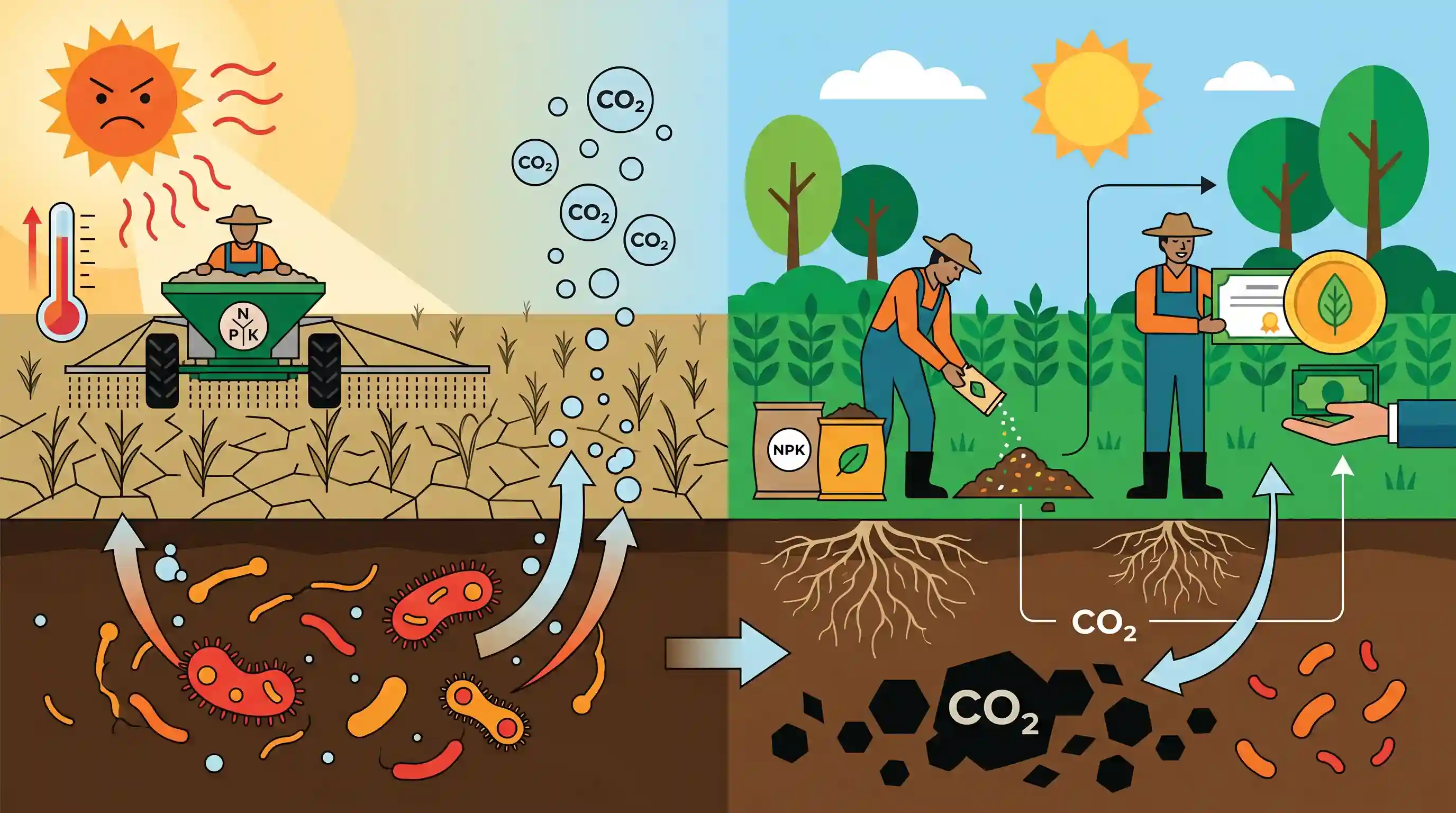
A recent study by the Indian Council of Agricultural Research (ICAR) highlights a severe threat to soil health, indicating that rising global temperatures and the imbalanced use of chemical fertilizers—especially excessive urea—are rapidly depleting Soil Organic Carbon (SOC). Elevated temperatures boost soil microbial activity, which consumes more organic carbon and releases it as carbon dioxide, while skewed NPK ratios further degrade soil vitality. To mitigate this depletion, the study recommends adopting balanced fertilizer applications, ensuring continuous crop cover, and providing farmers with carbon credits to incentivize soil carbon sequestration practices.
Key Points
- An ICAR study shows that climate change-induced temperature rise and imbalanced fertilizer use are depleting Soil Organic Carbon (SOC).
- Higher temperatures accelerate microbial activity in the soil, leading to the rapid breakdown and loss of SOC as carbon dioxide.
- Excessive and unscientific use of fertilizers, particularly urea, skews the essential NPK ratio, further degrading soil health and exacerbating carbon depletion.
- The study notes a positive correlation between elevation and SOC, whereas temperature and rainfall exhibit a negative correlation.
- To combat this trend, researchers advocate for balanced fertilization, maintaining soil cover, and incentivizing farmers through carbon credits for promoting soil carbon sequestration.
Important Terms
Soil Organic Carbon (SOC)

The carbon component of soil organic matter, primarily derived from decomposed plants and microorganisms, serving as a key indicator of soil health, fertility, and moisture retention.
UPSC context
GS Paper 3: Agriculture and Environment; tests understanding of soil fertility, climate change feedback loops, and sustainable farming practices.
Indian Council of Agricultural Research (ICAR)
An autonomous organization under the Ministry of Agriculture & Farmers Welfare, serving as the apex body for coordinating and managing agricultural research and education in India.
UPSC context
GS Paper 3: Agriculture/S&T; institutional framework for food security, the Green Revolution, and climate-resilient crop development.
Carbon Sequestration
The process of capturing atmospheric carbon dioxide and storing it in long-term reservoirs, such as soil organic matter, forests, or oceans, to mitigate global warming.
UPSC context
GS Paper 3: Environment; essential for climate mitigation strategies, Net Zero commitments, and nature-based solutions.
NPK Ratio
The relative proportion of Nitrogen, Phosphorus, and Potassium in fertilizers; while the ideal ratio is 4:2:1, India's usage is heavily skewed toward urea (Nitrogen).
UPSC context
GS Paper 3: Agriculture; impacts of fertilizer subsidies, soil degradation, and the need for Nutrient Based Subsidy (NBS) reform.
Carbon Credits
A tradable certificate representing the removal or avoidance of one tonne of carbon dioxide, used to provide financial incentives for farmers adopting sustainable practices.
UPSC context
GS Paper 3: Economy/Environment; market-based mechanisms for climate action and doubling farmers' income through ecosystem services.
Indian Institute of Soil Science (IISS)
A premier ICAR research institute located in Bhopal, dedicated to basic and strategic research on soil physical, chemical, and biological properties and health.
UPSC context
GS Paper 3: Agriculture; the specific body coordinating national-scale studies on soil degradation and organic carbon depletion.
Prelims Trap
"Rising temperatures increase soil microbial activity, which enhances the storage of Soil Organic Carbon (SOC)."
While microbial activity is generally good for soil, elevated temperatures accelerate microbial respiration, which rapidly breaks down organic matter and releases carbon as CO2, depleting SOC.
Static Concepts Connected
What is Soil Organic Carbon (SOC) and why is it vital?
- Definition: It is the measurable component of organic matter in soil, formed by the decomposition of plant and animal residues.
- Carbon Sink: Soils store more than twice the amount of carbon found in the atmosphere, making SOC crucial for climate change mitigation.
- Soil Health: High SOC improves soil structure, aeration, and water-holding capacity, which boosts agricultural resilience against droughts.
What is the ideal NPK ratio for Indian soils vs actual usage?
- Ideal Ratio: The universally accepted optimum ratio of Nitrogen (N), Phosphorus (P), and Potassium (K) for Indian soils is roughly 4:2:1.
- Actual Usage: Due to highly subsidized urea, the actual ratio is heavily skewed towards Nitrogen, exceeding 8:3:1 in agricultural states like Punjab and Haryana.
- Consequences: This imbalance causes soil acidification, groundwater pollution, deficiency in secondary micronutrients, and rapid depletion of soil organic carbon.
Cross-Topic Patterns
Fertilizer subsidies driving ecological ruin
The chronic overuse of urea connects directly to the Nutrient Based Subsidy (NBS) regime, which excludes urea, inadvertently driving imbalanced soil chemistry, skewed NPK ratios, and subsequent SOC loss.
Carbon credits for agricultural sequestration
The recommendation to offer farmers carbon credits links agricultural soil health directly to India's emerging domestic carbon market under the Energy Conservation (Amendment) Act.

Expect a multi-statement Prelims question linking Soil Organic Carbon (SOC) dynamics to microbial respiration and NPK imbalances in 2026.
Linked PYQs · 5
Linked PYQs · 5
- 2015PrelimsGS1
What can be the impact of excessive/inappropriate use of nitrogenous fertilizers in agriculture? 1. Proliferation of nitrogen-fixing microorganisms in soil can occur. 2. Increase in the acidity of soil can take place. 3. Leaching of nitrate to the groundwater can occur. Select the correct answer using the code given below.
- 2020PrelimsGS1
With reference to chemical fertilizers in India, consider the following statements : 1. At present, the retail price of chemical fertilizers is market-driven and not administered by the Government. 2. Ammonia, which is an input of urea, is produced from natural gas. 3. Sulphur, which is a raw material for phosphoric acid fertilizer, is a by-product of oil refineries. Which of the statements given above is/are correct?
- 2021PrelimsGS1
What is blue carbon?
- 2023PrelimsGS1
Consider the following activities: 1. Spreading finely ground basalt rock on farmlands extensively 2. Increasing the alkalinity of oceans by adding lime 3. Capturing carbon dioxide released by various industries and pumping it into abandoned subterranean mines in the form of carbonated waters How many of the above activities are often considered and discussed for carbon capture and sequestration?
- 2025MainsGS3
What is Carbon Capture, Utilization and Storage (CCUS)? What is the potential role of CCUS in tackling climate change?
