Andhra Pradesh Implements Action Plan to Mitigate Heatwave Impacts
Source:The Hindu ↗
Why It Matters
It provides a strong, positive case study for GS3 Disaster Management answers. The clear correlation between effective early warning systems/heat action plans and zero mortalities amidst a massive rise in heatstroke cases perfectly illustrates the benefits of proactive disaster preparedness and climate adaptation strategies.
Summary
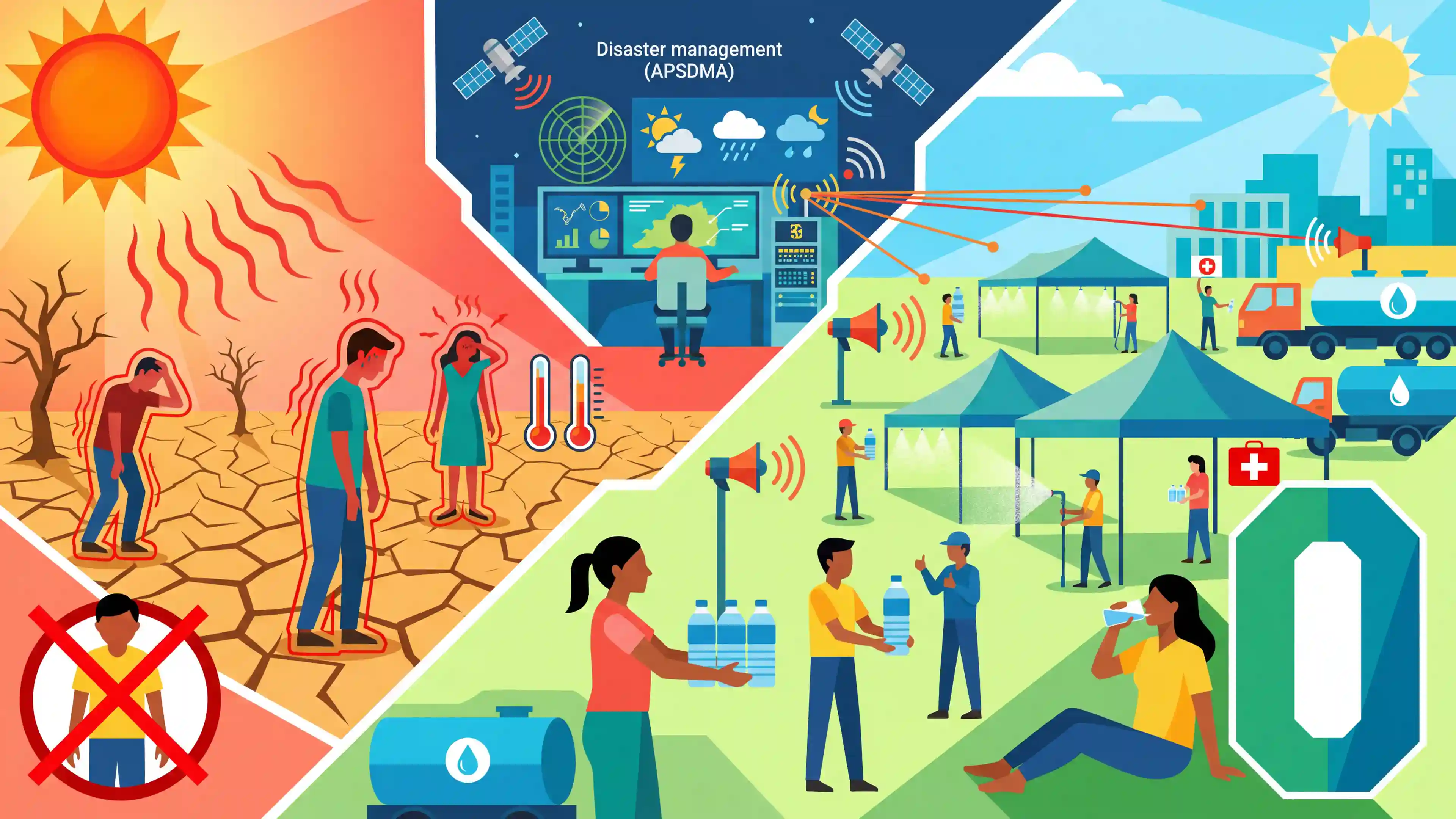
An alarming surge in heatstroke cases in Andhra Pradesh, driven by climate change, underscores the growing threat of extreme weather events. However, despite the spike in morbidity, zero heat-related deaths were recorded in 2025. This achievement is attributed to the A.P. State Disaster Management Authority's (APSDMA) effective implementation of the Heatwave Action Plan 2026, demonstrating the crucial role of continuous monitoring, early warning systems, and proactive disaster preparedness in mitigating the impacts of climate-induced public health emergencies.
Key Points
- Andhra Pradesh recorded a significant jump in heatstroke cases from 833 in 2023 to 5,154 in 2025 due to the increasing frequency of extreme weather events fueled by climate change.
- The A.P. State Disaster Management Authority (APSDMA) implemented the Heatwave Action Plan 2026, providing a framework for extreme heat response activities across multiple prone districts.
- Proactive disaster management, including continuous monitoring and early warning alerts, successfully reduced heatstroke-related deaths to zero in 2025, despite the surge in cases.
- IMD scientists note that the overall trend of extreme temperature events is rising due to global warming, necessitating long-term climate resilience and localized action plans.
Important Terms
Heatwave Action Plan 2026

A state-specific strategy aiming for zero fatalities through inter-departmental coordination, public awareness, and rescheduling outdoor activities during peak heat hours (12 PM – 4 PM).
UPSC context
GS Paper III (Disaster Management). Tests strategies for climate adaptation and local-level mitigation of extreme weather events.
A.P. State Disaster Management Authority (APSDMA)
A statutory body established under the Disaster Management Act, 2005, responsible for planning and coordinating disaster response, mitigation, and preparedness across Andhra Pradesh.
UPSC context
GS Paper II (Statutory Bodies) and GS III (Disaster Management). Tests institutional frameworks for disaster risk reduction.
India Meteorological Department (IMD)
India’s principal meteorological agency responsible for weather forecasting and declaring heatwaves when temperatures reach specific thresholds (e.g., ≥40°C in plains, ≥37°C in coastal areas).
UPSC context
GS Paper I (Geography) and GS III (Disaster Management). Key for questions on early warning systems and weather phenomena.
Disaster Management Act, 2005
The primary legislation in India providing the legal framework for disaster management, mandating the creation of national and state-level authorities (NDMA/SDMA) for proactive disaster response.
UPSC context
GS Paper II (Governance/Laws) and GS III (Disaster Management). Essential for understanding the mandate of disaster authorities.
AWARE System
A digital early-warning platform (Advance Warning Advisory for Resilient Ecosystem) used to issue heatwave alerts 4-5 days in advance for proactive administrative intervention.
UPSC context
GS Paper III (Science & Technology/Disaster Management). Example of technology-led disaster mitigation and early warning systems.
Heatwave
A period of abnormally high temperatures where the maximum temperature at a station reaches at least 40°C (plains) or 37°C (coastal) and deviates significantly from normal.
UPSC context
GS Paper I (Physical Geography) and GS III (Environment). Tests understanding of extreme weather impacts and climate change trends.
Notified Disaster
Calamities officially recognized under the Disaster Management Act, enabling states to access National/State Disaster Response Funds (NDRF/SDRF); heatwaves are currently categorized as local disasters.
UPSC context
GS Paper III (Disaster Management/Economy). Tests knowledge of disaster financing and administrative classification of calamities.
Prelims Trap
"Heatwaves are centrally notified disasters under the Disaster Management Act, making states fully eligible for standard NDRF and SDRF funding."
Heatwaves are NOT among the 12 centrally notified national disasters. States can only declare them as 'local disasters' and utilize up to 10% of their State Disaster Response Fund (SDRF).
Static Concepts Connected
What are the specific IMD temperature criteria for declaring a heatwave?
- Plains threshold: The maximum temperature of the station must reach at least 40°C.
- Hilly and Coastal: The maximum temperature must reach at least 30°C for hilly regions and 37°C for coastal stations.
- Departure criteria: A departure of 4.5°C to 6.4°C from normal marks a heatwave. A departure greater than 6.4°C marks a severe heatwave.
What is the structural framework of Heat Action Plans (HAPs) in India?
- Pioneering model: Ahmedabad implemented India's first city-level Heat Action Plan in 2013, pioneering decentralized climate resilience governance.
- NDMA Guidelines: The NDMA issued comprehensive guidelines in 2016 focused on early warning systems, vulnerable population mapping, and inter-agency coordination.
- Decentralized implementation: States and districts customize these frameworks to proactively manage local health infrastructure, public awareness, and water supply during summer months.
Cross-Topic Patterns
Urban Heat Islands + Disaster Governance
The exacerbation of heatwaves by the Urban Heat Island (UHI) effect parallels urban flooding. Both require decentralized, city-level climate resilience governance over top-down national frameworks.
Climate Change + Labour Productivity
Surging heatstroke morbidity links extreme weather to economic outcomes, severely impacting outdoor agricultural and gig-economy workers, thereby affecting occupational health policies and overall GDP.

Expect a multi-statement Prelims question merging IMD's numerical heatwave criteria with SDRF funding rules for local extreme weather.
Linked PYQs · 3
Linked PYQs · 3
- 2019MainsGS3
Disaster preparedness is the first step in any disaster management process. Explain how hazard zonation mapping will help disaster mitigation in the case of landslides.
- 2024MainsGS3
Flooding in urban areas is an emerging climate-induced disaster. Discuss the causes of this disaster. Mention the features of two such major floods in the last two decades in India. Describe the policies and frameworks in India that aim at tackling such floods.
- 2022MainsGS3
Discuss global warming and mention its effects on the global climate. Explain the control measures to bring down the level of greenhouse gases which cause global warming, in the light of the Kyoto Protocol, 1997.
