Disaster Mortality Trends and Early Warning Systems
Source:The Hindu ↗
Why It Matters
This article is highly relevant for GS3 (Disaster Management and Environment) as it highlights a critical paradox: while overall disaster mortality is falling due to better preparedness, climate change is making events more frequent, and heatwaves are emerging as a major, silent threat. It emphasizes the need for continuous adaptation and robust early warning systems.
Summary
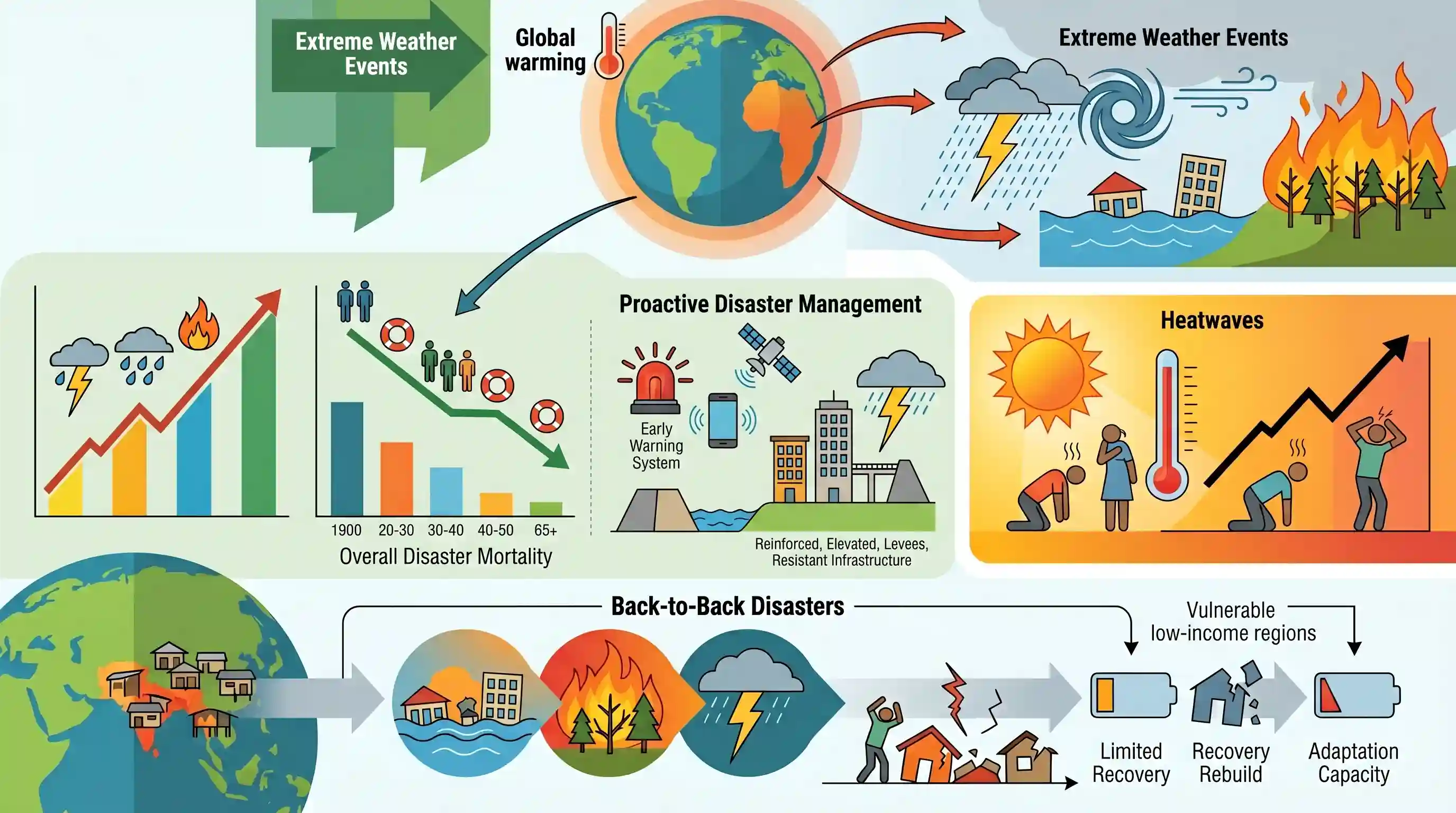
Climate change is amplifying the intensity of extreme weather events such as floods, storms, and wildfires. However, overall mortality from these disasters has declined over the past few decades, largely due to a shift towards proactive disaster management involving early warning systems and resilient infrastructure. Despite this success, heatwaves—often dubbed 'silent killers'—are proving to be an exception, with heat-related fatalities surging globally. Furthermore, the increasing frequency of back-to-back disasters severely limits recovery time, constantly challenging current adaptation capacities and stressing vulnerable low-income regions.
Key Points
- Despite an increase in the frequency and intensity of extreme weather events due to climate change, overall mortality from disasters like floods and storms has fallen over recent decades.
- The drop in mortality is attributed to better disaster preparedness, including early warning systems, storm barriers, and improved building codes.
- Heatwaves remain a notable exception, acting as a 'silent killer' with increasing and heavily underreported death tolls. The Lancet Countdown noted a 63% rise in heat-related deaths from 1990-1999 to 2012-2021.
- Compounding or back-to-back extreme weather events limit recovery time, pushing the boundaries of current adaptation measures and resilient infrastructure.
Important Terms
EM-DAT database

A global database of natural and technological disasters maintained by CRED. It records geographic, human, and economic impacts to support disaster risk reduction and humanitarian policy.
UPSC context
GS3 (Disaster Management). Tests ability to cite data-driven evidence for disaster trends and the efficacy of global risk reduction frameworks.
Early Warning Systems (EWS)
Integrated systems of hazard monitoring, risk assessment, and communication designed to provide advance notice of disasters. They enable proactive response to minimize life and property loss.
UPSC context
GS3 (Disaster Management). Core component of disaster preparedness. Tests understanding of 'last-mile connectivity' and Sendai Framework targets.
Centre for Research on the Epidemiology of Disasters (CRED)
A leading research unit at the University of Louvain (UCLouvain) that maintains the EM-DAT database. It specializes in studying the health and socio-economic impacts of mass emergencies.
UPSC context
GS3 (Disaster Management). Tests knowledge of primary international organizations and databases used for evidence-based climate policy and disaster mitigation.
Lancet Countdown
An annual international collaboration that tracks the health impacts of climate change. It provides independent assessments of government progress toward Paris Agreement commitments across multiple indicators.
UPSC context
GS3 (Environment/Health). Tests awareness of the nexus between climate change and public health, particularly heat-related mortality and vector-borne diseases.
Copernicus Climate Change Service (C3S)
A European Union initiative providing authoritative data on past, present, and future climate. It monitors global temperatures and sea ice to support adaptation and mitigation policies.
UPSC context
GS3 (Environment). Tests knowledge of international programs tracking global warming thresholds and extreme weather anomalies.
Munich Re
A global reinsurance company recognized for its extensive NatCatSERVICE database. It provides authoritative statistics on the economic losses and insured risks associated with natural disasters worldwide.
UPSC context
GS3 (Economy/Environment). Relevant for understanding the economic impact of disasters, climate risk insurance, and private sector risk assessment.
Prelims Trap
"Heatwaves are classified as a 'notified disaster' under the Disaster Management Act, 2005, making them eligible for NDRF funds."
Heatwaves are NOT notified disasters at the national level. However, states can use up to 10% of their State Disaster Response Fund (SDRF) for local, non-notified disasters like heatwaves.
Static Concepts Connected
How are disaster relief funds (NDRF/SDRF) allocated under the DM Act, 2005?
- SDRF Primary Funding: SDRF is the primary fund available with states. Center and State contribute in a 75:25 ratio (90:10 for Special Category States).
- NDRF Supplement: NDRF supplements SDRF only in cases of a disaster of a 'severe nature' where state funds are insufficient.
- Notified Disasters Only: Only specifically listed events (cyclone, drought, earthquake, flood, etc.) qualify automatically. Heatwaves are conspicuously absent from this national list.
What are the core components of India's National Guidelines for Heat Action Plans (HAPs)?
- Early Warning: Establishing early warning systems linked to IMD temperature forecasts and issuing public alerts.
- Vulnerability Assessment: Identifying and mapping high-risk populations, including outdoor workers, slum dwellers, and the elderly.
- Capacity Building: Building capacity among healthcare professionals to recognize and treat heat-related illnesses promptly.
Cross-Topic Patterns
Urbanization amplifying heatwave mortality
The 'silent killer' effect of heatwaves is exacerbated by the Urban Heat Island (UHI) effect, linking climate change adaptation directly to sustainable urbanization and smart city planning.
Compounding disasters and fiscal federalism
Back-to-back compounding disasters severely stress state budgets, linking climate impacts directly to the Finance Commission's disaster risk financing methodology and the debate on state resource constraints.

Expect a Prelims question mixing IMD heatwave criteria, their non-notified status under the DM Act, and state SDRF funding mechanisms.
Linked PYQs · 3
Linked PYQs · 3
- 2020MainsGS3
Discuss the recent measures initiated in disaster management by the Government of India departing from the earlier reactive approach.
- 2019MainsGS3
Disaster preparedness is the first step in any disaster management process. Explain how hazard zonation mapping will help disaster mitigation in the case of landslides.
- 2017MainsGS3
'Climate change' is a global problem. How India will be affected by climate change? How Himalayan and coastal states of India will be affected by climate change?
