Extreme Weather Disasters Surge While Mortality Drops Except Heatwaves
Source:The Hindu ↗
Why It Matters
Provides critical nuance for Mains answers by showing that climate adaptation (early warnings, infrastructure) is working for storms/floods, but failing for heatwaves. This data is essential for discussing the limitations of current disaster management frameworks.
Summary
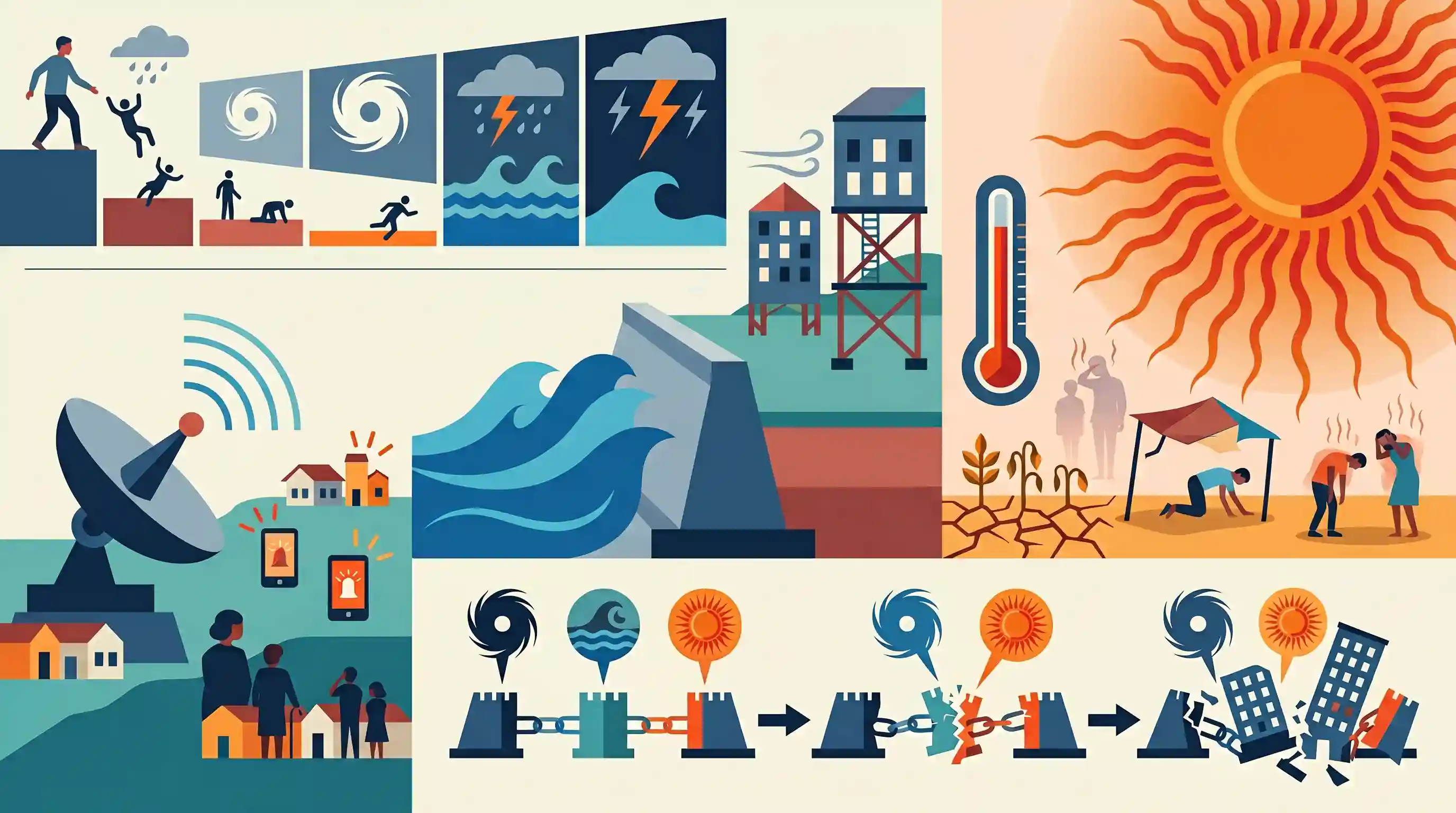
Although climate change is significantly increasing the frequency and intensity of extreme weather events such as floods and storms, global disaster-related deaths have actually fallen in recent decades. This decline is largely attributed to highly effective early warning systems, storm barriers, and improved infrastructure. However, heatwaves stand out as a growing, underreported threat—often termed a 'silent killer'—with heat-related deaths surging globally. Experts caution that while current adaptations are saving lives, there is a structural limit to resilience; consecutive disasters without adequate recovery time could overwhelm existing defenses.
Key Points
- While climate change has made extreme weather events more frequent and intense, overall mortality from these disasters has decreased over the last decade due to improved early warning systems and infrastructure.
- Heatwaves are a stark exception to this trend, serving as a 'silent killer' with global heat-related mortality increasing by 63% between the 1990s and the 2012-2021 period.
- Deaths from floods and storms have significantly declined over the 2015-2025 period compared to the previous decade, proving the efficacy of disaster preparedness, storm barriers, and better building codes.
- Heat-related deaths are often underreported due to the delayed attribution of mortality to heat stress, especially affecting the sick and elderly.
- Experts warn of an adaptation limit—back-to-back extreme weather events could eventually overwhelm even outstanding infrastructure and coping mechanisms by denying recovery time.
Important Terms
EM-DAT

The Emergency Events Database (EM-DAT) is the world's most comprehensive database on natural and technological disasters, recording human and economic losses globally since 1900.
UPSC context
GS Paper 3: Disaster Management. Essential for data-driven risk assessment, Sendai Framework monitoring, and formulating national resilience strategies.
Centre for Research on the Epidemiology of Disasters (CRED)
A Brussels-based research unit of UCLouvain that focuses on the public health and epidemiological impacts of disasters; it manages the EM-DAT database.
UPSC context
GS Paper 3: Disaster Management. Provides the scientific evidence base for health-related disaster preparedness and humanitarian response.
Lancet Countdown
An annual international report that monitors the impacts of climate change on global public health and assesses government commitments under the Paris Agreement.
UPSC context
GS Paper 2/3: Health and Environment. Tests understanding of climate change as a public health crisis and tracking global mitigation efforts.
Copernicus Climate Change Service (C3S)
The European Union's Earth observation component that provides authoritative, open-access data on past, present, and future climate indicators globally.
UPSC context
GS Paper 3: Environment/S&T. Key for monitoring global temperature trends, sea-ice levels, and climate re-analysis for policy planning.
Munich Re
A leading global reinsurance company that tracks the economic impact of disasters via its NatCatSERVICE database, highlighting the 'insurance protection gap.'
UPSC context
GS Paper 3: Economy/Environment. Important for understanding the financial burden of climate disasters and the role of disaster-risk insurance.
Imperial College London (WWA)
A leading research university whose Grantham Institute and World Weather Attribution (WWA) initiative quantify how climate change influences the frequency and intensity of extreme weather.
UPSC context
GS Paper 3: Environment/Disaster Management. Vital for 'Attribution Science,' linking specific weather disasters to human-induced global warming.
Prelims Trap
Global disaster-related deaths from floods and storms have steadily increased over the last decade due to climate change.
Mortality from floods and storms has actually decreased globally due to better Early Warning Systems (EWS). Only heat-related mortality is surging.
Static Concepts Connected
What are the IMD criteria for declaring a heatwave in India?
- Plains: Maximum temperature reaches at least 40°C.
- Hilly regions: Maximum temperature reaches at least 30°C.
- Coastal stations: Maximum temperature reaches at least 37°C.
- Departure criteria: Temperature departure from normal is 4.5°C to 6.4°C for a heatwave, and >6.4°C for a severe heatwave.
What is meant by 'Limits to Adaptation' in climate science?
- Definition: The point at which adaptive actions can no longer secure objectives or protect communities from intolerable climate risks.
- Soft limits: Adaptation is currently not possible due to a lack of finances, technology, or adequate socio-economic frameworks.
- Hard limits: No further adaptive actions are physically or ecologically possible (e.g., rising sea levels drowning low-lying coral atolls).
Cross-Topic Patterns
Heatwaves, UHI & Public Health
Heatwave mortality intersects with GS1 Urbanization. The 'silent killer' effect is uniquely exacerbated by concrete-dense urban heat islands (UHI) and a lack of dedicated heat action plans.
EWS & Sendai Framework Target G
The drop in storm mortality reflects the success of Sendai Framework Target G (Early Warning Systems), directly linking to GS3 space technology applications (e.g., INSAT for meteorology).

Heatwave IMD criteria + compounding disaster impacts (limits to adaptation) will likely feature as a multi-statement question in 2026.
Linked PYQs · 4
Linked PYQs · 4
- 2019MainsGS3
Disaster preparedness is the first step in any disaster management process. Explain how hazard zonation mapping will help disaster mitigation in the case of landslides.
- 2024MainsGS3
Flooding in urban areas is an emerging climate-induced disaster. Discuss the causes of this disaster. Mention the features of two such major floods in the last two decades in India. Describe the policies and frameworks in India that aim at tackling such floods.
- 2017MainsGS3
'Climate change' is a global problem. How India will be affected by climate change? How Himalayan and coastal states of India will be affected by climate change?
- 2022MainsGS3
Discuss global warming and mention its effects on the global climate. Explain the control measures to bring down the level of greenhouse gases which cause global warming, in the light of the Kyoto Protocol, 1997.
