Rajasthan Climate Change Adaptation And Water Security Workshop
Source:theenvironment ↗
Why It Matters
Rajasthan's high vulnerability to extreme temperatures, erratic monsoons, and groundwater depletion makes state-level climate governance, UNICEF partnerships, and initiatives like school heatwave modules and water budgeting highly relevant for current affairs and policy analysis in RPSC RAS examinations.
Summary
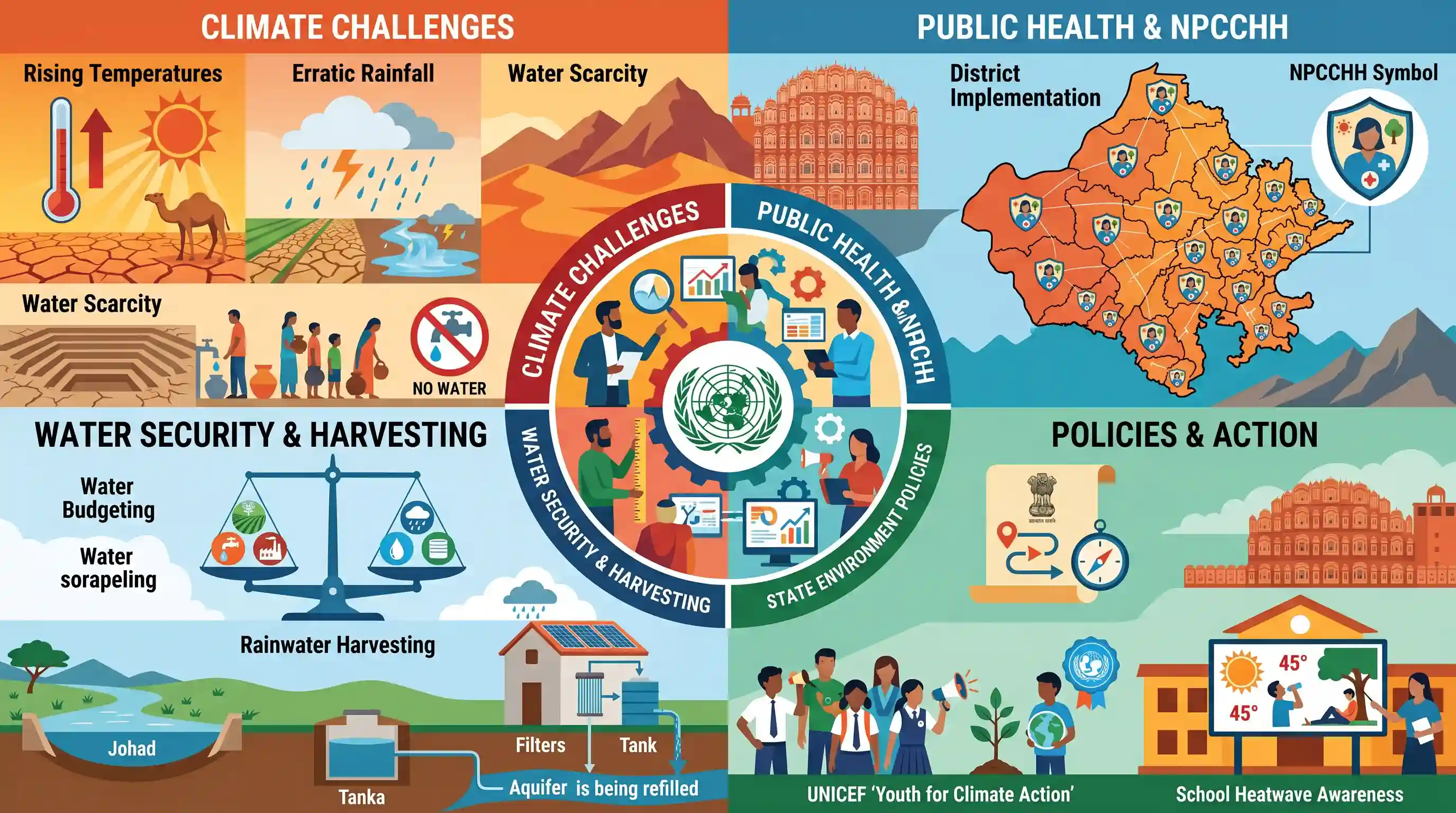
Experts and officials at a workshop in Jaipur highlighted the escalating climate change challenges in Rajasthan, including rising temperatures, erratic rainfall, and water scarcity. Held on the eve of World Environment Day 2026, the workshop focused on coordinated adaptation strategies. Key announcements included UNICEF's 'Youth for Climate Action' programme, district-level implementation of the National Programme on Climate Change and Human Health (NPCCHH), heatwave awareness modules in government schools, and initiatives targeting water security and budgeting.
Key Points
- A state-level climate workshop was held at the Constitution Club in Jaipur on June 4, 2026, to discuss climate resilience, health, water security, and livelihoods in Rajasthan.
- UNICEF Rajasthan Head Rushabh Hemani highlighted that Rajasthan conducted its first state-level climate consultation in 2023 to coordinate climate adaptation.
- District-level programmes under the National Programme on Climate Change and Human Health (NPCCHH) have been established in collaboration with the Department of Medical and Health to mitigate health risks and improve disaster response.
- Specialised heatwave awareness modules have been introduced in government schools to sensitise students and teachers on extreme heat and water conservation.
- Meteorological Centre Director Radheshyam Sharma emphasized water security, focusing on groundwater recharge, rainwater harvesting, water budgeting, and defining indicators for a 'water-secure Rajasthan'.
- UNICEF announced the 'Youth for Climate Action' programme to train young leaders in climate science, green jobs, policy, and carbon markets.
Important Terms
National Programme on Climate Change and Human Health

A Central initiative under India's Ministry of Health and Family Welfare to mitigate climate impacts on health, focusing on air pollution, heat-related illnesses, and developing climate-resilient healthcare facilities.
UPSC context
GS Paper II/III: Government policies and environmental health, testing understanding of institutional climate adaptation strategies in public health.
Youth for Climate Action
A climate leadership program launched by UNICEF Rajasthan that equips young people with training in climate science, policies, green jobs, and community leadership to build grassroots networks of climate-aware leaders.
UPSC context
GS Paper II/III: Social sector initiatives and climate change; tests strategies for youth engagement and grassroots environmental activism.
UNICEF
A United Nations agency dedicated to child rights and welfare, which increasingly leads interventions to protect children from climate risks and promotes child-centric climate adaptation strategies.
UPSC context
GS Paper II: International organizations, testing knowledge of global agencies and their roles in addressing socio-environmental crises.
Department of Medical and Health
A state-level administrative body (e.g., in Rajasthan) responsible for public health services, epidemic control, and executing initiatives like the National Programme on Climate Change and Human Health.
UPSC context
GS Paper II: State governance and public health, testing mechanisms of health policy implementation and central-state administrative coordination.
Meteorological Centre
A regional station of the India Meteorological Department (IMD) that tracks regional weather, issues early warnings for extreme weather (such as heatwaves), and supports climate adaptation strategies.
UPSC context
GS Paper I/III: Important geophysical phenomena and disaster management; tests knowledge of early warning systems and institutional weather forecasting.
Prelims Trap
Khadins are traditional storage structures designed primarily to irrigate and harvest Kharif crops during the monsoon.
Khadins trap runoff to saturate the soil. The actual cultivation is carried out in the winter (Rabi) season using the retained soil moisture, rather than cultivating during the active monsoon.
Static Concepts Connected
What is the traditional Khadin water harvesting system of Rajasthan?
- Origin and geography: Developed by the Paliwal Brahmins of Jaisalmer in the 15th century to harness runoff in extreme arid environments.
- Key structure: Consists of a long, hand-built earthen embankment (bund) constructed across low-lying hill slopes to capture runoff.
- Rabi cultivation: Water saturates the soil and deposits nutrient-rich silt; crop cultivation (primarily wheat and gram) occurs during the Rabi season.
What are the core components of the Atal Bhujal Yojana (ABY)?
- Funding and ministry: A Central Sector Scheme under the Ministry of Jal Shakti, funded 50:50 by the Government of India and the World Bank.
- Community-led budgeting: Focuses on sustainable groundwater management through community participation, water budgeting, and preparing Gram Panchayat-level Water Security Plans.
- Target areas: Targets severely water-stressed blocks across seven states, including Rajasthan, Gujarat, and Haryana.
Cross-Topic Patterns
Indigenous hydrology + State Climate Plans
Integrates historical, community-led water structures with modern policy frameworks like the State Action Plans on Climate Change to design localized, low-cost climate resilience.
Heatwave mitigation + Public Health governance
Connects disaster planning with public health delivery, showing how extreme heat and vector-borne shifts under climate change alter state-level epidemiological surveillance.

Expect questions coupling traditional rainwater systems (Khadin, Johad) with modern demand-management schemes like Atal Bhujal Yojana.
Linked PYQs · 4
Linked PYQs · 4
- 2024RPSC_PRELIMSGS1
In which district of Rajasthan 'Khadin' is a popular method of water conservation?
- 2025RPSC_PRELIMSGS1
In which district of Rajasthan is the ‘Khadin’ water conservation method prevalent?
- 2023RPSC_PRELIMSGS1
According to a recently released notification by the Forest, Environment and Climate Change Department of Rajasthan, how many wet-lands are there in the state?
- 2023RPSC_PRELIMSGS1
When is Energy Conservation Day celebrated in Rajasthan?
