Climate Change Threatens Western Ghats Forests in Nilgiris
Source:The Hindu ↗
কেন এটি গুরুত্বপূর্ণ
This article is highly relevant for UPSC Mains GS3 (Environment) and Prelims GS1 (Geography & Ecology). It provides empirical evidence of how climate change causes phenological desynchronization—disrupting symbiotic relationships like plant-pollinator networks—which is a critical but often overlooked dimension of biodiversity loss. It also highlights threats to specific endemic species (such as Magnolia nilagirica and Impatiens clavicornu) and the compounding impact of invasive alien species (such as Prosopis juliflora and Lantana camara), which are frequently asked about in the civil services examination.
সারসংক্ষেপ
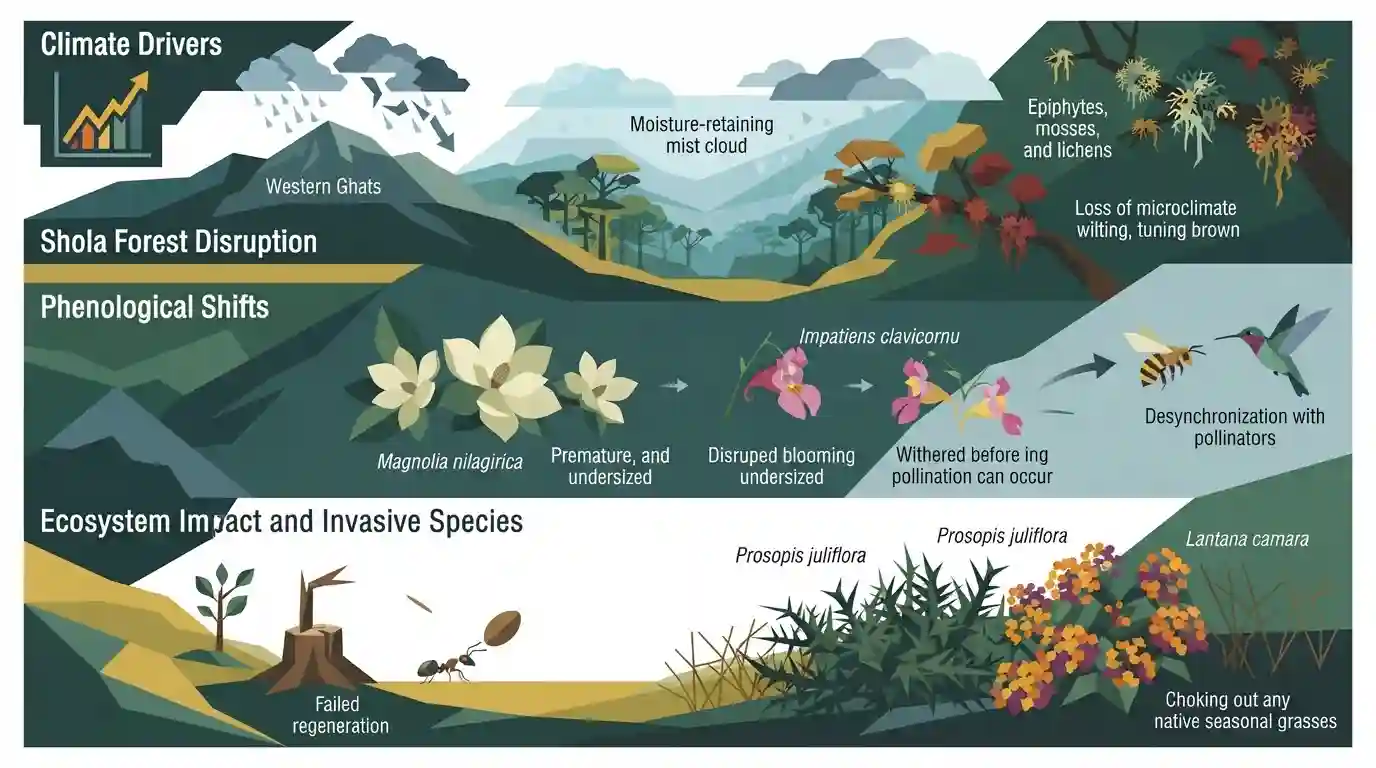
A research study (2024) reveals that erratic temperature rises and declining rainfall in the Nilgiri Biosphere Reserve (Western Ghats) are disrupting forest phenology (biological timing like greening and flowering). These climatic shifts are causing high-altitude Shola forests to lose their moisture-retaining microclimates, threatening epiphytes and mosses. Additionally, endemic species like Magnolia nilagirica and the endangered Impatiens clavicornu are suffering from premature or reduced flowering. This desynchronization between plants, pollinators, and seed dispersers undermines ecosystem regeneration, while dry tracts invaded by Prosopis juliflora and Lantana camara fail to produce seasonal grass cover.
মূল বিষয়
- A 2024 study titled 'Mapping forest phenological shift in Nilgiri Biosphere Reserve, Western Ghats: Response to Climate Change' reveals that warming and drying trends are destabilizing native forest ecosystems by altering their biological timing (phenology).
- Between 1950 and 2018, the Nilgiri Biosphere Reserve experienced a temperature rise of 0.01°C per year and a decrease in annual rainfall of 3.97 mm per year.
- The study analyzed four forest types (moist deciduous, dry deciduous, semi-evergreen, and wet evergreen) across two phases, showing erratic shifts in the Start of Season (SOS, greening), End of Season (EOS), and Length of Season (LOS). Phase I (2001-2010) saw delayed SOS and shorter seasons, while Phase II (2011-2020) witnessed advanced SOS and lengthened seasons.
- High-altitude Shola (cloud) forests are losing their unique self-contained microclimate (humidity and cool temperature), resulting in the drying and depletion of moisture-dependent epiphytes, mosses, ferns, and orchids.
- Phenological desynchronization is disrupting delicate plant-pollinator, seed-disperser, and fruit-eating animal relationships, which slows down forest regeneration and threatens wildlife movement.
- Endemic species are severely affected: Magnolia nilagirica (native to the Western Ghats) is flowering prematurely in June (instead of post-monsoon), while the rare grassland plant Impatiens clavicornu (Club-spur balsam) is showing drastically reduced flowering and seed-setting, escalating its extinction risk.
- In drier tracts like Thengumarahada, heavily invaded by Prosopis juliflora and Lantana camara, the ground failed to green up with annual grass cover, leaving the land dry and parched during typical growing seasons.
গুরুত্বপূর্ণ শব্দ
Forest Phenology

The study of periodic biological events in plants, such as leafing and flowering, driven by climate. Erratic temperatures and altered rainfall are causing these timings to shift, leading to ecological desynchronization.
UPSC context
GS-3 Environment. Vital for understanding how climate change mechanically disrupts ecosystem cycles and plant-animal interactions.
Nilgiri Biosphere Reserve (NBR)
India's first biosphere reserve (1986), located in the Western Ghats across Tamil Nadu, Kerala, and Karnataka. It harbors immense biodiversity and unique ecosystems highly sensitive to changing climatic conditions.
UPSC context
GS-3 Environment. Extremely common in Prelims and Mains for questions on UNESCO reserves and Western Ghats ecology.
Shola Forests
High-altitude stunted tropical montane evergreen forests unique to the Southern Western Ghats. They maintain moisture-retaining microclimates crucial for regional hydrology and the survival of dependent epiphytes and mosses.
UPSC context
GS-1 Geography & GS-3 Environment. Frequently tested regarding their unique topography, ecological significance, and vulnerability to global warming.
Upstream Ecology
A Nilgiris-based environmental conservation organization leading bottom-up ecological restoration in the Western Ghats. They work to revive degraded landscapes, native shola forests, and endangered endemic flora.
UPSC context
GS-3 Environment. Serves as an excellent Mains case study for grassroots biodiversity conservation and non-governmental ecological restoration.
Impatiens clavicornu
An endangered and highly endemic flowering herb of the balsam family. Restricted to moist rocky crevices in the Southern Western Ghats, it is deeply vulnerable to climate-induced microclimate loss.
UPSC context
GS-3 Biodiversity. Highly relevant for Prelims questions targeting specific Rare, Endemic, and Threatened (RET) species of India.
School of Planning and Architecture (SPA), Bhopal
A premier national institute under the Ministry of Education. Its researchers utilized remote sensing to conduct the 2024 study on climate-driven phenological shifts within the Nilgiri Biosphere Reserve.
UPSC context
GS-3 Science & Tech. Highlights the application of remote sensing and Indian academic research in monitoring climate impacts.
Invasive Alien Species
Aggressive non-native plants like Prosopis juliflora and Lantana camara that colonize degraded forest tracts. Their invasion suppresses the regeneration of seasonal native grasses, severely degrading local ecosystems.
UPSC context
GS-3 Environment. A recurrent Prelims and Mains topic concerning biological invasions, threats to endemic biodiversity, and forest management.
প্রিলিমস ফাঁদ
All Magnolia tree species in India are naturally endemic only to Northeast India and the Himalayas.
While 24 native Indian magnolias are restricted to Northeast India, Magnolia nilagirica is distinctly native to the Western Ghats-Sri Lanka biodiversity hotspot.
সংযুক্ত স্থির ধারণা
What constitutes the Nilgiri Biosphere Reserve and its ecological significance?
- Protected Areas: Comprises Mudumalai, Mukurthi, Nagarhole, Bandipur, and Silent Valley national parks, alongside Wayanad and Aralam sanctuaries.
- Biogeographical Link: Situated at the tri-junction of TN, Kerala, and Karnataka; serves as a vital ecological corridor connecting the Western and Eastern Ghats.
- Shola Forests: Features unique high-altitude stunted evergreen forests (Sholas) interspersed with rolling grasslands, hosting high endemism.
What is phenology and how does climate change cause ecosystem desynchronization?
- Biological Timing: Phenology involves periodic biological events (flowering, leafing, migration) driven by seasonal climatic cues like temperature and rainfall.
- Desynchronization: Climate shifts cause plants to bloom earlier or later than usual, breaking delicate mutualistic timing with pollinators and seed dispersers.
- Trophic Mismatch: This leads to reproductive failure in plants and food shortages for dependent wildlife, threatening overall ecosystem regeneration.
আন্তঃবিষয় প্যাটার্ন
Invasive species and forest fire vulnerability
The spread of Lantana camara and Prosopis juliflora in the dry Thengumarahada tract stifles native grass cover and creates dry, high-biomass fuel loads that escalate forest fire risks.
Ecological corridors linking the Ghats
Phenological shifts in Thengumarahada threaten a critical corridor connecting Mudumalai and Sathyamangalam Tiger Reserves, vital for genetic exchange between the Western and Eastern Ghats.

Expect a multi-statement question matching endemic flora (Magnolia nilagirica, Impatiens) to the Western Ghats and Shola forest impacts.
সংযুক্ত PYQ · 3
সংযুক্ত PYQ · 3
- 2018PrelimsGS1
Why is a plant called Prosopis juliflora often mentioned in news?
- 2017PrelimsGS1
From the ecological point of view, which one of the following assumes importance in being a good link between the Eastern Ghats and the Western Ghats?
- 2017MainsGS3
'Climate change' is a global problem. How India will be affected by climate change? How Himalayan and coastal states of India will be affected by climate change?
