Climate change threatens endemic bird habitats in Western Ghats
Source:The Hindu ↗
Why It Matters
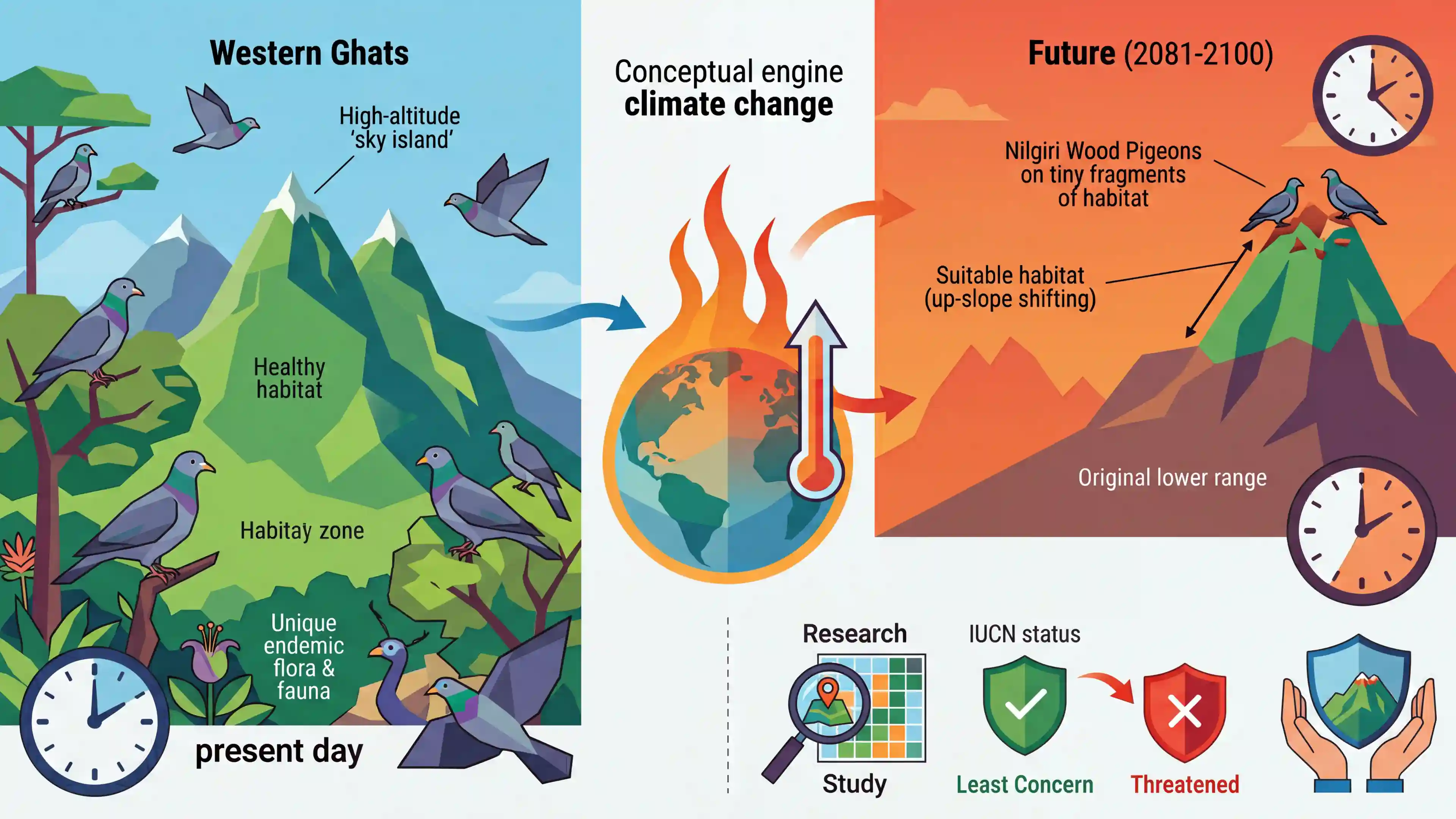
The concept of 'up-slope shifting' or altitudinal migration is a critical mechanism by which climate change impacts biodiversity, particularly for species restricted to isolated ecosystems like 'sky islands'. This highlights the limitations of current conservation statuses (like IUCN categorizations) that may not fully account for long-term climatic projections, making it highly relevant for UPSC questions on climate change impacts and biodiversity hotspots.
Summary
A recent study highlights the vulnerability of the Nilgiri Wood Pigeon, a species endemic to the Western Ghats, to future climate change. Utilizing the MaxEnt machine-learning method, researchers project a dramatic decline in the bird's high-suitability habitat between 2081 and 2100. The pigeon, which relies on the unique, high-elevation 'sky island' ecosystems, is expected to experience 'up-slope shifting' as temperatures rise, severely restricting its geographic range. Despite its current IUCN status of 'Least Concern', the findings underscore the need for targeted, climate-resilient conservation efforts to protect specialized, endemic biodiversity in the Western Ghats from climate-induced habitat contraction.
Key Points
- Climate change poses a severe threat to the Nilgiri Wood Pigeon, an endemic species of the Western Ghats, by significantly shrinking its available habitat by the end of the century.
- The species is highly specialized, primarily inhabiting the 'sky islands'—high-elevation wet evergreen and moist deciduous forests that are particularly sensitive to temperature shifts.
- Predictive modelling using the MaxEnt machine-learning method indicates an 'up-slope shifting' phenomenon, where the bird is forced to migrate to higher altitudes, leading to marked range contractions and population isolation.
- Although recently down-listed to 'Least Concern' by the IUCN, researchers argue that climate-induced habitat loss necessitates urgent field-based ecological studies and proactive, climate-resilient conservation strategies.
Important Terms
Western Ghats

A mountain range along India's western coast, a UNESCO World Heritage Site and one of the world’s eight 'hottest hotspots' of biological diversity, extending across six states.
UPSC context
GS Paper I & III: Core geographic region for biodiversity, monsoon regulation, and conservation-related questions.
IUCN Red List
The world's most comprehensive inventory of the global conservation status of biological species, maintained by the International Union for Conservation of Nature to track extinction risk.
UPSC context
GS Paper III: Standard framework for species conservation status; frequently tested in Prelims and Mains.
Sky Islands
Isolated high-elevation mountain-top ecosystems where unique habitats (like Shola forests) are separated from each other by deep valleys, behaving like biological islands in the 'sea' of lower-altitude plains.
UPSC context
GS Paper III: Advanced ecological concept relevant to Western Ghats biodiversity and climate-induced isolation.
Nilgiri Wood Pigeon
A bird species restricted to the Western Ghats (endemic), primarily inhabiting high-elevation shola forests; though currently 'Least Concern', it is highly vulnerable to climate-induced habitat loss.
UPSC context
GS Paper III: Example of endemic fauna and species-specific conservation challenges in Indian biodiversity hotspots.
Up-slope Shifting
The migration of species to higher altitudes to track cooler temperatures as the climate warms, often leading to range contraction at mountain summits (the 'escalator to extinction').
UPSC context
GS Paper III: Key phenomenon illustrating the impact of climate change on mountain ecology and species survival.
Endemic Species
Species naturally restricted to a specific geographical area and found nowhere else, often having specialized habitat requirements that make them vulnerable to environmental changes.
UPSC context
GS Paper III: Fundamental concept in biodiversity; tests knowledge of India's unique flora and fauna.
MaxEnt (Maximum Entropy) Modeling
A machine-learning algorithm for species distribution modeling that predicts potential habitats using 'presence-only' data and environmental variables like temperature and precipitation.
UPSC context
GS Paper III: Scientific methodology in conservation biology; relevant for technology-driven environment monitoring topics.
Prelims Trap
"The Nilgiri Wood Pigeon is a Critically Endangered bird endemic to the Western Ghats."
Aspirants instinctively assume endemic species facing severe habitat loss are 'Endangered' or 'Critically Endangered'. This bird is actually 'Least Concern'.
Static Concepts Connected
What are 'Sky Islands' and Shola forests in the Western Ghats?
- Geographic isolation: High-elevation mountain peaks isolated by lowland valleys, creating unique microclimates that function like islands in the sky.
- Shola vegetation: Stunted tropical montane evergreen forests found in valleys, separated by undulating montane grasslands.
- High endemism: Geographical isolation prevents species migration, leading to very high rates of endemic flora and fauna (e.g., Nilgiri Tahr).
How does climate change cause 'up-slope shifting' in montane ecosystems?
- Thermal niche: As global temperatures rise, species migrate to higher altitudes to stay within their optimal temperature range.
- Escalator to extinction: As species move higher, available land area shrinks. Eventually, they run out of mountain peak, leading to local extinctions.
Cross-Topic Patterns
Machine Learning in ecological conservation
The use of algorithms like MaxEnt for species distribution modelling highlights how AI/ML applications are becoming staple Prelims options for biodiversity conservation and climate impact prediction.
Western Ghats vs Himalayas Endemism
UPSC frequently compares Western Ghats biodiversity with the Eastern Himalayas. Both feature high-altitude isolated ecosystems (Sky Islands vs Himalayan Alpine) but differ heavily in latitudinal influences.

Expect a multi-statement Prelims question mixing the Nilgiri Wood Pigeon's surprising 'Least Concern' status with Shola 'Sky Islands'.
Linked PYQs · 4
Linked PYQs · 4
- 2011PrelimsGS1
Three of the following criteria have contributed to the recognition of Western Ghats-Sri Lanka and Indo-Burma regions as hotspots of biodiversity: 1. Species richness 2. Vegetation density 3. Endemism 4. Ethno-botanical importance 5. Threat perception 6. Adaptation of flora and fauna to warm and humid conditions Which three of the above are correct criteria in this context?
- 2020PrelimsGS1
With reference to India's biodiversity, Ceylon frogmouth, Coppersmith barbet, Gray-chinned minivet and White-throated redstart are
- 2017MainsGS3
'Climate change' is a global problem. How India will be affected by climate change? How Himalayan and coastal states of India will be affected by climate change?
- 2015PrelimsGS1
With reference to the International Union for Conservation of Nature and Natural Resources (IUCN) and the Convention on International Trade in Endangered Species of Wild Fauna and Flora (CITES), which of the following statements is/are correct? 1. IUCN is an organ of the United Nations and CITES is an international agreement between governments. 2. IUCN runs thousands of field projects around the world to better manage natural environments. 3. CITES is legally binding on the States that have joined it, but this Convention does not take the place of national laws. Select the correct answer using the code given below.
